Our Lady of the Conception Aparecida, Patroness of Brazil
By Prof. Dr. Daniel C. Afonso · Updated
“Dilecta es tu a Domino Deo tuo et placuit tibi ornamentum tuum” (Esth 5:1b), “You were loved by the Lord your God, and your beauty pleased him”
I. Esther before the king: the intercessor who risks everything for her people
The first reading of this Solemnity calls up one of the most dramatic and most beautiful scenes in all of deuterocanonical literature. Esther, the Jewish queen at the Persian court, crosses the threshold of the throne without having been summoned, knowing that this audacity could cost her her life. But she does not go out of ambition or caprice: she goes because her people are threatened with extermination and because she is the only one who can intercede with the King with enough authority to be heard. “Life is my petition, this is my desire, and the life of my people” (Esth 7:3). The depth of this gesture does not lie only in courage: it lies in the logic of love that puts others before oneself. Esther does not intercede because she can do so with impunity: she intercedes because her love for her people overcomes her fear for her own life. And it is precisely this logic of love that serves as the interpretive key to the solemnity that Brazil celebrates every October twelfth: that of a woman who, without sword or army, intercedes with love for her children.
II. The woman clothed with the sun: Mary, Aparecida, and the Apocalypse
The second reading carries us from the Persian palace to the great sign that appeared in heaven: “A woman clothed with the sun, with the moon under her feet and on her head a crown of twelve stars” (Rev 12:1). Exegesis recognizes in this woman a complex figure that refers simultaneously to Israel, to the Church, and to Mary. But the Brazilian liturgy, in choosing this text for the solemnity of Our Lady of the Conception Aparecida, makes a hermeneutical choice of great consistency: the woman of the Apocalypse whom the dragon pursues and whom God protects is the heavenly image of the one whom Brazil found in the waters of the Paraíba do Sul River in 1717. The image found by the fishermen was an image of the Immaculate Conception: Mary without stain, full of grace, clothed in brightness. And the narrative of the Apocalypse, with the dragon that seeks to devour and the earth that comes to the woman’s aid (cf. Rev 12:16), repeats in prophetic language the logic of Brazilian history: the faith of a people who, in their struggles and frailties, found in Mary the strength that does not come from themselves.

III. Cana: the mother who sees and intercedes before being asked
The Gospel of the wedding at Cana closes the biblical arc of this solemnity with a revelation of style: the style of Marian presence and intercession. Mary is at Cana, notices that the wine has run out, and acts with the discreet urgency of one who truly loves: she goes to her Son and presents the situation without properly formulating a request, only with the confidence of one who knows that love is intelligent enough to know what to do. “They have no wine” (Jn 2:3). Words that contain the whole pedagogy of Marian intercession: without rhetoric, without dramatics, without negotiation. And when Jesus responds in an apparently discordant way, Mary neither insists nor retreats. She turns to the servants and says the words that Tradition has fixed as her spiritual testament: “Do whatever He tells you” (Jn 2:5). Aparecida taught Brazil the same thing that Mary taught at Cana: she is not going to solve what we need. She is going to lead us to the only One who can solve it. “Do whatever He tells you.”
IV. Aparecida: the patroness who emerges from the waters and from poverty
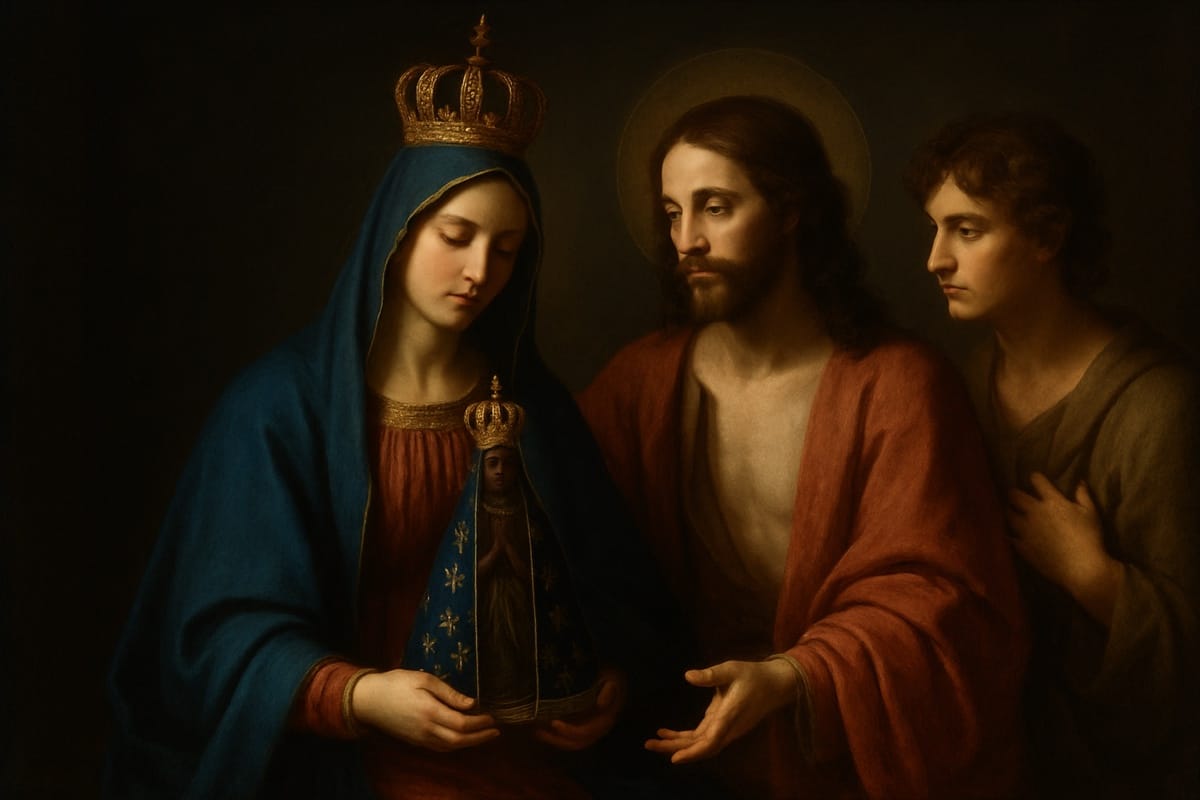
The story of the discovery of the image of Our Lady of the Conception Aparecida has a narrative theology that the centuries have not exhausted. In October 1717, three fishermen of the Paraíba do Sul River, after a day without fish, cast their nets one last time and brought to the surface, in two separate pieces, the darkened image of an Our Lady of the Immaculate Conception. They joined the two pieces, cast their nets again, and caught so much that they could hardly carry it. What popular faith immediately perceived was that here there was a language of God: Mary emerging from the muddy waters, in darkness, as a sign that the grace of God does not prefer clean places and noble spaces. It prefers the poor fishermen of the riverbanks. It prefers the clay. And after she had been found, she multiplied the fish. The solemnity that Brazil celebrates on October twelfth is not the glory of a statue: it is the recognition that God chose this people, this land, this river, to manifest in Mary His preferential love for the little ones. The Second Vatican Council, in presenting Mary as “a sign of sure hope and of consolation for the pilgrim People of God” (Lumen Gentium 68), was describing, without knowing it, what the image of Aparecida would mean for Brazil: not a symbol of power, but a sign that God does not abandon His children in the murky waters of history.
Postgraduate Program in Mariology
Would you like to deepen your formation in Mariology? Discover the Postgraduate Program in Mariology of Locus Mariologicus – an academic formation that unites theological rigor, spiritual life, and the living tradition of the Church.
Responses