Demonic infestation: what is it and what does the Church teach about places and objects?
By Prof. Dr. Daniel C. Afonso · Updated
“Demonic infestation” is the term exorcists use for the extraordinary action of the devil upon things and places, in distinction from that which affects people directly. The Church has not made this word a dogma, but the 1999 Ritual of Exorcisms recognizes that the devil’s action “affects people, things, and places,” and calls for utmost caution: before considering the devil, it is necessary to verify if it is not a disease or merely an impression of the imagination.
In summary
- Definition: a term used among exorcists, not a dogmatic definition.
- What the Ritual states: The action of the Devil can affect “people, things, and places” (De Exorcismis, 1999).
- Who exorcises: Solemn exorcism is reserved to a priest with express permission from the bishop (CIC, can. 1172, and Catechism, n. 1673).
- House Blessing: This is something separate, and can be presided over by a priest, deacon, or layperson.
- Prudence: Before any exorcism, it is necessary to exclude the disease, especially psychic, and the deception of imagination.
What is meant by demonic infestation?
Exorcists use four words to describe the extraordinary action of the demon: possession, obsession, vexation, and infestation. The International Association of Exorcists classifies as possession, obsession, and vexation the action exercised directly upon the person, and as “infestation” when it has as its object things given for human use (Guidelines for the Ministry of Exorcism, n. 46). The Italian bishops adopted this classification in the presentation of the Italian edition of the ritual (n. 7). Exorcist Francesco Bamonte defines local infestation as “an action of the demon upon inanimate nature (places, houses, objects).”

It is fitting to weigh the weight of these words. The very ritual does not use a technical term for the action upon things and places, as noted by the Directrices (n. 45). It is pastoral vocabulary, not a defined doctrine. What the faith asserts is found in the Catechism: “Satan and other demons were created good by God in their nature, but became evil by their own initiative” (n. 391). But Satan “is but a creature,” and his action “is permitted by Divine Providence” (n. 395).
## What does the 1999 Ritual say about things and places?
The ritual De exorcismis et supplicationibus quibusdam was promulgated by decree on November 22, 1998, with a typical edition in 1999. In the Preface, it states that the harmful and hostile action of Satan and demons “affects people, things, and places,” and that therefore the Church, “always conscious that ‘the days are evil’,” prays and continues to pray that men be freed from the snares of Satan (our translations).
Appendix I returns to the theme in the first number: the presence of the Devil, the text says, appears “not only in people tempted or afflicted, but also in things and places” that he, in some way, penetrates with his own action. If the diocesan bishop judges it appropriate, under particular circumstances, to call the faithful to pray under the direction of a priest, the appendix offers the elements: a Word celebration that speaks “of hope in Christ’s victory and the help of the Angels,” the litany of the saints, a prayer to the Holy Spirit, and finally, the sprinkling of the place with blessed water.
It is a prayer of the Church, not a formula. The imperative formula of exorcism is pronounced by the priest, “if it seems fitting,” and the Italian version of the ritual states that the faithful, “even if close to the priest,” refrain from reciting it (Appendix I, n. 10). Appendix II provides supplications that the faithful may pray in private. I did not find in the ritual index any specific rite for “liberating a house.”
Catechism, no. 1673, and Canon 1172: Who can exorcize?
The Catechism treats exorcism among the sacraments and includes the objects: “When the Church demands publicly and authoritatively, in the name of Jesus Christ, that a person or object be protected against the influence of evil and freed from its power, it is said to be exorcism” (n. 1673). In the same passage, it establishes two rules:
“The solemn exorcism, known as the ‘great exorcism’, can only be performed by a priest, with the permission of the bishop. It is necessary to proceed with prudence, strictly observing the rules established by the Church. […] Very different is the case of illnesses, especially psychological ones, whose treatment depends on medical science. It is important, therefore, to verify before celebrating the exorcism if it is a presence of the devil or a disease.” (Catechism of the Catholic Church, no. 1673)
The Code of Canon Law states the same thing in legal terms. Canon 1172, §1, stipulates that no one may legitimately perform exorcisms on the possessed without special and express permission from the Ordinary of the place, and §2 directs that it be granted only to a priest endowed with piety, knowledge, prudence, and integrity of life (our translation from the Latin). The ritual requires that the Ordinary of the place is, as a rule, the diocesan bishop (Praenotanda, n. 13). Therefore, exorcism is not an initiative of the faithful, however well-intentioned, and must be carried out in such a way that “no one may consider it a magical or superstitious act,” avoiding “a spectacle for the spectators” (n. 19).
Infestation, obsession, and possession
The distinction is one of object. In possession, according to Bamonte, the demon takes possession of the body and employs it as it wills. In obsession, it does not block the intellect or will, but imposes upon the mind thoughts or images that the person cannot dispel. In infestation, the action falls upon places, homes, or objects. See more in the difference between demonic possession and obsession and in exorcism in the Catholic Church. Even the exorcists themselves warn that the boundaries between these forms are not always clear (Guidelines, n. 48), which calls for caution, not sensationalism.
The blessing of the home is not exorcism
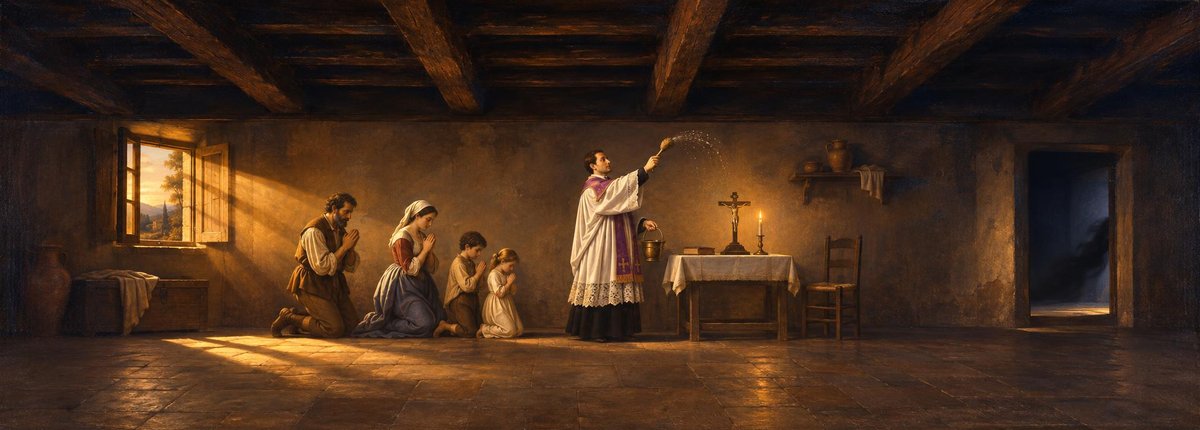
The Catechism reminds us that blessings “of people, of the table, of objects and places” are among the first sacraments (n. 1671). The ritual De Benedictionibus (1984) provides a rite for a new home, which may be celebrated, according to n. 475, “by a priest, a deacon, or even a layperson.” It begins with the greeting “Peace be to this house and to all who dwell in it” (n. 479), echoing Lk 10:5, asks that the inhabitants find refuge in God, and concludes with the sprinkling of blessed water, a memory of Baptism (n. 489). It is a gesture of faith and gratitude, not a means of “cleansing” the house from evil spirits.
Prudence: What the Ritual Mandates to Verify
The Roman Ritual of 1614 already instructed the exorcist “not to believe easily” that someone was possessed, and to distinguish the signs of those who suffer “from black bile or some disease” (Title XII, in the 1617 edition). The current ritual repeats: the exorcist, “above all, do not believe easily that someone is possessed by a demon when suffering from some disease, especially psychological,” nor admit possession merely because someone claims to have been tempted and vexed by the devil, “for each one can be deceived by his own imagination” (Preparation, n. 14). It also instructs to consult, when necessary, experts in medicine and psychiatry (n. 17).
Bamonte himself acknowledges that, among those seeking exorcists, the causes of the symptoms and facts are, “in most cases, ordinary or natural.” Italian bishops call for avoiding both “the foolish credulity that sees diabolic interventions in every anomaly and difficulty” and “the preconceived rationalism that excludes a priori any form of malign intervention,” and remind us that extraordinary phenomena “are possible, but in fact, according to the opinion of experts, are rare” (nos. 7 and 8). In doubt, the discernment belongs first and foremost to the priests who perform exorcisms (no. 8).
## Frequently Asked Questions
O que é infestação demoníaca?
É o nome que os exorcistas dão à ação extraordinária do demônio sobre coisas e lugares, e não diretamente sobre pessoas. É vocabulário pastoral, e não dogma. O ritual de 1999 reconhece que a ação do Diabo pode atingir «pessoas, coisas e lugares».
A Igreja ensina que existem casas infestadas pelo demônio?
Ensina que o demônio existe e que a sua ação pode alcançar também coisas e lugares. Não declara, porém, nenhum caso concreto. Pede que se exclua antes a doença e o engano, e que o discernimento seja feito por sacerdotes com licença do bispo.
Um leigo pode fazer exorcismo em casa?
Não. O Catecismo (n. 1673) e o cânon 1172 reservam o exorcismo solene a um sacerdote com licença expressa do bispo.
Posso pedir a bênção da casa?
Sim. É um sacramental previsto no De Benedictionibus, que pode ser presidido por sacerdote, diácono ou leigo, na presença dos moradores. Não é exorcismo.
Qual a diferença entre infestação, obsessão e possessão?
Na possessão, o demônio toma posse do corpo. Na obsessão, impõe à mente pensamentos que a pessoa não consegue afastar. Na infestação, a ação recai sobre lugares ou objetos. São distinções dos exorcistas, e as fronteiras nem sempre são nítidas.
## References
- Catechism of the Catholic Church, nos. 391, 395, 1671, and 1673.
- Code of Canon Law (1983), can. 1172, §§ 1-2. Our translation from the Latin text.
- The Roman Rite, as established by the decree of the Sacred Ecumenical Council of Vatican II, promulgated by authority of Pope John Paul II: On Exorcisms and Certain Prayers. Typical Edition. Vatican Press, 1999. Decree, Prologue, Preamble nos. 13, 14, 17, and 19, Appendices I and II. Our translations.
- Italian Episcopal Conference. Ritual of Exorcisms and Prayers for Particular Circumstances. Italian version of De exorcismis et supplicationibus quibusdam. Vatican Publishing House, 2001. Introduction, nos. 7 and 8, and Appendix I, no. 10. Our translations.
- The Roman Rite as Revised by Pope Paul V. Rome, 1617. Title XII, On Exorcising Those Possessed by the Devil. Our translation.
- On Blessings. Typical Edition. Vatican Polyglot Press, 1984. Chapter IX, Order of Blessings for a New Home, nos. 475, 479, and 489. Our translations.
- International Association of Exorcists. Guidelines for the ministry of exorcism in the light of the current ritual. Portuguese edition. Nos. 45-48.
- BAMONTE, Francesco. Demonic Possessions and Exorcisms. Brazilian edition. Ch. 1 (Possession) and Ch. 3 (Local Infestation, Obsessions, and Discernment).
Responses