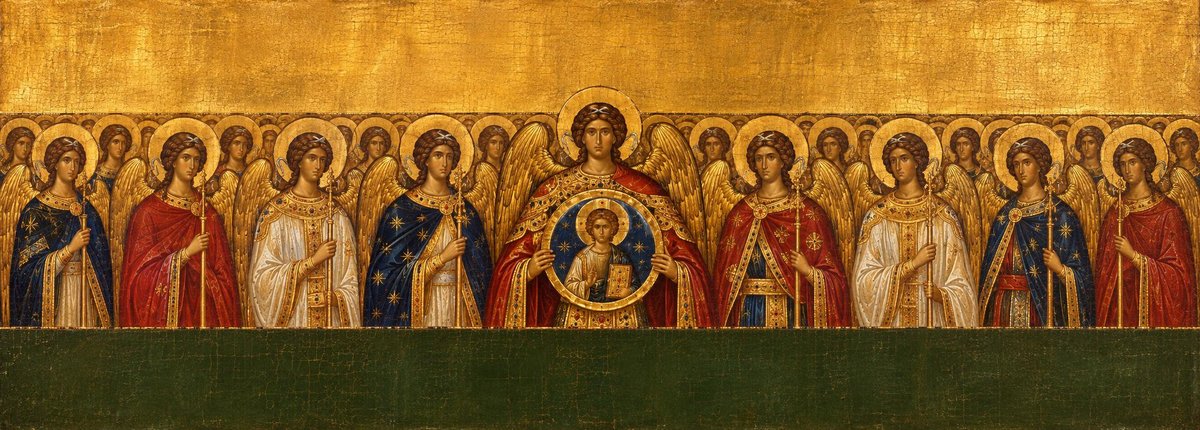
Synaxis of the Incorporeal: The feast day of Michael in the East is November 8
By Prof. Dr. Daniel C. Afonso · Updated
While the Latin Church celebrates the archangels on September 29, the Byzantine Church has another day: November 8, the “Sinaxe of the Incorporeal.” The work Quis ut Deus, by Prof. Daniel, concludes with it the section on the feast of September 29 and joins a clear assessment of what is documented fact, narrated tradition, and authors’ opinions.
In summary
- Orientation: The Constantinople Synaxary records, on November 8th, the Synaxis of the Incorporeal.
- The narrative: the entrance links the feast to the fall of Satan and positions Michael as the chief who gathers the angelic choirs.
- Confirmation: Works of dissemination and research give the same day for Michael, Gabriel, and the others.
- Balance: The book separates what is documented fact, narrated tradition, and authors’ opinions.
Another calendar, another date
Those who only know the Latin September 29th might be surprised: the Byzantine Church has another day for the angels. The Constantinople Synaxary, in the edition of Hippolyte Delehaye (1902), records on November 8th the Synaxis of the Unembodied. In the original Greek, the title is Σύναξις τῶν ἀσωμάτων.
Delehaye himself comments on the matter in a Latin note in the prolegomena. In the translation of the book, he writes that “the synod of all the angels is celebrated on November 8,” and adds another feast, that of the miracle of Saint Michael in Chonas, on September 6.

What does the entry in the Synaxary say?
The Greek entry for the day (col. 203-204) begins, in the translation of the book, by speaking of creation: God first thought of the angelic and celestial powers, and the thought became work.
“He established a chief ruler and archistratege for each order. One of the chief rulers, named Samael, who is also the devil, becoming proud and judging himself to be God, fell from his dignity and was cast down from the heavens with the order subject to him.” (Constantinople Synaxary, November 8th)
Then Michael enters. The text states that he was archistratego of another order of angels, and seeing the apostate fallen, he gathered the choirs of angels and sang a hymn. The translation of the book goes on here, because the text continues after the cut, and we will not say what follows. What can be affirmed is that the entrance connects the feast to the fall of Satan, called Samael, and positions Michael as the chief who gathers the angelic choirs. The critical note in the edition states that «Samael» is the reading of manuscript S, with a variant in manuscript Sa.
For the book, this entry is, in the East, the liturgical source for the feast.
Other voices confirm November 8th
The book does not rely solely on Delehaye. Three more recent works give the same date. Wybrew, in an Orthodox popular work, writes: “Gabriel is celebrated with Michael, the chief of angels, and all the incorporeal powers of heaven on November 8.”
Lymberopoulou, who studied the church of Kavalariana in Crete, notes that the Constantinople Synaxary does not have a separate feast for Raphael, revered on November 8 with the other archangels, when the Orthodox Church celebrates the Synaxis of the Asomatoi. She further states that the feasts of Michael in that church are on September 6 (Chonai Miracle) and November 8. Finally, the collective volume The Archangel Michael Beyond Orthodoxies asserts that the “Account” of Pantaleon and the “Sermon” of Clement were delivered on November 8, “the feast day of Michael and the incorporeal powers,” and that many other texts were composed for the same occasion.
The book summarizes: in the Eastern tradition, November 8th holds weight, in contrast to September 29th in the Latin tradition.
The balance of certainties in the section
As this is the final part of the section on the feast of September 29, the book provides a summary in degrees of certainty. It is documented fact that the Latin feast of September 29 began as the anniversary of the dedication of a basilica, which in 1960 was still a first-class “Dedicatio,” that the feast of May 8 was suppressed in 1960, and that the 1969 calendar, reproduced in the 2002 Missal, made it a feast of the three archangels.
It is also a documented fact that the feasts of Gabriel and Raphael were extended to the Universal Church by Pope Benedict XV in 1921, and that the Eastern Byzantine Church celebrates the Incorporeals on November 8.
The book presents the narrative of the bull and the arrow, which the 1927 Breviary reproduces as a narrative tradition, not as a documented fact. The title «Apparitio» appears in the Breviary of Pius V, but the assertion of Righetti that it was Pius V who introduced it cannot be confirmed. And the identification of the basilica dedicated is the opinion of authors, among them Duchesne and Kellner.
Frequently Asked Questions
On what day does the Byzantine Church celebrate the Archangels?
On November 8, at the Synaxis of the Incorporeal, recorded in the Constantinopolitan Synaxary, in the edition of Delehaye (1902).
What does the Synaxary say about Michael on this day?
The entry links the feast to the fall of Satan, called Samael, and presents Michael as the chief who gathers the choirs of angels. The book translates only the beginning of the entry, which continues after the cut.
Does Rafael have a feast day in the East?
According to Lymberopoulou, the Constantinople Synaxary does not have a dedicated feast for Raphael. He is venerated on November 8 with the other archangels.
What does the book consider as documented fact and what does it consider as tradition?
It is documented fact, among other things, that September 29th became the dedication of a basilica, that the feast of May 8th was suppressed in 1960, and that the feast of the Three Archangels was established in 1969. The narrative of the bull and the arrow is a tradition, and the identification of the basilica dedicated is the opinion of authors.
References
- DELEHAYE, Hippolyte (ed.). Synaxarium Ecclesiae Constantinopolitanae. Brussels: Bollandists, 1902. P. LXVI col. 203-204.
- WYBREW, Hugh. Orthodox Feasts of Jesus Christ and the Virgin Mary. Crestwood: St Vladimir’s Seminary Press, 2000. p. 102.
- Lyberopoulou, Angeliki. The Church of the Archangel Michael at Kavalariana. London: Pindar Press, 2006. pp. 103 and 111.
- TSAKOS, Alexandros and LIPPE, Marie von der (eds.). The Archangel Michael beyond orthodoxies. London: Bloomsbury Academic, 2025. p. 80.
- Source: the work Quis ut Deus. Saint Michael the Archangel in the sources of the faith, by Prof. Daniel (Locus Mariologicus).
Responses