Do angels pray? How do angels worship God
By Prof. Dr. Daniel C. Afonso · Updated
Yes, and in a way that surpasses our own. Scripture shows angels worshiping and praising God without ceasing, and in some texts, presenting the prayers of men to God. The Catechism summarizes: “The angels are spiritual creatures who glorify God without ceasing” (Catechism of the Catholic Church, no. 350). In the texts we will see, the angel worships, gives thanks, and intercedes for others, and none of them asks for anything for themselves.
In summary
- Short answer: Yes. Angelic prayer is, above all, adoration and praise (Isaiah 6, Revelation 4, 5, 7, Luke 2).
- The Bible uses the verb “adorar”: the angels “fell down before the throne on their faces and worshiped God” (Rev 7:11).
- We offer our prayers: Rafael states that he presented the prayer of Tobit and Sara (Tb 12,12), and an angel offers the incense with the prayers of the saints (Rev 8:3-4).
- The Church prays with them: “In its Liturgy, the Church associates itself with the angels” (Catechism, n. 335), and the Holy of the Mass is the song of the seraphim.
- What remains unclear: How, inwardly, a pure spirit’s prayer to Scripture does not say.
«Holy, Holy, Holy»: the song of the seraphim
One of the most well-known scenes of celestial beings praising God is the vocation of Isaiah. The prophet sees the Lord on a high throne, and beside Him are the seraphim, with six wings: with two they covered their faces, with two they covered their feet, and with two they flew. And one cried to another:
“Holy, Holy, Holy is the Lord of hosts. All the earth is full of his glory.” (Isaiah 6:3)
The text calls them “serafins” and not “angels,” but the liturgy includes them among the celestial spirits, as we will see. All they say is adoration, without any request.

# The Heaven of the Apocalypse: Praise Without Ceasing
The Apocalypse takes up the song of Isaiah. Four living beings “do not rest, day or night,” and say: “Holy, holy, holy is the Lord God Almighty, who was, and is, and is to come” (Rev 4:8). The text calls them “living beings” and not “angels,” and it is fitting to say no more than it does. The angels enter immediately after: “I saw and heard the voice of many angels around the throne […] and their number was myriads of myriads and thousands of thousands, saying in a loud voice: Worthy is the Lamb who was slain to receive power, and wealth, and wisdom, and strength, and honor, and glory, and blessing” (Rev 5:11-12).
In another chapter, the verb is stated directly: “All the angels stood around the throne […] and fell prostrate before the throne, worshiping God, saying: ‘Amen! Blessing, glory, wisdom, thanksgiving, honor, power, and might to our God forever and ever. Amen'” (Rev 7:11-12).
The Apocalypse speaks in the language of vision, but the Catechism reads in it the celestial liturgy and includes among those participating in the praise “the heavenly powers” (no. 1138). And it says that the Church on earth “also sings these songs, in faith and in trial” (no. 2642).
The Night of Bethlehem
When the angel announces to the shepherds the birth of Christ, the scene is completed with a chorus: “And suddenly there appeared with the angel a multitude of the heavenly army, praising God and saying: Glory to God in the highest, and on earth peace among men of good will” (Lk 2:13-14). The Mass collects these words in the hymn “Glory to God in the highest and on earth peace to men of good will” (Roman Missal, Ordinary of the Mass).
The Angels Adore the Son
The Letter to the Hebrews reveals to whom angelic adoration is due. After asking, “To whom did he ever say, ‘Let all God’s angels worship him’?” (Heb 1:5), the author writes, “When he brings in his Firstborn into the world, he says, ‘Let all the angels of God worship him'” (Heb 1:6). The Greek words are nearly identical to those in Deut 32:43 in the Septuagint (Brenton edition). The following verse describes angels as God’s servants, and the contrast with the Son is the focus of the passage. The Catechism states: “Christ is the center of the angelic world” (no. 331).
Angels who carry our prayers to God
Scripture goes beyond praise. In the Book of Tobias, the angel Raphael reveals himself at the end of the narrative. He tells Tobit, also speaking of his granddaughter Sarah: “When you and Sarah prayed, I presented your prayer before the glory of the Lord” (Tob 12:12). And he adds: “I am Raphael, one of the seven holy angels who stand in the presence of the Lord’s glory” (Tob 12:15). In the Greek text we consult, they are angels “who present the prayers of the saints.” Tobias is one of the books in the Catholic canon (Catechism, n. 120). For more on Raphael, see Archangel Raphael.
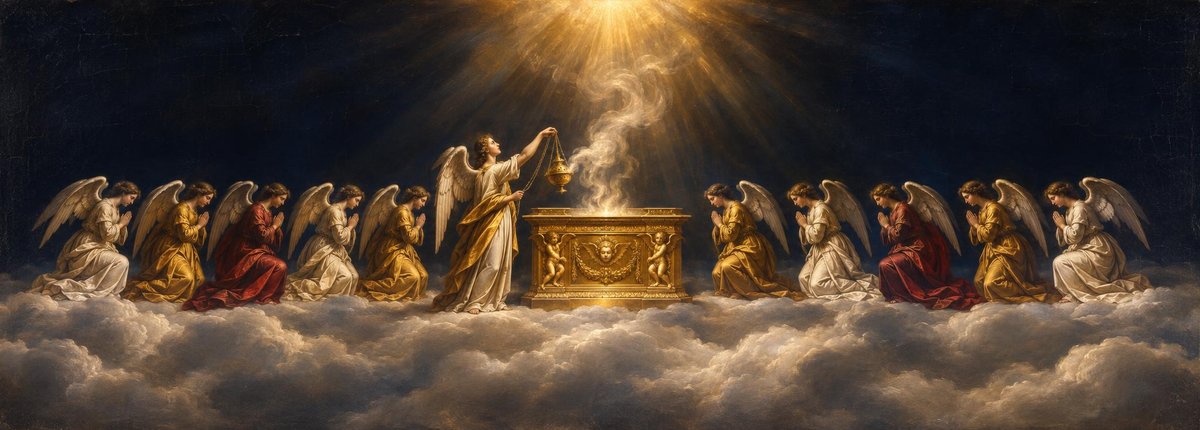
In the Book of Revelation, the image is that of incense: “and another angel came and stood by the altar, having a golden censer,” and he was given much incense. Then: “the smoke of the incense, with the prayers of the saints, went up before God” (Rev 8:3-4). It is an image of vision, and from it one can only draw what the text says: the angel carries before God, with the incense, the prayers of the faithful.
There is yet another text in which an angel speaks to God on behalf of a people. In the vision of Zechariah, the angel of the Lord says: “Lord of hosts, how long wilt thou be angry with Jerusalem and the cities of Judah, against which thou art wroth?” (Zech 1:12). God responds with “good words, words of comfort” (Zech 1:13). The angel intercedes for others.
# What the Church Teaches and What Remains Open
In the texts we have gathered, angels adore, praise, give thanks, present the prayers of men, and intercede for Jerusalem. None of them asks for anything for themselves. This accords with the Catechism, which states that they “contemplate continually the face of my Father who is in heaven” (n. 329, citing Mt 18:10).
That angels praise God is taught by Scripture and the Catechism (n. 350). That they present the prayers of men to God comes from Tobias and the Apocalypse, and the liturgy echoes this. However, the way a pure spirit prays from within is not described in revelation, and whoever claims more than this speaks for himself.
The Church prays with the angels
The Catechism teaches that “In her Liturgy, the Church associates herself with the angels” to adore the “Three Holy God” (n. 335), and adds that she invokes their assistance.
This is found in the words of the Mass. Several prefaces of the Roman Missal unite the assembly’s song with that of the angels. In the Second Preface of Advent, the priest says:
“And therefore, with Angels and Archangels, with Thrones and Dominions, and with all the host of heaven’s army, we sing the hymn of your glory, saying without cease: Holy, Holy, Holy, Lord God of hosts.” (Roman Missal, Third Edition, Typical Edition, Preface II of Advent, our translation)
The Preface of the Most Holy Trinity names other choirs: “To whom the Angels, Archangels, Cherubim, and Seraphim continually sing praise, crying out with one voice, ‘Holy'” (our translation). It is the song of Isaiah 6 and Revelation 4, put into the mouth of the assembly.
The Roman Canon preserves another image that recalls Rev 8:3-4. The priest asks God that these things be brought “by the hand of your holy Angel to your altar of holy splendor, in the presence of your divine majesty” (our translation). The text does not say who this Angel is, and whoever tries to identify him is already interpreting. On the presence of angels in the celebration, see Angels at Mass.
What does this mean for us?
Angels teach us the first act of prayer, which is adoration. When the assembly sings the Holy, it repeats the word that Isaiah and John heard in heaven. And knowing that an angel presents our prayers before God, as Raphael did for Tobit and Sarah, is a cause for confidence.
## Frequently Asked Questions
Os anjos rezam?
Sim, no sentido de que adoram e louvam a Deus. O Catecismo diz que os anjos «glorificam a Deus sem cessar» (n. 350), e a Escritura os mostra adorando (Ap 7,11).
O que os anjos dizem quando adoram a Deus?
O canto mais repetido é «Santo, santo, santo, Senhor Deus todo-poderoso» (Ap 4,8), que vem de Isaías 6,3.
Os anjos levam as nossas orações a Deus?
É o que dizem Tobias e o Apocalipse. Rafael afirma que apresentou a oração de Tobit e de Sara «diante da glória do Senhor» (Tb 12,12), e em Ap 8,4 a fumaça do incenso sobe «da mão do anjo» com as orações dos santos.
Os anjos adoram Jesus?
Sim. Hebreus 1,6 diz: «E adorem-no todos os anjos de Deus». No Apocalipse, os anjos louvam o Cordeiro (Ap 5,11-12).
Por que cantamos o «Santo» na Missa?
Porque, segundo o Catecismo, «Em sua Liturgia, a Igreja se associa aos anjos» (n. 335). O Santo repete o canto de Isaías 6,3 e de Ap 4,8.
## References
- SACRED SCRIPTURE: Is 6:2-3. Lk 2:13-14. Heb 1:5-7. Rev 4:8. 5:11-12. 7:11-12. 8:3-4. Tb 12:12 and 12:15. Zech 1:12-13. Translated from the Nova Vulgata (Holy See), confirmed with Greek (SBLGNT for the New Testament, Septuagint in the Brenton edition) and Hebrew (Westminster Leningrad Codex, Is 6 and Zc 1).
- Catechism of the Catholic Church, nos. 120, 329, 331, 335, 350, 1138, and 2642. Brazilian Portuguese edition.
- Missale Romanum, Third Typical Edition (2002). Order of the Mass (Gloria and First Eucharistic Prayer). Preface II of Advent. Preface on the Mystery of the Most Holy Trinity. • Digital example from the Locus collection, pages 177, 248, 256, and 261-263 of the PDF.
Responses