Gabriel and Raphael: How the three archangels gained a single feast
By Prof. Dr. Daniel C. Afonso · Updated
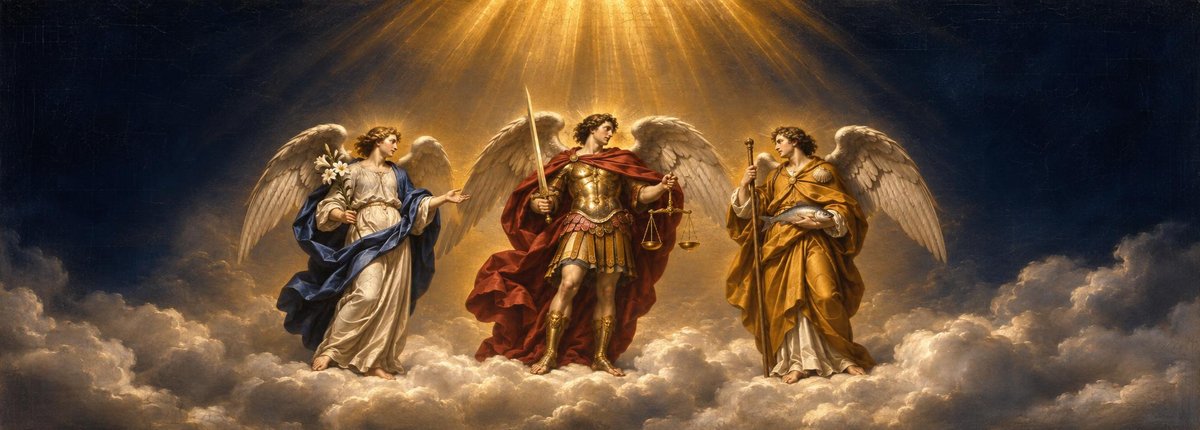
Today the Church celebrates Michael, Gabriel, and Raphael together on September 29, but this has not always been the case. In the Missal of 1962, Gabriel and Raphael still had their own feasts on March 24 and October 24, respectively, while Michael was celebrated with his “Dedication.” The single feast of all three archangels did not come into being until the calendar of 1969.
In summary
- In 1962: Gabriel (March 24) and Raphael (October 24) have separate feasts, both of third class.
- In 1921: Benedict XV extends both feasts to the whole Church with the decree “Urbis et Orbis.”
- In 1969: Paul VI promulgates the new General Roman Calendar, and September 29th becomes the feast of the three Archangels.
- What was lost: the mention of the dedication of the basilica on the Via Salaria is no longer on the calendar.
Two distinct feasts in the 1962 Missal
The work Quis ut Deus by Prof. Daniel shows that the Missal of 1962 lists the feasts of Gabriel and Raphael separately, both of third class. The feast of Gabriel is on March 24, and the collect prays to the Lord for the help of the archangel who announced the Incarnation: “O God, who among other Angels didst choose the Archangel Gabriel to announce the mystery of thy Incarnation.” The reading for the day is Dan 9:21-26.

The feast of Raphael is on October 24. The collection remembers Tobias’ traveling companion: “God, who gave the blessed Archangel Raphael as a companion to your servant Tobias, grant us, your servants, that we may always be protected by his guard and supported by his help.” The reading is Tb 12,7-15. Thus, each archangel had his own day and well-defined mission.
Pope Benedict XV extends the feasts to the whole Church (1921)
The universal introduction of these two feasts is from Pope Benedict XV. The decree Urbis et Orbis of the Sacred Congregation of Rites, dated October 26, 1921, was published in Acta Apostolicae Sedis 13 (1921), pp. 543-544. In the translation provided by the book, the Pope decides that certain feasts, including those of Gabriel and Raphael, are to be extended to the whole Church, with proper liturgical rites and masses. For both archangels, the decree establishes the rank of “duplex major.”
“It is no less expedient, for the promotion of piety and its association with the Holy Family, to celebrate with religious solemnity the divine mission of both Archangels, namely, Saint Gabriel to announce the mystery of the Incarnation of the Lord, and Saint Raphael, whose benefits granted to the family of Tobias are described in Sacred Scripture.” (Urbis et Orbis, 1921)
The feasts were to be celebrated beginning in 1922, with the option to defer to 1923. The decree bears the signature of Cardinal A. Vico, Prefect of the Congregation, and Alexander Verde, Secretary. The 1927 Breviary confirms the measure, stating in the lesson of March 24th that Pope Benedict XV extended the feast of Saint Gabriel to the entire Church.
1969: On September 29, the title changes.
The unification is posterior. The General Roman Calendar was promulgated by Pope Paul VI in the motu proprio Mysterii paschalis, signed in Rome, at St. Peter’s, on February 14, 1969, his sixth year of pontificate (Acta Apostolicae Sedis 61, pp. 222-226). The 2002 Missal, which reproduces this calendar, places the feast of the three archangels on September 29. It states that the form of a single feast for Michael, Gabriel, and Raphael dates from 1969, not from the rites of 1960 and 1962, which still had the “Dedicatio” of Michael.
There is a useful precision. The motu proprio, on the pages of the Acts, does not name Michael, and the universal norms that he approves are issued separately, in the Roman Calendar of 1969. It is in this typical edition that September 29 appears as «SS. Michaelis, Gabrielis et Raphaelis, archangelorum», with the rank of feast. The official commentary explains the change:
“The ancient feast of the Dedication of Saint Michael the Archangel (September 29th) was changed to the feast of the Holy Angels Michael, Gabriel, and Raphael. The feast of the Angels of the Guard (October 2nd) is to be preserved among the obligatory memories.” (Calendarium Romanum, 1969)
In the commentary for September 29th, the text adds and subtracts: “The dedication of the basilica of Saint Michael on the Via Salaria, in the 5th century, on September 29th, is remembered in the Hieronymian Martyrology. The mention of this dedication is now omitted, and the name of Saint Michael is joined by those of Saint Gabriel and Saint Raphael, who have been celebrated respectively on March 24th and October 24th since 1921.” On March 24th and October 24th, the same commentary states that the feasts of Gabriel and Raphael are joined with the feast of the Archangels on September 29th.
“And Michael, will he lose his place?”
Whoever wishes to know if Michael was diluted in the common feast finds an observation from the liturgist Righetti, as early as 1969. For him, the feast on September 29 «seeks to honor Saint Michael, not only individually, but especially as chief and representative of all angelic ranks». It is a reading from an author, not a text from the calendar, but it shows how scholars perceived the new title. What the calendar documents is the union of the three names on the same day.
## Frequently Asked Questions
Quando Gabriel e Rafael passaram a ter festa na Igreja inteira?
Em 1921. O decreto Urbis et Orbis, de 26 de outubro daquele ano, estendeu a toda a Igreja as festas de São Gabriel (24 de março) e de São Rafael (24 de outubro), por vontade de Bento XV.
Quando os três arcanjos passaram a ter uma festa só?
Com o Calendário Romano Geral de 1969, promulgado por Paulo VI no motu proprio Mysterii paschalis. O Missal de 2002 reproduz esse calendário e traz a festa dos três arcanjos a 29 de setembro.
O que aconteceu com a festa da Dedicação de São Miguel?
O comentário oficial do calendário de 1969 diz que a antiga festa da Dedicação foi convertida na festa dos três arcanjos, e que a menção da dedicação da basílica da Via Salária foi suprimida.
O dia dos Anjos da Guarda foi suprimido?
Não. O mesmo comentário diz que a festa dos santos Anjos da Guarda (2 de outubro) será conservada entre as memórias obrigatórias.
## References
- Sacred Congregation for Rites. Decree Urbis et Orbis (October 26, 1921). In: Acta Apostolicae Sedis, vol. 13, pp. 543-544, 1921.
- PAUL VI. Motu proprio Mysterii paschalis (14 February 1969). In: Acta Apostolicae Sedis, vol. 61, pp. 222-226, 1969.
- Roman Calendar, typical edition. Vatican City: Vatican Polyglot Press, 1969. Commentary on Universal Norms and the Calendar.
- Missale Romanum, typica edition 1962 (feasts of March 24th and October 24th) and third typica edition, 2002.
- Righti, Mario. Manual of Liturgical History, vol. 2, p. 440.
- Source: the work Quis ut Deus. Saint Michael the Archangel in the sources of the faith, by Prof. Daniel (Locus Mariologicus).
Responses