Was Saint Joseph a carpenter? What does tékton mean?
By Prof. Dr. Daniel C. Afonso · Updated
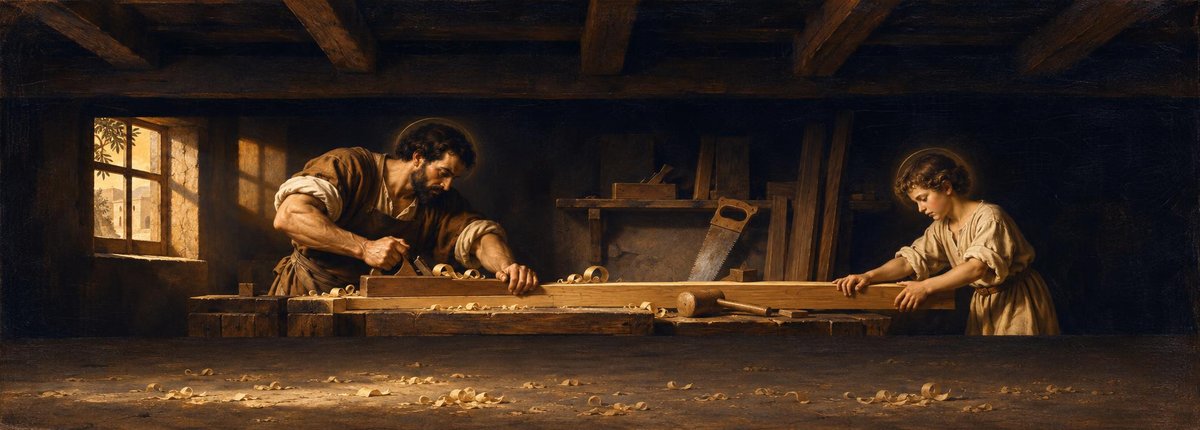
Yes, the tradition of the Church calls him a carpenter, but the word of the Gospels is broader than it seems. Matthew and Mark use the Greek term tékton, which designates the handworker, and the Vulgate translated it as faber. From the Fathers to Saint John Paul II and Pope Francis, the Church has understood this office as that of a carpenter and has seen in it the value of work.
In summary
- The texts: Mt 13:55 («the son of a carpenter») and Mk 6:3 («the carpenter, the son of Mary»).
- The terms *tékton* in Greek and *faber* in the Vulgata have a broad sense: a craftsman, an artisan, a master of a manual trade.
- The Fathers: Saint Justin speaks of plows and jugs. Others imagined work with iron and fire.
- The Magisterium: St. John Paul II speaks of the “carpenter’s work” (Redemptoris Custos, 22) and Francis, of the “working father” (Patris Corde, 6).
- What is certain: Joseph worked with his hands. The exact nature of his trade is a matter of interpretation.
What Matthew and Mark Say
When Jesus teaches in the synagogue at Nazareth, his fellow townsmen are astounded and ask, “Where does he get such wisdom?” In Matthew, the question runs: “Isn’t this the carpenter, the son of Mary, and the brother of James, Joseph, Simon, and Judas?” (Mt 13:55). In Mark, it is Jesus himself who is addressed: “Isn’t this the carpenter, Mary’s son, and the brother of James, Joseph, Judas, and Simon?” (Mc 6:3). (Our translations from the Greek text.)
Neither of the two texts names Joseph, but Matthew speaks of the “son of the carpenter,” and from this the office is read as that of the father. See also what is said about Saint Joseph the Worker here.
The New Vulgata translates thus: “Isn’t this the carpenter’s son?” (Mt 13,55) and “Nonne iste est faber, filius Mariae…?” (Mc 6,3). The Vulgata therefore translates τέκτων as fabricer.
What do tékton and faber mean?
The theologian Llamera, in his *Theology of Saint Joseph* (1953), explains that *faber*, as the Greek *tékton*, has a “general meaning” and is translated as “artifice, craftsman, or master in some mechanical or manual art.” He adds that in the Bible, and especially in the terminology, these terms designate the carpenter’s office by itself. For him, the negative argument is strong: in the apocrypha, Joseph is never attributed another profession.
Therefore, it is legitimate to translate it as “carpenter,” as is customary in Portuguese Bibles, but it is important to know that the original word covers a broader range. Even the Protoevangelium of James, an ancient apocryphal text, presents Joseph as a builder: he throws down his axe to go meet the priests, and when he leaves Mary in her house, he says: “I will build my buildings, and I will return to you” (Protoevangelium of James 9, translated from the English version). Carpenter, builder, or craftsman, what the texts show is a man who lives from manual labor.
The Fathers: plows, jugs and iron
Saint Justin, in the *Dialogue with Trypho*, is one of the earliest witnesses. He writes that Jesus was considered the son of Joseph and a carpenter (tékton), and he explains what he did.
«ταῦτα γὰρ τὰ τεκτονικὰ ἔργα εἰργάζετο ἐν ἀνθρώποις ὤν, ἄροτρα καὶ ζυγά» («pois fazia obras de carpinteiro quando vivia entre os homens, arados e jugos») (Justino, Diálogo com Trifão 88, em PG 6, col. 688, tradução nossa)
Origin offers a curious point. The philosopher Celus mocked Christians for attaching such importance to wood, either because their Master had been nailed to it, or because he was a carpenter by trade. Origin replies that in none of the Gospels circulating in the churches is it written that Jesus himself was a tékton (Against Celus VI, 36, in PG 11, col. 1352-1353). In a note by Migne’s editor, Grotius sees either a lapse in memory by Origin or a different reading in the then-existing copies of Mark, and recalls the testimony of Justin.
Other Fathers conceived of the office otherwise. The *Catena Aurea*, a collection of patristic commentaries compiled by Saint Thomas Aquinas, gathers from Saint Hilary a reading where the son of the *faber* (craftsman) is the son who “conquers iron with the force of fire,” an allegorical interpretation. According to Alfonso’s manual, a current mainly from northern Italy saw Joseph as the craftsman who works with iron and fire, an image of the Heavenly Father. It is notable that the office of a blacksmith was a common opinion among medieval Latin authors. However, the more common tradition stuck with the carpenter.
In the same *Catena Aurea*, St. Jerome comments that the error of the Nazarenes “is plain to see,” for they “suspect him to be the son of a craftsman” (fabri filium suspicantur).
# What does the Church teach about Joseph’s work?
Saint John Paul II, in the Exhortation *Redemptoris Custos* (1989), quotes the Gospel text. In paragraph 22, he writes: “The Gospel specifies the kind of work by which Joseph sought to provide for the support of the Family: the work of a carpenter.” He continues: “He who was called the ‘son of the carpenter’ had learned the craft from his ‘putative father’.” In the same paragraph, he states: “Through his workbench, Joseph brought human labor close to the mystery of Redemption.”
In #23, the Pope observes that in Jesus’ human growth, “a notable part was played by the virtue of diligence.” And in #24, he proposes Joseph as “a model of the humble,” demonstrating that to be an authentic follower of Christ, “great things are not needed, but only common, human, simple, and authentic virtues.” On this document, see Redemptoris Custos.
Pope Francis, in the letter *Patris Corde* (2020), dedicates section 6 to the theme, «The Working Father»: «Saint Joseph was a carpenter who worked honestly to provide for his family. With him, Jesus learned the value, dignity, and joy of what it means to eat bread earned through one’s own labor.» And he concludes that «Saint Joseph’s work reminds us that God himself, made man, did not despise work.»
What is certain and what is interpretation?
Certainly, the Gospels tell us that Joseph practiced a manual trade, and his neighbors in Nazareth knew him by that name, and Jesus learned from him. The Magisterium explicitly teaches this. The translation “carpenter” is the common interpretation from the Fathers. The exact type of work, whether wood, metal, or construction, is not defined by the text and remains a matter of interpretation. The details in the apocrypha, such as the ax and building works, are pious legend and do not enter into the doctrine.
## Frequently Asked Questions
São José era carpinteiro?
Segundo a tradição da Igreja, sim. Mateus fala do «filho do tékton» (Mt 13,55) e Marcos chama Jesus de «tékton» (Mc 6,3). A Vulgata traduz por faber, e a palavra, de sentido amplo, foi entendida como carpinteiro.
O que significa tékton?
É uma palavra grega que designa o artífice ou artesão que trabalha com as mãos. Em português se traduz por «carpinteiro», mas o termo é mais amplo, como o latim faber.
Jesus também foi carpinteiro?
Mc 6,3 o chama de tékton, e a tradição entende que ele aprendeu o ofício com José. Mt 13,55, porém, só fala do «filho do tékton». São João Paulo II diz que Jesus aprendeu o ofício de seu pai putativo (Redemptoris Custos, 22).
Por que São José é patrono dos trabalhadores?
Porque os Evangelhos o mostram como artesão que sustentava a família com o seu trabalho. A Igreja vê nesse trabalho uma participação na obra da salvação (Redemptoris Custos, 22, e Patris Corde, 6).
O ofício de São José é questão de fé?
Não. É certo que ele trabalhava com as mãos, mas se era carpinteiro, ferreiro ou construtor é questão de leitura do termo grego. A tradição comum escolheu o carpinteiro.
## References
- SACRED SCRIPTURE: Mt 13:55, Mk 6:3. Translations from the Greek text (SBLGNT) and the New Vulgata (vatican.va).
- John Paul II. Apostolic Exhortation Redemptoris Custos (1989), nos. 22-24. Portuguese version available at vatican.va.
- FRANCISCO. Apostolic Letter Patris Corde (2020), n. 6. Portuguese version at vatican.va.
- Justinus. Dialogue with Trypho, 88. In: MIGNE, J.-P. Patrologia Graeca, vol. 6, col. 688.
- ORIGEN. *Contra Celsum* VI, 36. In: MIGNE, J.-P. *Patrologia Graeca*, t. 11, col. 1352-1353 (with the editor’s note).
- Thomas Aquinas. *Golden Chain on Matthew*, Chapter 13 (Hilary and Jerome). Corpus Thomisticum: https://www.corpusthomisticum.org/cmt13.html.
- “Proto-Gospel of James, ch. 9. In: Ante-Nicene Fathers, vol. 8. Available at: https://www.newadvent.org/fathers/0847.htm.”
- “Llamera. *Theology of Saint Joseph*. 1953, p. 69.”
- AFONSO. “Go to Joseph: A Manual of Josefology.” 2025, p. 120.
Responses