The Son of Man shall be delivered up: The second prediction of the passion and Mary on the way to the cross
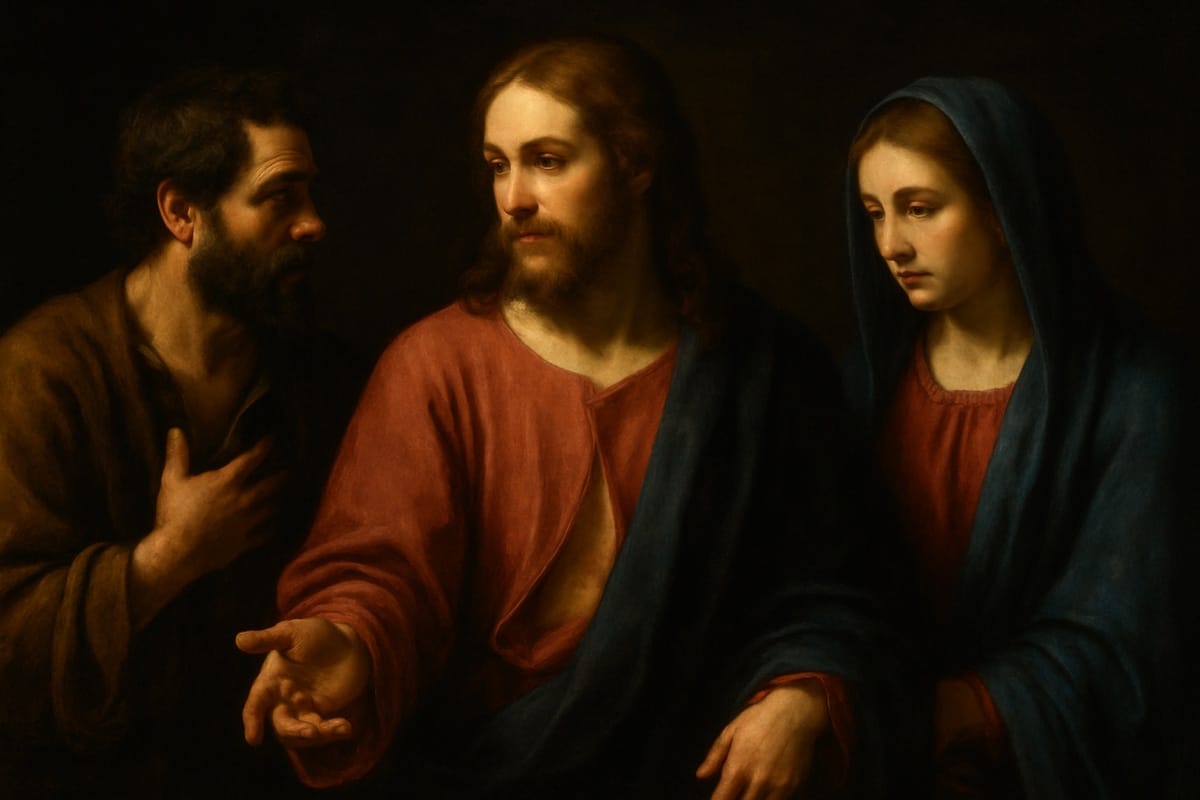
Scripture: “While they were talking together in Galilee, Jesus said to them, ‘The Son of Man is to be delivered into the hands of men, and they will kill him, and on the third day he will rise.’ And they were deeply saddened.” (Matthew 17:22-23)
Exegesis: Matthew 17:22-27 presents a dual pericope: the second prediction of Jesus’ passion (verses 22-23) and the Temple tax incident (verses 24-27). The second prediction, the shortest of the three in Matthew (compared to Matthew 16:21 and 20:18-19), states: “The Son of Man is to be delivered into the hands of men, and they will kill him, and on the third day he will rise.” This concise statement lacks the details about Jerusalem, the elders, and the priests found in the third prediction. Its brevity heightens the solemnity: the passage from life to death is expressed with economic words, imbuing the announcement with a nearly unbearable density.
Disciples’ Reaction: The disciples’ response, “they were deeply saddened” (contristati sunt vehementer), is the only recorded mourning reaction in Matthew’s Gospel following predictions of Jesus’ passion. The first prediction elicited Peter’s resistance (Matthew 16:22). The third will prompt an ambitious request from James and John (Matthew 20:20-21). Yet, the second prediction, simply stated, evokes profound sorrow. Their grief is not misplaced; it reflects a comprehension that something terrible is approaching, even if they do not yet grasp the meaning of Jesus’ resurrection.
I. “Filius hominis tradendus est”: The Act of Surrender
“Tradendus est,” the future passive tense, announces not only what will happen but also the structure of Jesus’ mission: to be “delivered.” The verb παραδίδωμι (paradidomi) permeates the Passion narrative: Judas betrays Jesus to the priests (Matthew 26:16), the priests deliver him to Pilate (Matthew 27:2), and Pilate delivers him for crucifixion (Matthew 27:26). “Delivery” is the unifying thread of the Passion story, and Jesus announces it as part of his mission, not an accidental historical event. “Will be delivered” is not passivity but consent: Jesus knows and accepts what is to come.
The phrase “into the hands of men” (in manus hominum) is paradoxical: the Son of Man, evoking Daniel 7:13’s universal powerful being, is delivered into the hands of corrupted humanity, political and religious power that condemns the righteous. The Passion represents a clash between two humanities: Jesus’ acceptance of delivery versus humanity’s power of condemnation. This paradoxical delivery is at the heart of soteriology: God in human form submitting to human power to rescue humanity from within.
The Temple tax incident (Matthew 17:24-27) that follows provides a revealing contrast. As Jesus, moments away from being “delivered,” debates whether to pay the Temple tax, he concludes that “the children” are “free” but he pays to avoid scandal. Jesus’ inner freedom contrasts with his imminent outer delivery. This structure of self-giving love is exemplified: free within, delivered without.
II. “Contristati sunt vehementer”: The Prophetic Sorrow
“”They were deeply saddened” (Mt 17:23), the sorrow of the disciples at the second prediction is one of the most human emotions in the Gospels. They heard, understood partially, and partial understanding, knowing that something terrible is approaching without exactly knowing what, is more disturbing than complete ignorance. Sorrow without full comprehension is the sorrow of faith awaiting what it has not yet seen.”
“The disciples’ sorrow is ‘prophetic’ in the sense that it anticipates the grief of the Passion: the ‘deep sorrow’ of Gethsemane (Mt 26:37-38: ‘My soul is sorrowful unto death’), the disciples’ flight after Jesus’ arrest (Mt 26:56), Peter’s weeping after his denial (Mt 26:75). The sorrow in Mt 17:23 is the first echo of a chain of sorrows that will culminate at the tomb and be dispelled by the Resurrection already foretold.”
“
III. Mary and the second prediction: ‘She kept it in her heart’
“
“Mary is not mentioned in the second Passion prediction in Matthew, but her presence is implied in Lk 2:19.51: ‘Mary kept all these things, pondering them in her heart’. From the Temple Presentation (Simeon’s prophecy about the ‘sword’, Lk 2:35) to the wedding at Cana (where the ‘time’ has not yet come, Jn 2:4), Mary had been accumulating signs of what her Son’s destiny would entail. The Passion predictions were not a complete surprise to Mary; they were the gradual clarification of something she had intuited since the Annunciation.”
“The spiritualitas of ‘keeping it in her heart’ that Luke attributes to Mary is the spiritualitas of lectio divina: chewing over the Word, letting it sink from intellectual memory into the heart that acts. Mary, who heard the Passion predictions, either directly or through the disciples, did not react with Peter’s resistance nor the ambition of James and John: she kept silent, allowing the Word to make its way to her total availability on the Cross.”
“The ‘deep sorrow’ of the disciples at the prediction has its Marian parallel in Simeon’s ‘sword’ that pierces her soul (Lk 2:35). But Mary’s sorrow differs: she ‘keeps’ the incomprehension with faith, without transforming it into resistance. The Passion prophecy that the disciples received with paralyzing sadness, Mary receives with a sorrow that does not prevent availability, the renewed fiat at each prediction, at each step towards the Cross.”
“
IV. ‘Et tertia die resurget’: the horizon of Resurrection
“
“The second Passion prediction includes, as the first and third, reference to the Resurrection: ‘on the third day he will rise’ (Mt 17:23). The disciples did not hear this part, or heard it without understanding. But the structure of the prediction is not merely an announcement of death; it is an announcement of death-and-resurrection. The horizon of the Passion is Easter. The deep sorrow of the disciples is the sorrow of those who heard only the first part and failed to integrate the second.”
Mary, whom tradition identifies as the first to contemplate the Risen One (John Paul II, Redemptoris Mater26), lived the “third day” as the confirmation of the faith she had sustained on Holy Saturday. But before the third day there was the path, the Via Crucis announced in the second prediction. Mary on the Way of the Cross is the figure of the Church that accompanies the Lord’s steps knowing that the third day will come but not knowing “when.”
The devotion to the “Way of the Cross” developed by Marian tradition, from Mary’s Seven Sorrows to the Stabat Mater, has its root in the Passion predictions that Mary “kept in her heart”: each prediction is a station on the path, each “distress” of the disciples finds an echo in Mary’s soul that welcomes the sword without breaking. The second prediction of Mt 17 is, in Marian meditation, the moment when Mary clearly knows what is approaching and continues to walk, with the Son, towards the Son, in our name.
Postgraduate Program in Mariology
Would you like to deepen your formation in Mariology? Discover the Postgraduate Program in Mariology from Locus Mariologicus – an academic formation that combines theological rigor, spiritual life, and the living tradition of the Church.
Would you like to study Mariology seriously?
This article draws on the works of the Locus Mariologicus library. The Postgraduate Program in Mariology takes you to the same sources with academic guidance: Scripture, the Church Fathers and the Magisterium, from the first dogma to contemporary questions.





Responses