Our Lady of Lourdes: the apparitions to Bernadette Soubirous
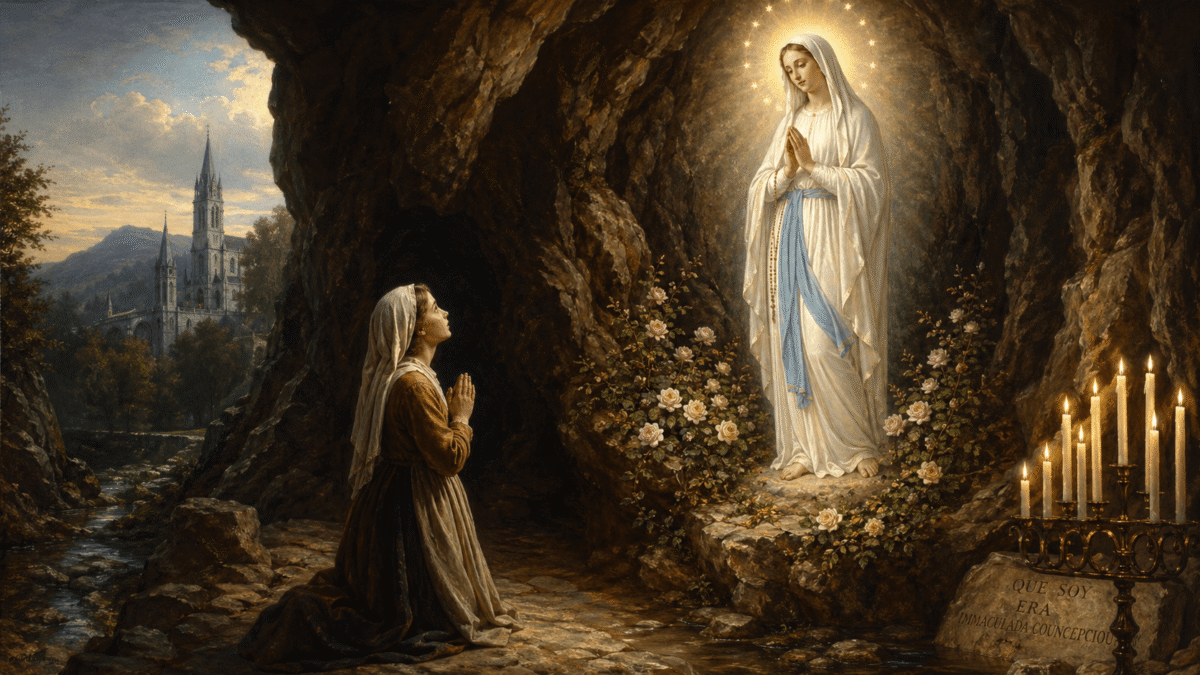
Our Lady of Lourdes, the apparitions to Bernadette Soubirous
Our Lady of Lourdes appeared to Bernadette Soubirous (1844-1879), a young peasant girl of a very poor family, in the grotto of Massabielle, beside the river Gave, at Lourdes (southern France), from February 11 to July 16, 1858, in a total of 18 apparitions. The bishop of Tarbes recognized the authenticity of the apparitions in 1862, and Lourdes became one of the greatest pilgrimage centers in the world, with more than four million pilgrims a year. For the full article: Our Lady of Lourdes.
The history of the apparitions
On February 11, 1858, Bernadette, 14 years old, daughter of a destitute family of the “cachot” (the former prison) of Lourdes, went with her sister and a friend to gather firewood near the grotto of Massabielle. There she heard a “noise like a strong wind” and saw, in the niche of the grotto, a “wonderful young lady” dressed in white, with a blue sash, golden roses on her feet, and a yellow rosary. In the following weeks, the Virgin asked Bernadette to come back for 15 days. In the apparitions she gave her messages and concrete instructions: she pointed out a spring (which Bernadette uncovered by digging in the earth), she asked that a chapel be built, and she ordered processions. On March 25, the solemnity of the Annunciation, Bernadette, who kept insisting on asking the name of the apparition, heard the answer in the Gascon dialect: “Que soy era Immaculada Concepción” (“I am the Immaculate Conception”). The statement reached the parish priest Peyramale, who at first did not understand it: “The Virgin is not her conception.” The last apparition took place on July 16, 1858.
The message of Lourdes
The message of Lourdes is articulated in four words. Poverty: not explicitly proclaimed, but strongly signified by the choice of Bernadette, daughter of the poorest people of Lourdes. “What is weakest in the world” (1 Cor 1:27) was chosen as messenger. Prayer: it is the watchword of the Virgin herself, from the beginning of the apparitions. The request to build a chapel and to hold processions means “Church on the way and Eucharist.” Penance, that is, conversion (metanoia): the Virgin repeatedly asked for “Penance, penance, penance!” and invited people to pray “for the conversion of sinners.” Grace: the last word of the message is the identity of the One sent. In identifying herself as “Immaculate Conception,” Mary reveals that for her everything is grace, everything is born of the gratuitous grace of God, as she herself sings in the Magnificat. Lourdes makes present again the prolegomena of the Gospel: the baptism of penance of John the Baptist, conversion, prayer, the beatitude of the poor.
The witness: Saint Bernadette
Bernadette’s confessor declared: “The best proof of the apparitions is Bernadette herself.” Unlettered, of frail health, belonging to a family of no standing, she faced the police commissioner, the court, the gendarmes, and several commissions of inquiry without ever contradicting herself. In 1866 she entered the congregation of the Sisters of Charity of Nevers, where she lived her last years in a “threefold night”: the night of physical suffering (tuberculosis, asthma, bone caries), the night of the senses (the distance from the apparitions left her with the temptation of having deceived herself), and the night of faith (the feeling of not having corresponded to grace). Bernadette lived interiorly the message she had received. She died on April 16, 1879, and was canonized by Pius XI in 1933. She herself said before dying: “She did not promise me happiness in this world, but in the other.”
The shrine and the pastoral ministry
The shrine of Lourdes is, after Rome, the largest center of international pilgrimage in the world. Its pastoral ministry directs the whole of Marian devotion in a Christocentric way: as the tradition of the shrine affirms, “the presence of Mary is discreet and entirely directed toward Christ.” The Virgin asked for a chapel, but basilicas were built. The Eucharist is the center of every pilgrimage. Lourdes is especially known as a place of pilgrimage for the sick, and its medical archives document numerous inexplicable cures recognized as miracles. The liturgical memorial of Our Lady of Lourdes is celebrated on February 11. Pius X instituted the feast in 1908.
Deepen your studies: explore Mariology, Marian apparitions, Immaculate Conception, and the Postgraduate Program in Mariology.
Magisterium of the Church
Quod signum fuit apparitionis Beatae Mariae Virginis apud Lourdes: ipsa se appellavit “Immaculata Conceptio”, confirmans dogma a Pio IX definitum.
Pius XII, Enc. Le Pèlerinage de Lourdes (2 iulii 1957)
📚. Literal translation: What was the sign of the apparition of the Blessed Virgin at Lourdes: she herself called herself “the Immaculate Conception,” confirming the dogma defined by Pius IX.
Postgraduate Program in Mariology
Would you like to deepen your formation in Mariology? Discover the Postgraduate Program in Mariology of Locus Mariologicus – an academic formation that unites theological rigor, spiritual life, and the living tradition of the Church.
See the complete list of Marian apparitions recognized by the Church.
Learn what the Church teaches about Mary, Mediatrix of All Graces.
Would you like to study Mariology seriously?
This article grows out of the works in the Locus Mariologicus library. The Postgraduate Program in Mariology takes you to the same source, with academic guidance: Scripture, the Fathers of the Church, and the Magisterium, from the first dogma to contemporary questions.

Responses