The mountain of God for all peoples: Is 2 and Mt 15, dedication of Saint Mary Major
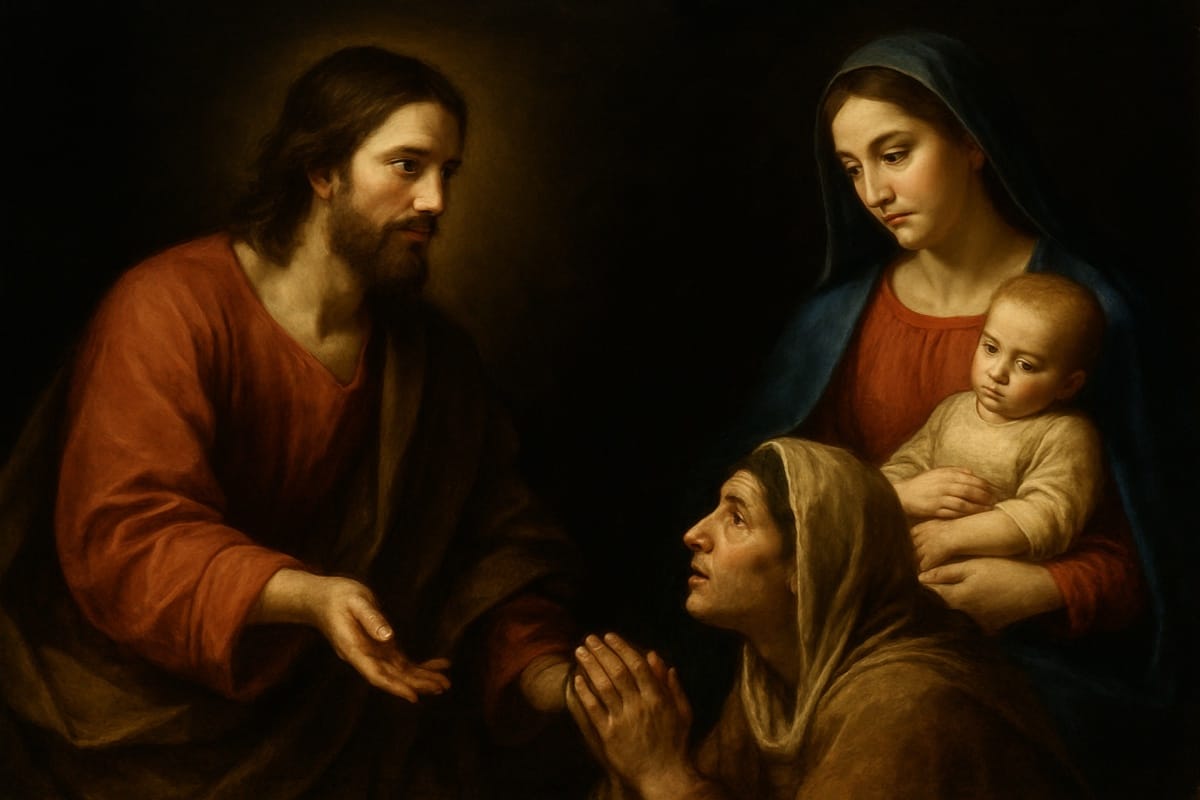
“Fluent ad eum omnes gentes”.
“All peoples shall flow to it”. (Is 2:2)
I. The mountain of God and the house of the mother of all peoples
The prophecy of Isaiah 2:2-5 is one of the most universalist texts in the whole Old Testament: “In the last days, the mountain of the House of the Lord shall be established at the top of the mountains and shall be raised above the hills. To it all peoples shall flow. Many nations shall come and say: ‘Come, let us go up to the mountain of the Lord, to the House of the God of Jacob. He will teach us His ways and we will walk in His paths’” (Is 2:2-3). The vision is not that of a temple closed in on itself. It is that of an irresistible attraction of all the nations toward the center where God dwells. The mountain of God does not exclude: it summons.
The Basilica of Saint Mary Major, on the Esquiline in Rome, is one of the most eloquent realizations of this prophetic vision in the history of the Church. It is the largest papal basilica dedicated to the Virgin Mary, one of the four great shrines of Rome that have welcomed pilgrims from every continent since the fifth century. Its history is bound to two founding moments: the legend of the “Snow of August” and the theological decision of the Council of Ephesus.
Tradition recounts that, on the night of August 4 to 5 in the year 352, Pope Liberius and a Roman nobleman named John had, separately, the same dream: Mary was asking them to build a basilica on the Esquiline. On waking, they found the summit of the hill covered with snow, an extraordinary phenomenon in August in Rome. The snow marked out the perimeter of the temple to be built. For this reason the feast is also known as “Our Lady of the Snows”. This account, regardless of its strict historicity, communicates a spiritual truth: the initiative is Mary’s, and the human response is one of listening and of obedience to what she asks.
II. The faith that persists: the Canaanite woman
The Gospel of Matthew 15:21-28 recounts one of the most disconcerting encounters of Jesus’ ministry: the healing of the daughter of a Canaanite woman. The text situates the action in the “district of Tyre and Sidon”, outside the territory of Israel, in pagan country. A woman cries out after Jesus: “Lord, Son of David, have mercy on me! My daughter is severely tormented by a demon” (Mt 15:22). The title “Son of David” is messianic: this pagan woman recognizes in Jesus the Messiah of Israel, before many Israelites recognize Him.
The response of Jesus is silent at first (“he did not answer her a word”) and then restrictive: “I was not sent except to the lost sheep of the house of Israel” (Mt 15:24). The woman does not give up. She prostrates herself and says: “Lord, help me!” Jesus answers with a sentence that scandalizes on a first reading: “It is not right to take the children’s bread and throw it to the little dogs” (Mt 15:26). The woman, far from taking offense, turns the image into an argument: “Yes, Lord. Yet even the little dogs eat the crumbs that fall from their masters’ table” (Mt 15:27). Jesus answers with admiration: “O woman, great is your faith! Let it be done for you as you desire” (Mt 15:28). The daughter was healed at that very hour.
III. “Great is your faith!”, the woman, Mary, and intercession
This episode illuminates the memorial of Saint Mary Major from several angles. In the first place, the Canaanite woman is a pagan: she belongs to the nations that Isaiah announces as recipients of salvation. The encounter with Jesus on the border of Israel is, narratively, the anticipated realization of the prophecy: all the nations flow to the mountain of God, even those who are outside the chosen people. The Basilica of Saint Mary Major, built to be the great Marian house of Rome, capital of the empire and place of confluence of the nations, is the stone and the mosaic of this universality.
In the second place, the faith of the Canaanite woman is a model of Marian intercession. She does not come to ask for herself. She asks for her daughter. She does not give up when the request seems refused. She insists with humility and with argumentative creativity. This persistent and interceding faith is the faith that the Church recognizes in Mary: the mother who intercedes for all her children, who does not give up when the answer is slow in coming, who always finds the argument that opens the heart of the Son. “They have no wine” (Jn 2:3): at Cana, Mary anticipated the miracle with the same confident discretion as the Canaanite woman.
The exclamation of Jesus, “great is your faith!”, is unique in the Gospel of Matthew, where only this woman and the centurion (Mt 8:10) receive praise of this magnitude. The greatness of faith lies neither in theological perfection nor in belonging to the chosen people. It lies in tenacious trust, in the humility that takes no offense, in the creativity that turns rejection into argument. It is the faith of one who knows that God is good, even when the way is hard.
IV. Saint Mary Major, from Ephesus to the mosaic of the coronation
The present basilica of Saint Mary Major owes its fundamental architectural form to a historic theological decision: the Council of Ephesus, in 431. The Council defined that Mary is Theotokos, Mother of God, against the position of Nestorius, who preferred the title Christotokos (Mother of Christ). Sixtus III, pope from 432 to 440, rebuilt and embellished the basilica on the Esquiline as a theological monument in stone and mosaic in response to this definition. The pope wanted Rome to have a great Marian basilica that would proclaim to the world the dignity of the Theotokos.
The mosaics of the apse, largely preserved since the fifth century, are exceptional in the history of Christian art. The central mosaic of the apse, the work of Jacopo Torriti in the thirteenth century but reproducing an earlier paleo-Christian composition, shows the coronation of Mary by Christ. It is one of the oldest representations of this theme in the Christian West. Christ and Mary are seated side by side, on a throne covered with stars. The Queen is at the right hand of the King, taking up the image of the Davidic gebirá: Bathsheba seated at the right hand of Solomon (1 Kgs 2:19).
The basilica also guards a venerated relic: the boards of the manger of Bethlehem, the Reliquia Cunabuli, preserved in a crystal urn beneath the high altar. The presence of this relic in the greatest Marian basilica of Rome is theologically eloquent: the house of the Mother guards the sign of the poverty of the Son. The place where Mary is celebrated with all architectural and artistic grandeur is also the place where the crib is remembered. Grandeur and poverty, the imperial basilica and the manger of straw, coexist without contradiction: they are the two faces of the mystery of the Incarnation.
The memorial of August 5 therefore invites us to an interior pilgrimage: to flow toward the mountain of God that Isaiah announced, to persist in the faith of the Canaanite woman whom Jesus admired, to contemplate the face of the Theotokos that the mosaics of Saint Mary Major have celebrated since the fifth century. All the nations flow to the mountain of God, and Mary is the gate through which salvation comes down to all the nations. This is the theology that the basilica proclaims with its stone, its mosaic, and its liturgical memorial.
Postgraduate Program in Mariology
Would you like to deepen your formation in Mariology? Discover the Postgraduate Program in Mariology at Locus Mariologicus – an academic formation that unites theological rigor, spiritual life, and the living tradition of the Church.
Would you like to study Mariology seriously?
This article grows out of the works in the Locus Mariologicus library. The Postgraduate Program in Mariology takes you to the same source, with academic guidance: Scripture, the Fathers of the Church, and the Magisterium, from the first dogma to contemporary questions.



Responses