Mary, the New Eve: The Eve-Mary Typology in the Fathers of the Church
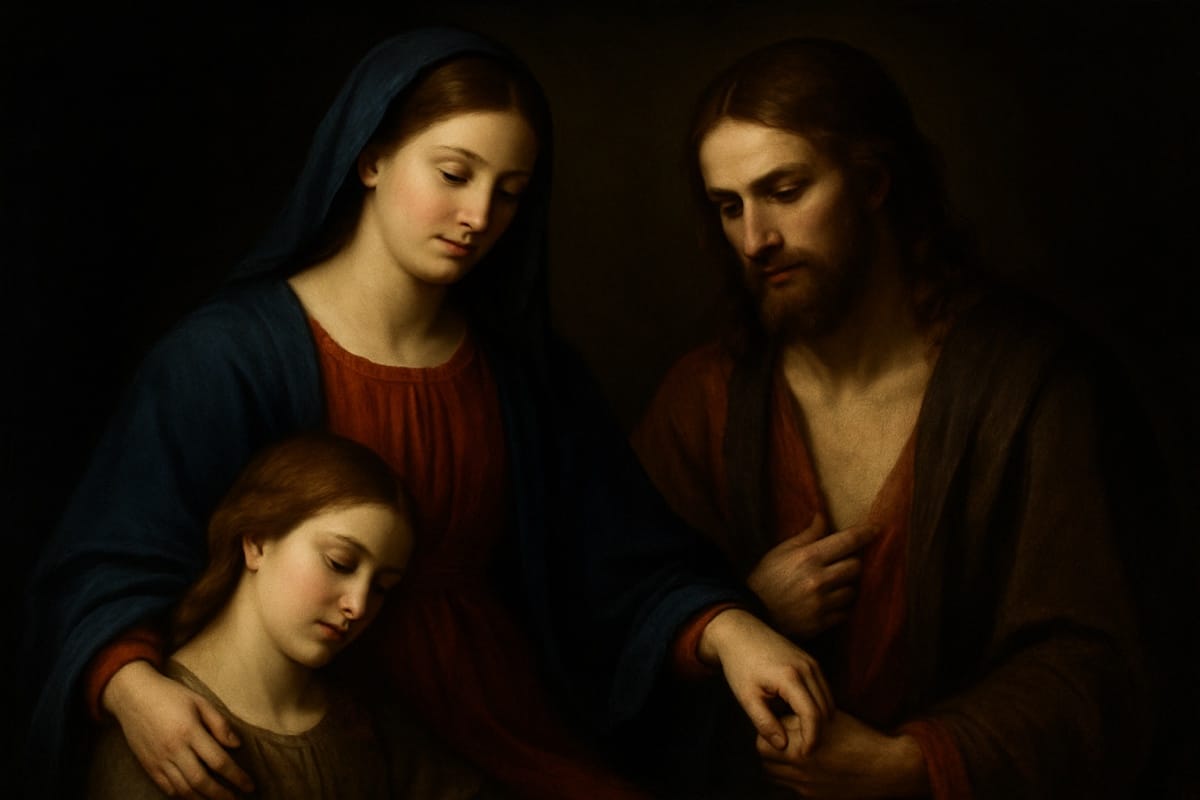
Mary, the New Eve, is one of the oldest keys for reading the figure of Mary in the Christian tradition. Already in the first centuries, the Fathers of the Church contrasted the two “women” of the history of salvation: as the disobedience of Eve brought death, the obedience of Mary brought life. This parallel – called the Eve-Mary typology – lies at the root of all Mariology. This guide explains its biblical and patristic origin and its meaning.
The biblical root: the “woman” of Genesis
The starting point is the Protoevangelium (Gen 3:15): “I will put enmity between you and the woman, between your seed and hers.” Tradition read in this “woman” and in her seed an announcement of Mary and of Christ, who conquer the serpent. The Gospel of John takes up the title “Woman” at the two key moments – Cana and the Cross – and Revelation 12 shows “the Woman clothed with the sun” in combat with the dragon.
The Fathers of the Church
The Eve-Mary typology was developed by the earliest Fathers:
- Saint Justin Martyr (second century): Eve, a virgin, conceived disobedience and death by listening to the serpent; Mary, a virgin, conceived faith and life by listening to the angel.
- Saint Irenaeus of Lyons: “the knot of Eve’s disobedience was untied by Mary’s obedience; what the virgin Eve bound by unbelief, the Virgin Mary loosed by faith.” Mary becomes the “advocate of Eve.” It is the doctrine of recapitulation.
- Tertullian and, later, Saint Jerome, with the parallel summed up in the formula: “death through Eve, life through Mary.”
The theological meaning
To call Mary “New Eve” does not place her beside Christ as a savior, but shows her as the new woman who, by her faith and free obedience, cooperates in God’s plan. Just as Christ is the “new Adam” (Rom 5; 1 Cor 15), Mary is the “new Eve” – the first and perfect disciple. The Second Vatican Council gathers up this tradition in Lumen Gentium (n. 56): by her obedience, Mary “became a cause of salvation for herself and for the whole human race.” This cooperation is rooted in her Immaculate Conception and in the “yes” of the Annunciation.
Frequently Asked Questions
Where is the idea of Mary as the New Eve found in the Bible?
It is implicit in Gen 3:15 (the “woman” and her seed) and developed by the typological reading the Fathers made in the light of the New Testament.
Who created the expression “New Eve”?
Saint Justin and Saint Irenaeus, in the second century, were the first to develop it systematically.
See also
Would you like to study Mariology seriously?
This article grows out of the works in the Locus Mariologicus library. The Postgraduate Program in Mariology takes you to the same source, with academic guidance: Scripture, the Fathers of the Church, and the Magisterium, from the first dogma to contemporary questions.





Responses