The Annunciation to Mary (Lk 1:26-38): The Text and Its Meaning
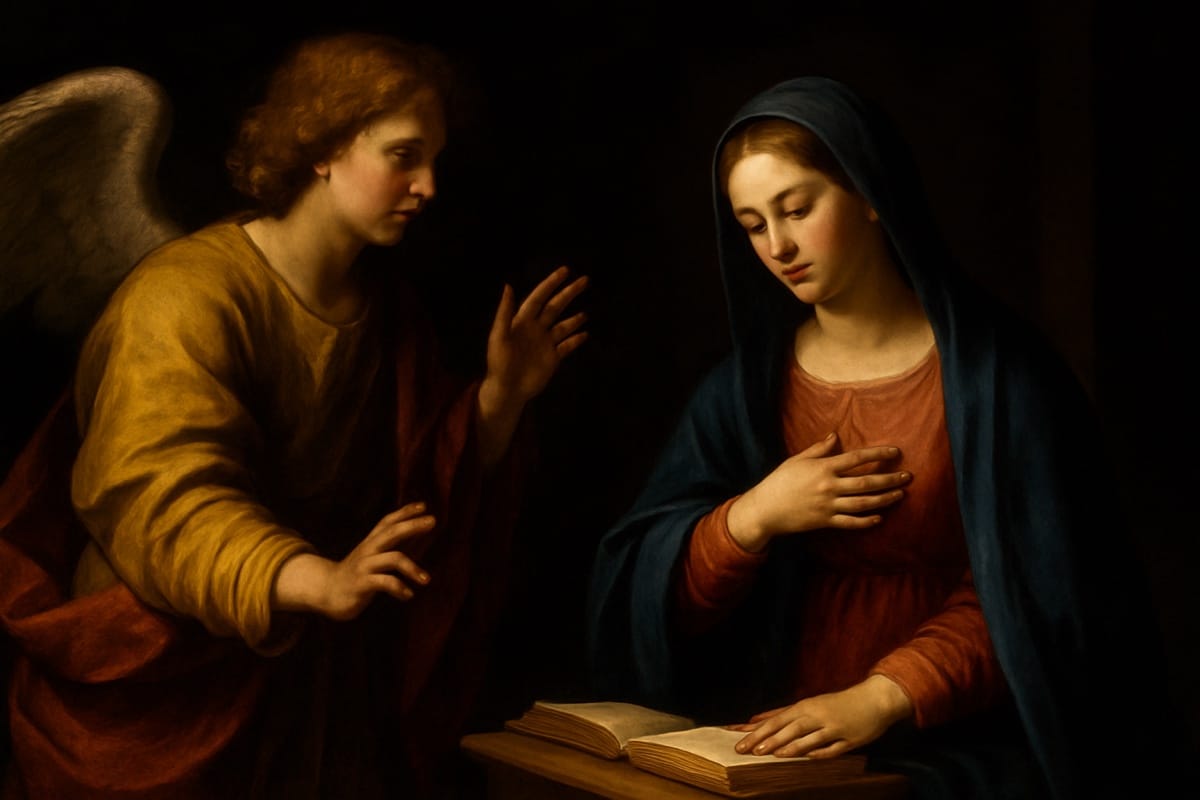
The Annunciation to Mary (Lk 1:26-38) is the moment in which the angel Gabriel announces to Mary that she will be the Mother of the Son of God, and in which Mary responds with her free and total “yes.” It is the first revelation of the mystery of Jesus and the beginning of its fulfillment. This guide presents the text of Saint Luke and the theological richness of every word of the announcement.
The text of Luke (Lk 1:26-38)
In the sixth month, the angel Gabriel is sent by God to Nazareth, “to a virgin betrothed to a man named Joseph, of the house of David; and the virgin’s name was Mary.” The angel’s greeting – “Rejoice, full of grace, the Lord is with you” – troubles Mary, who ponders its meaning. Gabriel announces to her that she will conceive Jesus, Son of the Most High, whose kingdom will have no end. To the objection “How shall this be, since I do not know man?” the angel answers: “The Holy Spirit will come upon you.” Mary concludes: “Behold, the handmaid of the Lord; let it be done to me according to your word.”
“Rejoice” (chaire): an invitation to messianic joy
The angel’s first word, chaire, was translated by the Vulgate as “Ave,” but the Greek Fathers and the Byzantine liturgy interpret it as an invitation to joy. In the Greek Old Testament (LXX), the same verb is addressed to the Daughter of Zion in the messianic announcements (Zeph 3:14; Zech 9:9; Joel 2:21-23). Throughout Luke’s infancy gospel, the joy of salvation is a dominant theme: it would be strange for the announcement of Christ’s birth to be reduced to a simple greeting.
“Full of grace” (kecharitoméne): transformed by grace
The Greek term kecharitoméne is theologically extremely dense. Luke did not use the usual formula “pleres charitos” (full of grace), but the perfect passive participle of the verb charitóo – which has a causative, transformative sense. Literally, it means “she who has been transformed by grace.” The perfect tense indicates a grace that comes from God and remains operative in her. It is a new name, given to Mary in view of her vocation and mission – as Gideon was called “mighty man of valor” (Judg 6:12). This is the biblical root of what the Church confesses in the Immaculate Conception.
A vocation account
The Annunciation is not merely an “announcement of a birth”: it has the form of a vocation account, like those of Moses (Ex 3), Gideon (Judg 6), or Jeremiah (Jer 1). The focus is as much on Jesus as on Mary’s response. Luke effects a radical inversion of values: while the birth of John the Baptist is announced to the man (Zechariah), the birth of Jesus is announced to the woman, to the young unknown virgin of Nazareth – a sign of the absolute gratuitousness of God’s choice.
Mary’s “yes”
To the title kecharitoméne that she receives at the beginning, Mary responds at the end with that of “handmaid of the Lord” (doulé) – a title of humility, but above all of dedication to God’s plan. The optative verb génoito (“let it be done”) expresses a free, unconditional, and generous assent. This “yes” inaugurates the fulfillment of salvation and lies at the root of her fruitful Virginity through the action of the Spirit.
Frequently Asked Questions
When is the Annunciation celebrated?
On March 25, nine months before Christmas.
What does “full of grace” mean?
It translates the Greek kecharitoméne: “she who has been transformed by the grace of God,” a grace that precedes her and dwells in her totally.
Why does the angel say “do not be afraid”?
It is the typical formula of vocation accounts, God’s assurance and encouragement for the one who receives a mission.
See also
Would you like to study Mariology seriously?
This article grows out of the works in the Locus Mariologicus library. The Postgraduate Program in Mariology takes you to the same source, with academic guidance: Scripture, the Fathers of the Church, and the Magisterium, from the first dogma to contemporary questions.





Responses