The Marian Devotion of Leo XIII
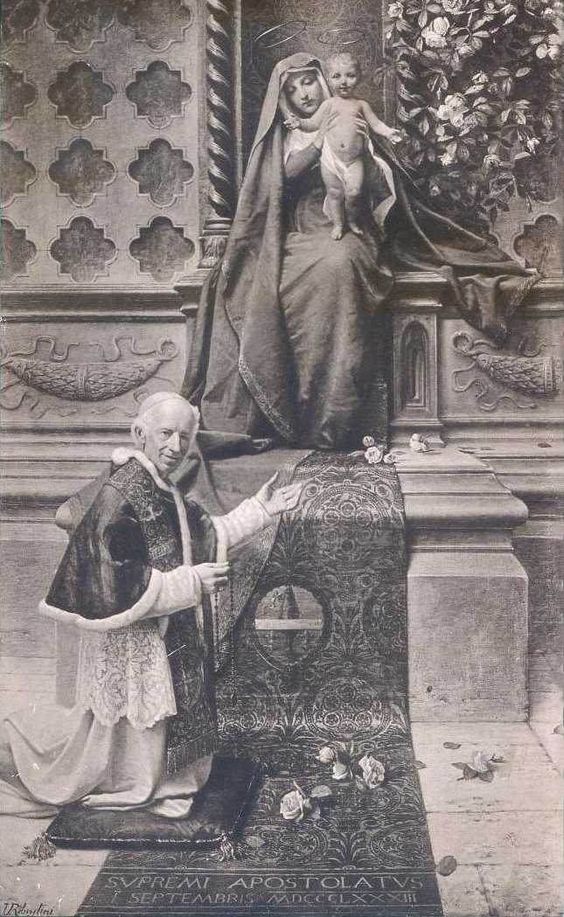
The suspension of Marian propaganda: mysteries in the Vatican Archives
In the heart of the Vatican Archives rest documents that show the complex fabric of the Catholic faith and the papal decisions that shaped its history. Among them are peculiar records concerning Marian devotion during the pontificate of Leo XIII, who was known for his fervent Marianism. A little-known but highly significant episode was the temporary suspension of Marian propaganda. This action, shrouded in mystery, raises questions: was it a response to internal theological tensions, an ecumenical gesture, or a political maneuver?
The answer lies hidden in the old manuscripts and sealed correspondence of the period, waiting to be investigated by Mariologists and historians. This event is a reminder that devotion to Mary, although deeply rooted in the Catholic faith, has crossed and continues to cross rough seas of interpretations, practices, and, at times, controversies.
Leo XIII’s exhortation to seek the protection of the Most Holy Virgin Mary
Despite the episode of the suspension of the Assumptionist movement, Leo XIII remained an ardent defender of the Virgin Mary. In his writings and encyclicals, he exhorted the faithful to seek refuge and protection under the mantle of the Most Holy Virgin. His veneration for Mary was eloquently expressed in the encyclical “Supremi Apostolatus Officio,” where, in addressing the Rosary, he highlighted the power of Marian intercession in times of crisis.
Over the years, Leo XIII continued to emphasize the importance of the Rosary through subsequent encyclicals, culminating in “Diuturni Temporis” in 1898. These encyclicals were not mere documents: they were manifestations of a living faith, echoing belief in Mary’s powerful intercession and in the Rosary as a means of obtaining divine graces. They also served as a call to unity and peace, emphasizing Mary’s role as mother and mediatrix.
Constitutions and apostolic letters on Marian devotion
In addition to the encyclicals devoted to the Rosary, Leo XIII also issued a series of constitutions and apostolic letters that reinforced Marian devotion in various ways. These documents varied in form and purpose, but all of them shared a common theme: the recognition of the Virgin Mary not only as the Mother of God, but also as the spiritual mother of all the faithful.
Through these texts, Leo XIII not only reaffirmed Marian doctrines but also encouraged the faithful to make Mary part of their life of prayer and to regard her as a model of virtue and faith. These documents helped to cement the view of Mary as a central pillar of the Catholic faith and to establish Marian devotional practices that endure to this day.
The Rosary and Mary in the vision of Leo XIII
The Rosary, in Leo XIII’s vision, transcends the simple recitation of prayers: it is a weave of the angelic salutation and of reflections on the life of Christ, and a powerful weapon in the defense of the faith. This article explores the dimensions of the Rosary as understood and promoted by Leo XIII.
Leo XIII saw the Rosary not merely as a sequence of prayers, but as a profound meditation on the mysteries of the Christian faith. Each Hail Mary recited is an angelic salutation that recalls the Annunciation, linking the faithful to that crucial moment in the history of salvation. By contemplating these mysteries, the devout weave a spiritual framework that connects them intimately to the life, passion, death, and resurrection of Christ.
For Leo XIII, the Rosary was a vital tool in the defense of the faith, especially in times of crisis and challenge. He believed that, by meditating on the mysteries of the Rosary, Christians would not only strengthen their faith but also find examples of virtue in the lives of Jesus and Mary. The Rosary thus served as a model of how to live according to Christian teaching, fostering justice, patience, humility, and love.
Leo XIII emphasized the Rosary as a remedy for the ills that afflicted the Church of his time. He saw the prayers of the Rosary as a source of spiritual healing, capable of renewing the faith of individuals and of the Church as a whole. In times of persecution, heresy, or moral decline, the Rosary emerged as a beacon of hope and an instrument of spiritual renewal.
The practice of the Rosary of Mary inspired by Leo XIII
Leo XIII did not merely admire the Rosary: he promoted it and recommended it as a practice of profound spiritual significance. This subheading explores the nuances of that recommendation, emphasizing the efficacy and power of the Rosary in the life of the faithful and in perseverance in the faith.
Leo XIII, speaking the language of his time, frequently referred to Mary as the “Co-Redemptrix,” highlighting her intimate role in the redemption. In praying the Rosary, the faithful are invited to meditate on the mysteries of the life of Jesus and Mary, recognizing not only the saving role of Christ but also Mary’s participation in the redemption of humanity. For Leo XIII, this contemplation was a source of spiritual efficacy and power, leading to personal and communal transformation.
The Rosary, for Leo XIII, was more than a devotional practice: it was a means of perseverance in the faith. In a constantly changing world, with its challenges and uncertainties, the Rosary served as a spiritual anchor. The regularity and repetition of the prayers provided a structure that helped the faithful to remain steadfast in their faith, even in the face of adversity. Moreover, the practice of the Rosary cultivated a more intimate relationship with the divine, strengthening both individual and collective faith.
Theology and life in the mystery of the Rosary of Mary
The Rosary is more than a sequence of prayers: it is a profound journey through the mysteries of the Christian faith. This subheading considers how the Rosary serves as a bridge between theology and everyday life, inviting the faithful to meditate on the saving mysteries and to make Mary’s Gospel virtues part of their lives.
At the heart of the Rosary are the mysteries that contemplate significant events in the life of Jesus and Mary. Leo XIII emphasized the importance of meditating on these mysteries as a means of deepening theological understanding. By reflecting on the Annunciation, the Crucifixion, the Resurrection, and other central moments, the faithful are invited to enter into the saving mystery of God. This meditation is not merely an intellectual exercise, but a transforming encounter with the Divinity that enriches the spiritual life and strengthens faith.
Besides being a meditation on the mysteries, the Rosary is also an invitation to live the Gospel virtues exemplified by Mary. Humility, charity, unshakable faith, and obedience to God are some of the virtues that emanate from Mary’s life, as it is meditated upon in the Rosary. Leo XIII encouraged the faithful not only to admire these virtues but to make them part of their lives. In doing so, Christians draw closer not only to Mary but also to Christ, seeking to imitate His example of life and love.
The Rosary of Mary: prayer for the Church and of the Church
The Rosary is recognized not only as a personal prayer, but as an act of intercession and support for the whole Church. The Rosary is established as a daily practice for the faithful and acts as the “Psalter of the Virgin,” defending the faith and serving as a model of virtue.
Leo XIII saw the Rosary as a prayer accessible to all, regardless of their state in life. He encouraged its daily recitation, stressing that the Rosary is a form of prayer that can easily be integrated into everyday life. This practice is not reserved only for the religiously devout: it is a spiritual tool for all members of the Church, offering a way to remain constantly in the presence of God and of the Virgin Mary.
The Rosary is often called the “Psalter of the Virgin” because its structure echoes the Book of Psalms. Like the Psalms, the Rosary is a source of comfort, strength, and guidance. For Leo XIII, the Rosary was a powerful weapon in the defense of the faith, helping the faithful to resist the temptations and challenges of the modern world. Moreover, it serves as a model of virtue, with each mystery reflecting a quality or teaching that can be incorporated into the daily life of the faithful. Thus, the Rosary is both a prayer of protection and a guide to a virtuous life.
Leo XIII’s Marian devotion and his emphasis on the Rosary as prayer to Mary are explored in greater depth in the apostolic exhortation Marialis Cultus (Paul VI), a document that systematizes Marian piety and the Rosary as a privileged expression of the Catholic faith.
Deepen your studies: explore Mariology, Marian Theology, Marian apparitions, and the Postgraduate Program in Mariology.
Postgraduate Program in Mariology
Would you like to deepen your formation in Mariology? Discover the Postgraduate Program in Mariology of Locus Mariologicus, an academic program that unites theological rigor, spiritual life, and the living tradition of the Church.
Would you like to study Mariology seriously?
This article grows out of the works in the Locus Mariologicus library. The Postgraduate Program in Mariology takes you to the same source, with academic guidance: Scripture, the Fathers of the Church, and the Magisterium, from the first dogma to contemporary questions.





Responses