The Mariology of Romano Guardini
The Anthropology of Romano Guardini
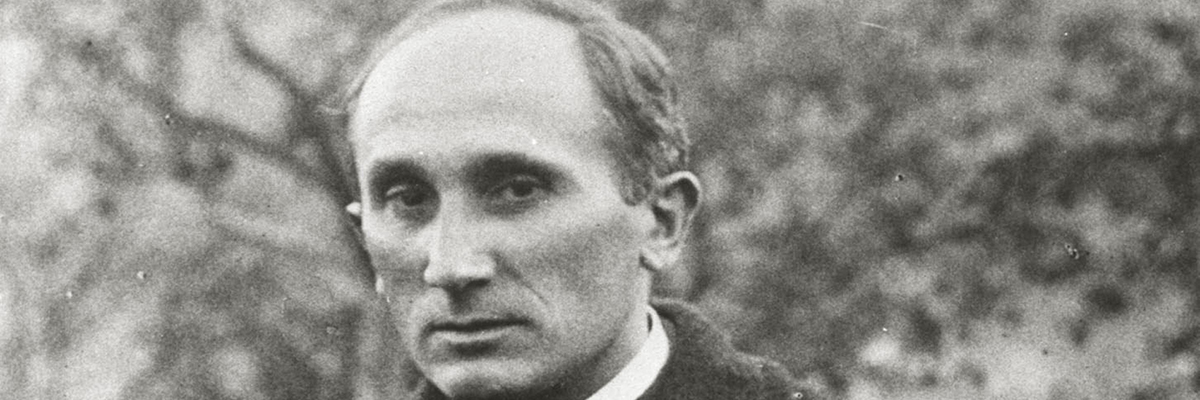
Although his intention was neither that of a professional theologian nor that of a systematic thinker organizing the faith into complete conceptual schemes, it is to Romano Guardini, interested above all as an educator in the formation of an authentic Christian life, that we owe the communication, with rare sensitivity, of the closeness of Jesus Christ to the people of his time. His word, more than proposing a system, sought to make perceptible the concrete presence of Christ in human existence, illuminating the questions, the anxieties, and the choices of daily life.
Particularly significant was his contribution to the renewal of theology through a more faithful and more living interpretation of the datum of Revelation. For Guardini, this renewal calls for constant attention to the exegesis of Sacred Scripture, for a Christological concentration that places Christ once again at the center, and for a profound investigation of the mystery of the human person. In other words, he seeks to unite two requirements: to let Revelation speak with its own density and to understand, in its light, what it means to be human.
Guardini defines his theological research as the effort to attain an overall view of the complexity of Christian existence, which is, above all, human existence. Christianity is not added to life as an external ornament, but touches the very structure of human living, with its limits, its tensions, and its possibilities.
According to Guardini, the human concrete is marked by pairs of opposed and correlative principles: immanence and transcendence, unity and plurality, novelty and continuity, and also nature and grace, world and Christianity, among others. These poles are not defects to be eliminated, nor mere logical contradictions. They describe the way human life actually unfolds: in tension, in search of synthesis, without either side being simply erased.
Upon this observation he grounds his Christian discourse about man. The opposed poles must be acknowledged honestly, not denied. But at the same time they must open to a higher pole, that is, to an instance that does not destroy the tension but makes it habitable and fruitful. For Guardini, that higher pole is God, the supreme opposite and, at the same time, the highest point that makes possible the union of the concrete, its cohesion and its consistency. God, indeed, is not the enemy of the self or of the world. He is the Thou who gives meaning to life and to the world, the foundation in which the human being can reconcile his contradictions without trivializing them.
The Role of Mary in the Mariology of Romano Guardini
Romano Guardini’s book on Mary bears the title Die Mutter des Herrn and consists of a letter written to a friend between 1942 and 1943, published later in 1955. There is also a small book devoted to the Rosary with the title Der Rosenkranz. What follows sets out, in its central points, Guardini’s thought on Mary, with a more developed explication of its scope.
Mary as Fully Human
Guardini presents Mary as a human being like us. He avoids resorting, as habitual and automatic language, to superlatives and exalted formulas that have often been absorbed into the way of speaking, thinking, and feeling whenever Mary is mentioned. For him, such superlatives can arise as much from the enthusiasm of some as from the impatience and rejection of others. In both cases Mary’s figure ends up obscured: either she becomes distant and unrecognizable, or she becomes the occasion of defensive reactions. Guardini prefers, on the contrary, a path of sobriety: to approach Mary through her concrete human reality, without diminishing her greatness, yet avoiding false rhetorical elevations.
Mary’s History Within Revealed History
Mary’s personal and historical story is situated within revealed history. Guardini insists that Revelation is not a mere transmission of abstract ideas. It is a fabric of concrete events and words in which God makes Himself known and acts in history. For this reason, Mary’s life must be understood as part of that living tissue of Revelation: not as an isolated episode, nor as a religious myth, but as a real existence traversed by the divine initiative.
Religious Psychology and Existential Language
In describing Mary and the events that concern her, Guardini masterfully sketches a religious psychology of the Virgin. He seeks to show, with delicacy and precision, how faith takes shape from within, how the soul reacts before the call, how the spiritual life develops when a person is led beyond what she can control. For this reason he draws on existential terms such as drama, tragedy, risk. It is not a matter of dramatizing artificially, but of recognizing that the encounter with God, in concrete history, involves real decisions, interior costs, moments of darkness and of self-surrender.
Mary’s Faith and the Character of the Fiat
Guardini extols above all the faith of Mary. After the Annunciation she places her life within an adventure that is almost impossible by purely human criteria. Her “fiat” is not the simple acceptance of a teaching, as of one who assents to an idea or a thesis. It is, rather, an association with the action of God, a casting of herself into the unknown of an event still entirely to come. In Mary, the act of faith is not a one-time, completed gesture, but the beginning of a journey.
For this reason the Virgin knows a growth in faith and in adherence as the events unfold. And this growth takes place in a special way in her intimate relationship with the Son, a relationship that gradually becomes clearer without ceasing to preserve its character of mystery. Guardini observes that to minimize this process, or to treat it as though Mary had everything fully resolved from the outset, contradicts the data of the Gospel and impoverishes Mary’s own experience. She would cease to be a concrete woman and be transformed into a mythological image, like an ancient mother-goddess figure. For Guardini, this is theologically poor and humanly unreal.
Closeness and Distance Between Mary and Jesus
Faithful to his conception of opposites, Guardini underscores the closeness and the distance between Mary and Jesus. She is the creature closest to the Redeemer, but precisely for that reason she experiences with intensity the insuperable difference between creature and Creator. Guardini speaks of pairs such as creature and Creator, redeemed and Redeemer, saved and Savior. Mary shares much with the Son, yet between them lies a boundary that cannot be crossed: the abyssal opposition between the divine and the human, between God and the creature.
Jesus is the Incomparable One. Mary bears in her own life the weight of that incomparability: to love a Son who is also the Lord, to accompany someone who belongs to her and who at the same time infinitely surpasses her. Yet it is precisely there that her greatness appears: the adherence of faith and of love to the Incomparable One, to the great One who, for her, is also her own Son. Without tiring, she accompanies step by step, with the strength of faith, the path of the Son, whose identity and mission retain an arcane, that is, mysterious character, always greater than any immediate grasp.
Mary as an Inspiring Model for Every Believer
In this constant referring of herself to Christ, who surpasses her and at the same time calls her to an ever greater union and understanding, Mary becomes an inspiring model for every believer. She is not a distant example because of extraordinary privileges taken in isolation, but because of her real humanity and her growing fidelity. For Guardini, it is not miracles, legends, or accessory elements that make her close, but her unshakable faith, ever stronger and more tenacious, which draws her near to Christ and leads her more deeply into the work of Redemption. And this carries particular weight in the present, for in times marked by tensions and contradictions the robustness of faith becomes indispensable.
A Mystery More Alive and Closer to the Human
Seen in this light, Mary expresses a mystery that is more alive, more true, and greater, because it is closer to the human condition illumined and transformed by grace. Her figure, far from fleeing reality, shows what grace can accomplish in a concrete life: not by erasing humanity, but by elevating it, strengthening it, and directing it toward God.
Expanded Outline of the Book “The Mother of the Lord”
The little book is structured as a letter. It is organized between an Exordium and an Epilogue, with five chapters in the central body. The whole has a meditative and pedagogical character: Guardini does not intend merely to inform, but to help the reader understand Mary in a way that is more true, more biblical, and more existential.
Exordium of the Letter
Guardini begins from an observation: some feel perplexity when the use of superlatives in speaking of Mary seems imposed upon them. And it is not only a matter of the superlative of enthusiasm, but also of the superlative of impatience, which, although it seems to move in the opposite direction, is likewise unreliable and equally inadequate to the doctrine of the Church. Guardini acknowledges that from the origins the Church formulated the loftiest affirmations about Mary. Nevertheless, in order to understand them correctly, concrete questions must be posed, questions that arise from the Gospel and from human experience.
He proposes questions such as these: what did Mary live through when, at the hour of the Annunciation, she became the Mother of Jesus? What took place within her during the time she was in physical communion with the Son? What did the descent of the Holy Spirit mean for her? To these questions others are joined concerning Christ Himself: how does He act? How were the fundamental data of human existence manifested in His life? How does He teach, pray, suffer? And further: who is the Spirit? Guardini indicates that the starting point for answering is Sacred Scripture, even though it says relatively little about Mary. Even so, that little is decisive, because it is norm and foundation.
The Outline: History and Setting
Before entering into the episodes, Guardini seeks to place Mary’s person and life journey within the context of the Revelation of the Old Testament. This means situating her in the horizon of the promises, of the messianic expectation, of the figures and the words that prepared the people for the fullness of time. Mary does not appear as an exception outside the history of Israel, but as belonging to a concrete history in which God educates, corrects, guides, and prepares.
The Youth of Mary
Guardini considers Mary’s youth up to the message of the Angel, seeking to understand what may have characterized her ordinary life: silence, prayer, belonging to her people, insertion into a religious environment marked by hope.
He explores Mary’s interior life on the basis of the Magnificat and of her response to the Angel at the Annunciation, showing how Mary’s faith is rooted in the Word and, at the same time, is expressed as a personal decision.
He describes Mary’s form of life according to the canons of the Old Testament, including the waiting for marriage before the Annunciation. The focus is not a minute biographical reconstruction, but an understanding of the way of living proper to that context.
Finally, he addresses the value of virginity, seeking to translate it into the language of contemporary man, without emptying it or reducing it to a merely moral or psychological category.
The Message of the Angel
The angelic message brings the period of Mary’s youth to a close, because it introduces a new stage of existence. Life can no longer simply follow its expected course.
At the hour of the Annunciation, Mary decides to exist on the basis of faith alone. This formulation, in Guardini, underscores that faith is not an ornament but ground: from that moment on, Mary sustains herself on what God promises, even without seeing how everything will come about.
Life with Jesus
Guardini considers how Mary lives the events of Jesus’ early childhood, with their signs of joy and also of disquiet, because the mystery of the Son manifests itself in a surprising way.
He examines how Mary passes through the public activity of Jesus, a time in which affective closeness coexists with a growing distance, not out of coldness, but because of the singular mission of the Son.
He reflects on the meaning of Pentecost for Mary, as the moment in which the presence of the Spirit illumines and confirms, in a new way, the meaning of all that had been lived.
The Time After Jesus’ Return to Heaven
Guardini starts from the sober datum of the Gospel: the disciple took her into his own home, and Mary was present among the Apostles at Pentecost. He respects that limit and avoids filling the gaps with fantasy.
The event of Pentecost is treated as decisive: not only as a fact of the nascent Church, but as a moment that profoundly touches Mary.
Within this horizon, Mary receives clarity about the Son: He was true man and true Son of God. And she also receives clarity about herself and about her position in relation to Him. This is an understanding that matures within faith and under the action of the Spirit.
As for Mary’s death and her glorification, Guardini recalls that the dogma brings to consciousness the truth about the whole human being and about his eschatological destiny. Mary’s glorification points to the final meaning of human history when it is reached and transfigured by God.
The Presupposition
The central question is taken up again: how was all this possible in Mary? Guardini points out that the authentic answer is found in the concept of grace. God granted her to stand firm within the immense, that is, to sustain an existence that surpasses common measures.
For this reason, everything in Mary is a gift of grace. It is not a matter of denying her freedom, but of recognizing that God’s initiative precedes, sustains, and guides, and that Mary responds with a real, concrete, and persevering fidelity.
Epilogue
Guardini concludes by contemplating Mary as the Woman of the Apocalypse, a sign of salvation in a world in danger. This final image does not seek to remove Mary to an abstract plane, but to set her forth as an eschatological sign, that is, as a living promise that human history has a meaning and a term in God. In times of threat and insecurity, Mary appears as a sign of protection and of hope, not out of sentimentalism, but because the grace that triumphs in her points to the salvation offered to all.
Conclusion
A reading of the anthropology and the Mariology of Romano Guardini reveals a profound unity between his understanding of the human being and his contemplation of the mystery of Mary. In both fields, Guardini refuses simplifications, rigid schemes, and abstract idealizations. His thought is born of attention to concrete existence, marked by tensions, opposites, and risks, and it finds in God not the negation of that reality, but the higher point that confers on it meaning, cohesion, and consistency.
Guardini’s Mariology, in particular, is inserted organically into his Christian vision of man. Mary does not appear as a mythological figure or as an exception detached from the human condition, but as a real woman, situated within the history of Revelation and called to walk, in a singular way, the path of faith. Her greatness does not reside in rhetorical superlatives or in isolated privileges, but in the fidelity with which she welcomes and accompanies the action of God, remaining open to the mystery even when it shows itself obscure and demanding.
By highlighting the progressive character of Mary’s faith, Guardini restores to her human density and theological force. The Virgin does not live from a full and immediate understanding, but grows in adherence, learns in silence, suffers the distance between creature and Creator, and sustains with perseverance the paradoxical closeness to the Son who is at the same time Lord. This tension, far from diminishing her, constitutes the core of her vocation and manifests the way grace acts without suppressing humanity.
In this sense, Mary becomes an eminent model for every believer. Not because she is unattainable, but precisely because she is close. Her life shows that authentic faith does not eliminate the drama of existence, but passes through it, entrusting itself to the fidelity of God. In a time marked by contradictions, uncertainties, and spiritual fragility, the figure of Mary, as presented by Guardini, emerges as a luminous sign of a robust, sober, and persevering faith, capable of sustaining human life in all its complexity.
Thus the Mariology of Romano Guardini not only enriches theological reflection, but offers a spiritual horizon in which the human and the divine meet without confusion or separation. Mary, woman of faith, remains a living testimony that grace does not draw one away from reality, but transforms it from within, directing it toward its fullness in God.
To deepen the role of Mary in the economy of salvation, the encyclical Redemptoris Mater of John Paul II offers a magisterial synthesis that converges with the theological aims of Romano Guardini.
Deepen your studies: explore Mariology, Marian theology, Marian apparitions, and the Postgraduate Program in Mariology.
Postgraduate Program in Mariology
Would you like to deepen your formation in Mariology? Discover the Postgraduate Program in Mariology of Locus Mariologicus – an academic formation that unites theological rigor, spiritual life, and the living tradition of the Church.
Would you like to study Mariology seriously?
This article is born of the works in the library of Locus Mariologicus. The Postgraduate Program in Mariology takes you to the same source, with academic guidance: Scripture, the Fathers of the Church, and the Magisterium, from the first dogma to contemporary questions.




Responses