Confide fili: the paralytic, forgiveness, and Mary who presents sinners
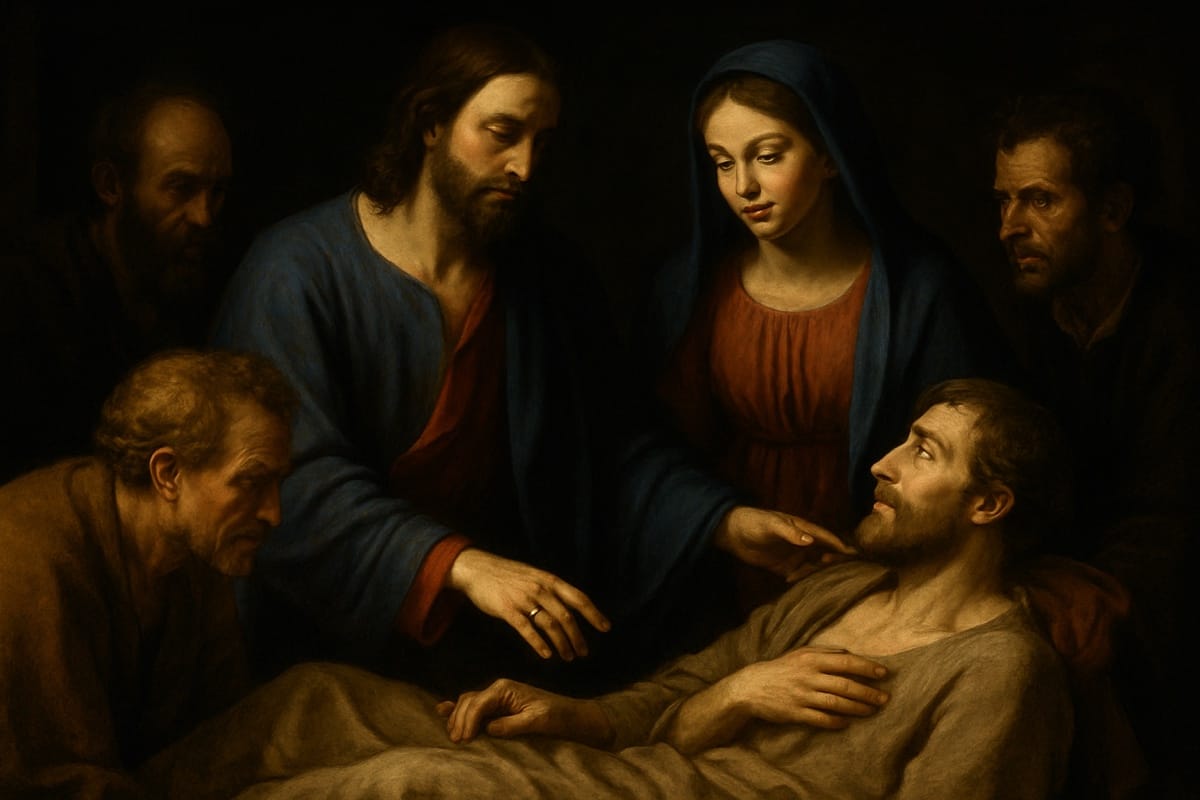
Et videns Iesus fidem illorum, dixit paralytico: Confide, fili, remittuntur tibi peccata tua.
Mt 9:2
The healing of the paralytic (Mt 9:1-8) is the first episode of the second sequence of miracles in Matthew (chapter 9) and one of those that open up the most radical question of Jesus’ ministry: His authority to forgive sins. “Who can forgive sins but God?” (Mt 9:3, implicit in the scribes’ accusation of blasphemy) is the right question, and the answer is the visible demonstration that the one who made the paralytic walk also has the invisible power to forgive. The physical healing is the sign that makes verifiable what cannot be directly verified: the forgiveness of sins.
Matthew narrates this episode with a remarkable economy of words. Luke (Lk 5:17-26) and Mark (Mk 2:1-12) describe the friends who opened a hole in the roof to lower the paralytic, an image of bold faith that Matthew omits in order to focus on the essential: “seeing their faith” (Mt 9:2), Jesus responds. The faith that Jesus “saw” is the faith of those who carried the paralytic; nothing is said explicitly about the faith of the paralytic himself. This detail is theologically precious: the healing and forgiveness of the paralytic were mediated by the faith of others who presented him to Jesus. Intercession, bringing others into Jesus’ presence, is a condition of healing.
I. “Seeing their faith”: the intercession that heals
“Videns fidem illorum”, “having seen their faith” (in the plural), is one of the most remarkable formulations in the Gospels regarding intercession. Jesus did not ask the paralytic whether he believed. He did not examine his spiritual state before intervening. He saw the faith of those who were carrying him, and He acted. The structure of the scene is that of pure intercession: someone in need, unable to present himself on his own, carried by others who believe, and presented to the Healer, who responds to the faith of those who present him.
This structure is the theological model of Marian intercession. Mary does not replace the penitent’s faith; she cannot believe for anyone else. But she can “carry” those who, through spiritual weakness, the paralysis of sin, or distance from the faith, are unable to present themselves to the Son on their own. “They have no wine” (Jn 2:3) is the canonical formula of this intercessory presentation: Mary presents to the Son the needs of those who cannot present themselves, or do not know how. Like the paralytic’s friends, Mary “carries” to Jesus those whom their own weakness prevents from walking.
The theology of the “intercession of the saints” finds a solid Gospel foundation in this episode. If Jesus responded to the faith of the paralytic’s friends, then the structure of divine action includes the mediation of others’ faith as a condition of benefit for the sick person. This does not mean that God is unable to act without mediation: as we saw with the centurion (Mt 8:8), He can act at a distance without visible intercession. But the scene of the paralytic reveals another possibility: that the faith of the one who intercedes can be the path by which grace reaches someone who lacks sufficient faith to walk to the Healer.
The communal dimension of this intercession is also relevant: “their faith” is shared faith, not individual faith. The body of Christ, the Church, is the space where the faith of some carries the weakness of others. The intercessory prayer that the community offers for its sick or absent members is the ecclesial equivalent of the paralytic’s friends: bringing to Jesus, through prayer and presence, those whose own condition prevents them from getting up and walking.
II. “Your sins are forgiven”: the scandal of priority
Jesus’ response to the paralytic is unexpected: not “rise and walk” but “your sins are forgiven” (Mt 9:2). The physical healing comes afterward, as a response to the scribes’ scandal. This order of priorities, first forgiveness and then healing, reveals what Jesus considers most urgent: not the paralytic’s physical suffering (real and visible) but his spiritual condition (invisible). The forgiveness of sins is the deepest healing. The use of his legs is the sign of this deeper healing.
“Some of the scribes said to themselves: This man is blaspheming” (Mt 9:3). The accusation is technically correct within the Jewish theological framework: only God can forgive sins (because sins are offenses against God, and only the offended party can forgive). What the scribes fail to see is that the premise of their accusation confirms what Jesus is asserting: if only God can forgive, and Jesus forgives, then either Jesus is blaspheming or Jesus is God. The scribes chose the first option. The Church, taught by the Risen One, chose the second.
“That you may know that the Son of Man has power on earth to forgive sins, He says to the paralytic: Rise, take up your bed and go home” (Mt 9:6). The physical healing is an apologetic demonstration of the invisible forgiveness. Jesus uses the verifiable (the paralytic walking) as proof of the unverifiable (forgiveness). This structure, the visible as a sign of the invisible, is the sacramental structure: baptismal water as the sign of baptismal grace, bread and wine as the sign of the Eucharistic presence, spoken absolution as the sign of sacramental forgiveness.
In the patristic tradition, the Sacrament of Reconciliation is the New Testament counterpart of this healing of the paralytic. Ambrose of Milan and Augustine of Hippo developed a reading of the healing of the paralytic as a type of the sacrament of penance: the “paralysis of sin” that prevents one from walking spiritually; the presentation to the Healer through the mediation of those who carry the penitent (the community, the Church); and the twofold gift of forgiveness and of the ability to walk once more in the Christian life.
III. “Confide, fili”: the tenderness of forgiveness
“Courage, son” (Mt 9:2, “tharsei, teknon”): before speaking of forgiveness, Jesus addresses the paralytic with an expression of tenderness and encouragement. “Teknon” (“son”, “child”) is a form of affectionate address that evokes the relationship between parent and child. Jesus does not forgive coldly, like a judge handing down a sentence of acquittal. He forgives with the tenderness of one who knows the weight of what the paralytic has borne. “Courage” is not an appeal to willpower: it communicates that the situation has changed, that what seemed impossible is now happening.
This tenderness of forgiveness is one of the less visible but more important aspects of Matthew’s soteriology. Salvation is not a cold transaction between a defendant and a court; it is the restoration of a relationship between father and son. “Courage, son” evokes Luke’s parable of the prodigal son, in which the father runs to meet his son before the son has finished his speech of repentance. Jesus’ forgiveness comes before the paralytic has given any account of himself: we do not know whether he confessed himself a sinner, nor whether he promised to amend his life. Jesus forgave because He saw the faith of those who presented him.
Marian devotion to the Sacred Heart of Jesus finds in this “Confide, fili” one of its favorite texts: the heart that Jesus offers is not the heart of an indifferent judge but the heart of one who says “courage, son” to the human being who has been carried to Him. Mary, who knew this heart more closely than anyone else, who carried Him in her womb, who fed Him, who accompanied Him on Calvary, is the one who, through her intercession, can lead her spiritual children to experience the “Confide, fili” that she herself heard throughout her whole life.
“Refugium Peccatorum”, Refuge of Sinners, is the Marian title that captures this aspect of her intercession on behalf of those who bear the weight of sin. Mary is the refuge: not forgiveness itself (which is Christ’s gift in the sacrament) but the welcoming space where sinners find the security to let themselves be “carried” to Jesus. Like the paralytic’s friends, who did not leave their friend abandoned in his paralysis, Mary does not abandon her children in their helplessness: she presents them to the Son, who has power to forgive and to make them walk.
IV. The crowd that glorified God: the fruit of forgiveness
“When the crowds saw this, they were filled with fear and glorified God, who had given such power to men” (Mt 9:8). The episode ends not with the joy of the man who was healed but with the collective glorification of God. The healing of one man has an effect on the community: the witness of forgiveness and healing becomes a reason for praise for those who behold it. Salvation is not a private event between Jesus and the paralytic: it overflows to the community, which glorifies the God who “gave such power to men”.
The phrase “gave such power to men” (Mt 9:8) is ecclesiological: Matthew does not say merely “to Jesus” but “to men”. This extension of the power to forgive to human beings anticipates Mt 18:18 (“whatever you bind on earth shall be bound in heaven”) and Jn 20:23 (“the sins you forgive are forgiven”). The power to forgive that Jesus demonstrated in healing the paralytic was handed on to the Church, and it is in this handing on that the Sacrament of Reconciliation finds its direct theological foundation.
Mary’s role in the ecclesial dimension of forgiveness is that of the one who was the first to experience the “remission of sins” in the broadest sense: the preservation of the Immaculate One and the redemptive work of the Son who was born of her are the sources of the sacrament that the Church administers. When Mary intercedes for penitents in the Sacrament of Reconciliation, through the Rosary prayed before confession, or through the veneration of Our Lady of Perpetual Help as an icon of mercy, she does not compete with Christ, but presents to the Son those whom their spiritual paralysis prevents from making their own way to the confessional.
Postgraduate Program in Mariology
Would you like to deepen your formation in Mariology? Discover the Postgraduate Program in Mariology of Locus Mariologicus, an academic formation that unites theological rigor, spiritual life, and the living tradition of the Church.
Would you like to study Mariology seriously?
This article grows out of the works in the Locus Mariologicus library. The Postgraduate Program in Mariology takes you to the same source, with academic guidance: Scripture, the Fathers of the Church, and the Magisterium, from the first dogma to contemporary questions.




Responses