Ego autem dico vobis non resistere malō: Mary and the Meekness of the Wounded Heart

Ego autem dico vobis non resistere malo: sed si quis te percusserit in dexteram maxillam tuam, praebe illi et alteram.
Mt 5:39
The fourth antithesis of the Sermon on the Mount, “You have heard that it was said: an eye for an eye and a tooth for a tooth. But I say to you: do not resist the one who is evil” (Mt 5:38-39), is one of the most radical and most debated in the entire New Testament. Jesus did not abolish the law of talion, which in its origin was a norm of proportionality that set limits on vengeance, but proposed a way of surpassing it that goes to the root: the disciple of the Kingdom refuses the logic of retaliation, not because he is incapable of defending himself, but because he chooses a different response. The Greek word anthistemi (“to resist,” “to oppose”) that Jesus uses describes the kind of opposition that reproduces the violence of the aggressor. What Jesus rejects is not every response to evil, but the response that perpetuates the cycle.
The four examples Jesus gives—the slap on the right cheek, the lawsuit for one’s cloak, the demand to go one mile, the request for a loan—are situations of humiliation, exploitation, and coercion that first-century Galilean listeners would have recognized. The slap on the right cheek in particular was, in Middle Eastern culture, the gesture of utmost humiliation, delivered with the back of the left hand. “Turning the other cheek” is not passive submission: it is a gesture that refuses humiliation without resorting to violence. This subversive wisdom—responding to evil in an unexpected way that unsettles the aggressor without imitating his violence—is the heart of Jesus’ antithesis.
I. Meekness as Self-Mastery
The patristic and scholastic tradition interpreted this commandment as an expression of the virtue of mansuetudo, meekness, which is not the absence of emotion but the mastery of anger by reason enlightened by grace. Augustine of Hippo argued that the commandment to “turn the other cheek” is primarily an interior disposition: the Christian may defend himself and defend others, but he must not be governed by the desire for revenge or by resentment. What Jesus forbids is not self-defense, but the eye-for-an-eye logic that makes the victim the equal of the aggressor.
Thomas Aquinas, in the Summa Theologiae (II-II, q. 157), carefully distinguished between iracundia vitiosa (the anger that seeks retaliation) and mansuetudo (which governs anger according to justice and love). The meek man is not the one who feels no anger: he is the one who is not enslaved by anger. This interior freedom—not being determined by the behavior of another, not being dragged into the spiral of violence—is one of the most profound forms of spiritual sovereignty that the Gospel proposes. The disciple who “turns the other cheek” shows that the aggressor does not have the power to dictate his reaction.
Francis de Sales, in the Treatise on the Love of God, called meekness “the queen of the virtues” precisely because it demands the most difficult mastery of all: mastery of oneself. In Francis’s Letters we find a concrete pedagogy of everyday meekness: the cutting word answered with gentleness, the aggressive gesture received with patience, the injustice borne without bitterness. This pedagogy is not Stoicism; it is the fruit of love, of the recognition that the aggressor, too, is a child of God and that love can transform him where retaliation only hardens him.
II. Mary at the Foot of the Cross: The Face That Does Not Turn Away
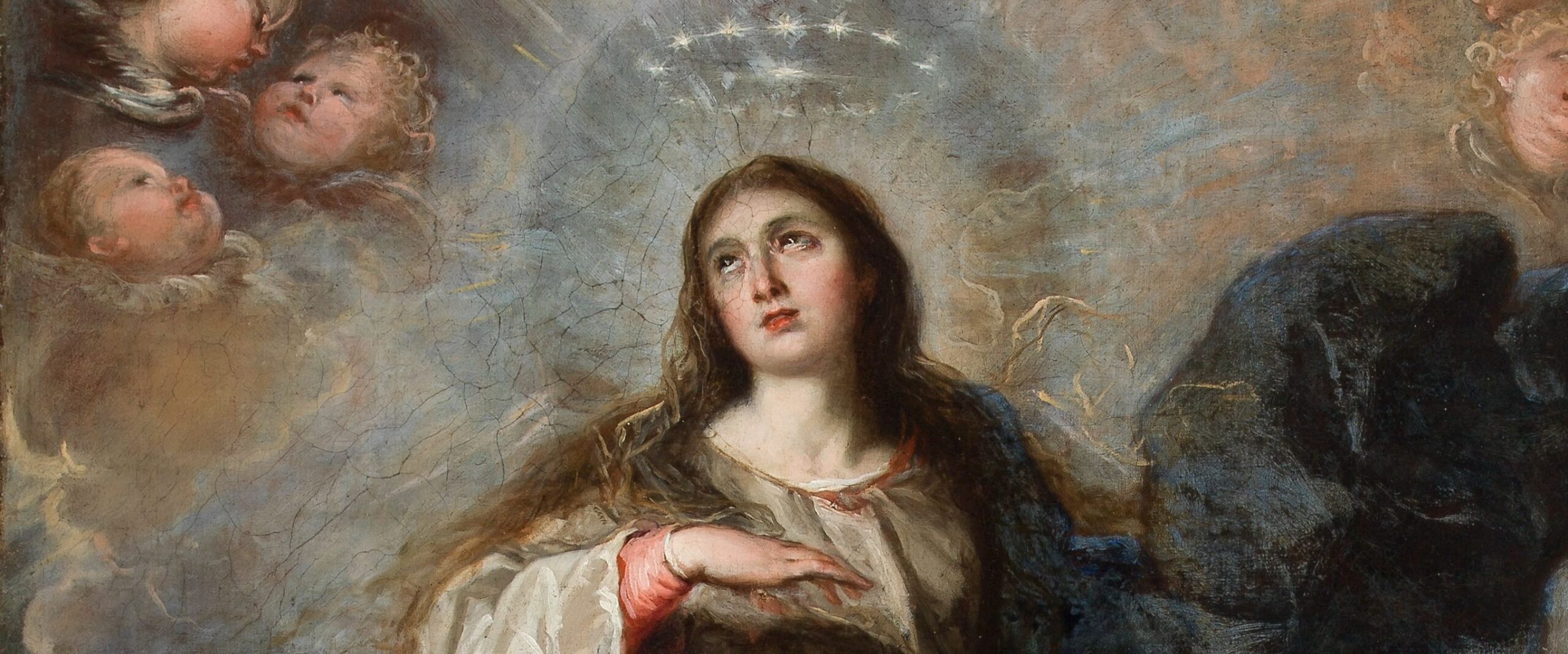
The most perfect fulfillment of this commandment in the Christian tradition is Mary beneath the Cross. Simeon had prophesied: “A sword will pierce your soul” (Lk 2:35). Throughout the public ministry, when Jesus’ relatives thought that “he was beside himself” (Mk 3:21), and when the crowd called for the crucifixion, Mary did not respond with bitterness or accusation. On Calvary, while the disciples fled, Mary stayed: “Standing by the Cross of Jesus was his mother” (Jn 19:25). This silent fidelity is love’s way of “turning the other cheek.”
The theology of Mary’s compassio, her co-suffering with Christ, is not passive sorrow: it is active participation in the redemptive mystery through a love that did not harden in the face of evil. The Marian tradition has contemplated Mary on Calvary as the one in whom Jesus’ commandment was fulfilled in an unsurpassable way: she witnessed the unjust death of her Son without uttering a curse, without demanding immediate justice, without withdrawing. This meekness was not indifference to suffering; it was love that remained faithful in spite of suffering, love that did not allow sorrow to turn into hatred.
John Paul II, in Salvifici Doloris (1984), reflected on suffering accepted with love as a participation in the Redemption. Mary is the paradigmatic figure of this “redemption of suffering”: her not resisting the sword that pierced her soul was not fatalistic resignation, but a theological act of trust in the Father. This trust did not eliminate the suffering; it transfigured it into participation in the saving mystery. Mary’s meekness on Calvary is therefore not merely a moral example but a soteriological reality: she who did not resist evil shared in Christ’s definitive victory over evil.
III. Breaking the Cycle of Violence
The theologian René Girard, in his analysis of sacrificial violence, showed that all violence has a mimetic structure: the victim tends to imitate the aggressor, becoming violent in turn in an endless spiral. Jesus’ commandment, “do not resist the one who is evil,” is, within this framework, the decisive break in the mimetic cycle. The disciple who refuses to imitate the aggressor’s violence interrupts the spiral. The victim who forgives dismantles the mechanism of collective vengeance. The Cross of Christ is, for Girard, the moment in which this cycle is exposed and broken once and for all: the innocent victim who forgives (“Father, forgive them,” Lk 23:34) reveals and undoes the perverse logic of violence.
Mary, present at the foot of the Cross, is witness to and participant in this break. She who did not demand vengeance, who did not nurture resentment, who remained silent when the cycle of violence threatened to swallow her up—she is the image of the community of disciples that chooses the logic of forgiveness instead of the logic of retaliation. Paul sums up this principle: “Do not be overcome by evil. On the contrary, overcome evil with good” (Rom 12:21). This is the law of Calvary, of which Mary was the first and most complete disciple.
In the daily life of the Christian, this commandment translates into concrete decisions: the offensive word that is not answered with another offense, the contempt that is received with equanimity, the injustice that is borne without nurturing resentment. These are the “slaps on the right cheek” of ordinary life, and offering them “the other cheek” is the most common, most difficult, and most fruitful way of living the Gospel. Mary, who “kept in her heart” without growing bitter, is the model of this silent pedagogy of meekness that the Sermon on the Mount proposes for every day.
IV. Meekness, Justice, and Mercy
A frequent objection to Jesus’ commandment is that it would be incompatible with the demands of justice. If I do not resist evil, do I not become an accomplice to injustice? This objection confuses two distinct planes. The meekness Jesus speaks of is an interior disposition—not seeking revenge, not being governed by resentment—and it is not incompatible with just action in defense of the innocent. Jesus Himself “resisted” the merchants in the Temple (Jn 2:15). Paul invoked his rights as a Roman citizen (Acts 25:11). Meekness is not social passivity: it is the absence of vengeful anger as the driving force of action.
The tradition of nonviolent resistance, of which Gandhi and Martin Luther King are the modern icons, has shown that it is possible to resist injustice effectively without reproducing the logic of violence. This secular tradition has deep roots in the Sermon on the Mount, even if it does not always acknowledge this. The “force of truth” (satyagraha) that Gandhi set against the British Empire is, in the final analysis, the same logic that Jesus proposes: not the annihilation of the adversary, but his transformation by the power of a love that remains faithful.
Mary is the model of this active meekness: she who served Elizabeth “with haste,” who interceded at Cana, who remained in prayer in the Upper Room, was not a passive figure. Her meekness was that of a wholly free person, governed not by fear or by anger, but by love. This interior freedom, which the commandment “do not resist evil” paradoxically produces, is the highest form of spiritual strength that the Gospel proposes, and the ripe fruit of a life directed toward God.
Postgraduate Program in Mariology
Would you like to deepen your formation in Mariology? Discover the Postgraduate Program in Mariology of Locus Mariologicus, an academic formation that unites theological rigor, spiritual life, and the living tradition of the Church.
Would you like to study Mariology seriously?
This article grows out of the works in the Locus Mariologicus library. The Postgraduate Program in Mariology takes you to the same source, with academic guidance: Scripture, the Fathers of the Church, and the Magisterium, from the first dogma to contemporary questions.




Responses