The Magnificat: The Canticle of Mary (Lk 1:46-55), Structure and Meaning
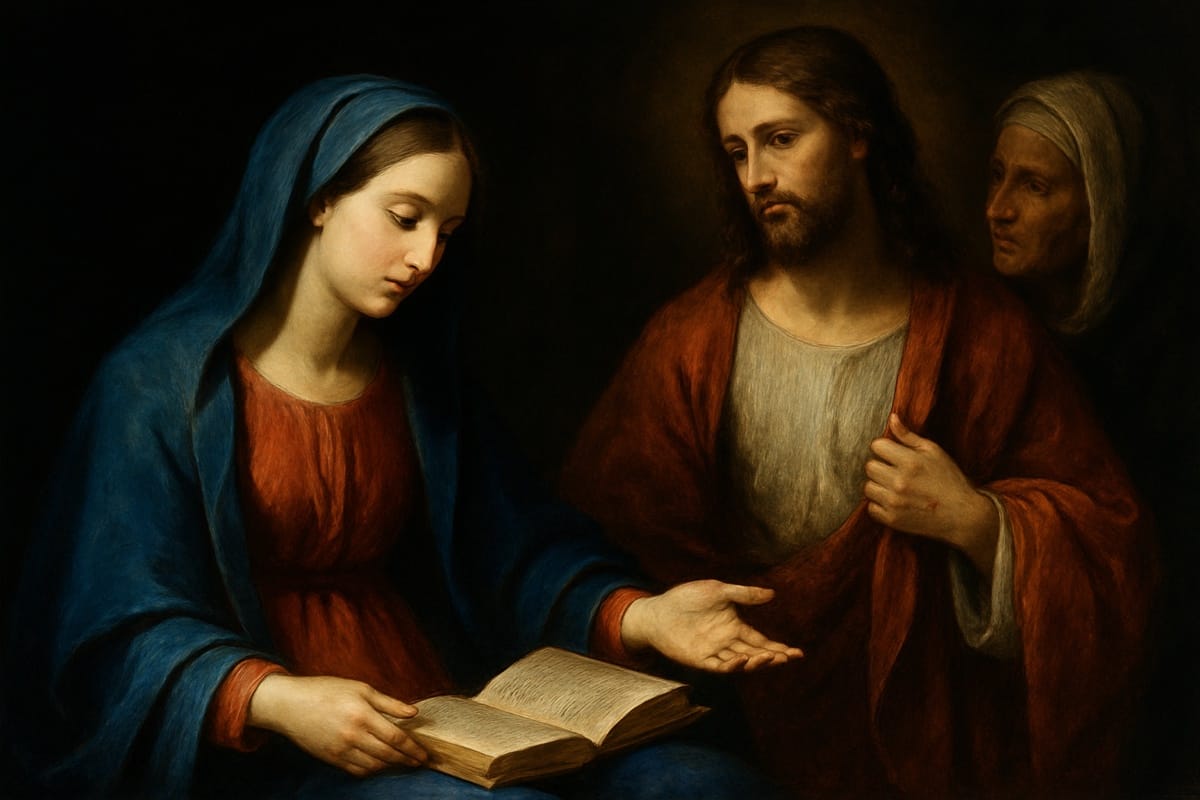
The Magnificat is the canticle of praise that Mary sings when she visits her kinswoman Elizabeth (Lk 1:46-55). Beginning with the words “My soul magnifies the Lord” (in Latin, Magnificat anima mea Dominum), it is Mary’s longest discourse in the Gospels and one of the densest texts in all of Scripture. The Church prays it every evening at Vespers in the Liturgy of the Hours. This guide explains its structure, its themes, and its meaning.
The canticle (Lk 1:46-55)
Mary proclaims: “My soul magnifies the Lord and my spirit rejoices in God my Savior, for He has looked upon the lowliness of His handmaid… The Mighty One has done great things for me… His mercy extends from generation to generation… He has cast down the mighty from their thrones and exalted the humble; He has filled the hungry with good things and sent the rich away empty.”
The structure of the Magnificat
The canticle unfolds in three great movements:
- Personal praise (vv. 46-50) – Mary praises God for what He has done in her, “looking upon the lowliness of His handmaid.”
- The great reversal (vv. 51-53) – God casts down the mighty and exalts the humble, fills the hungry and sends the rich away. It is the announcement of an overturning in history.
- Fidelity to Israel (vv. 54-55) – God fulfills the promise made to Abraham and to his descendants.
A canticle that comes from the Scriptures
The Magnificat is woven from Old Testament quotations. Its closest model is the canticle of Hannah, the mother of Samuel (1 Sam 2:1-10), but it also echoes the Psalms and the Prophets. Mary thus appears as the voice that gathers up all the hope of Israel and brings it to its fulfillment – the true “poor one of the Lord” (anawim) who expects everything from God. It is the natural continuation of the “yes” she pronounced at the Annunciation.
The central themes
- Humility exalted – God “has looked upon the lowliness (tapeínosis) of His handmaid.” It is not Mary’s greatness that draws God, but her trusting littleness.
- The option for the poor – the Magnificat announces a God who does justice to the humble and the hungry. For this reason it is, down through the centuries, the canticle of those who await liberation.
- Faithful mercy – God is faithful to His covenant “from generation to generation.”
Frequently Asked Questions
When is the Magnificat prayed?
Daily at Vespers (evening prayer) in the Liturgy of the Hours, and on the feast of the Visitation (May 31).
Why is it called “Magnificat”?
It is the first word of the canticle in the Latin version: Magnificat anima mea Dominum (“My soul magnifies the Lord”).
Where is the Magnificat in the Bible?
In the Gospel of Saint Luke, chapter 1, verses 46 to 55, during Mary’s Visitation to Elizabeth.
See also
Would you like to study Mariology seriously?
This article grows out of the works in the Locus Mariologicus library. The Postgraduate Program in Mariology takes you to the same source, with academic guidance: Scripture, the Fathers of the Church, and the Magisterium, from the first dogma to contemporary questions.





Responses