Non veni solvere sed adimplere: Mary and the Perfect Fulfillment of the Law
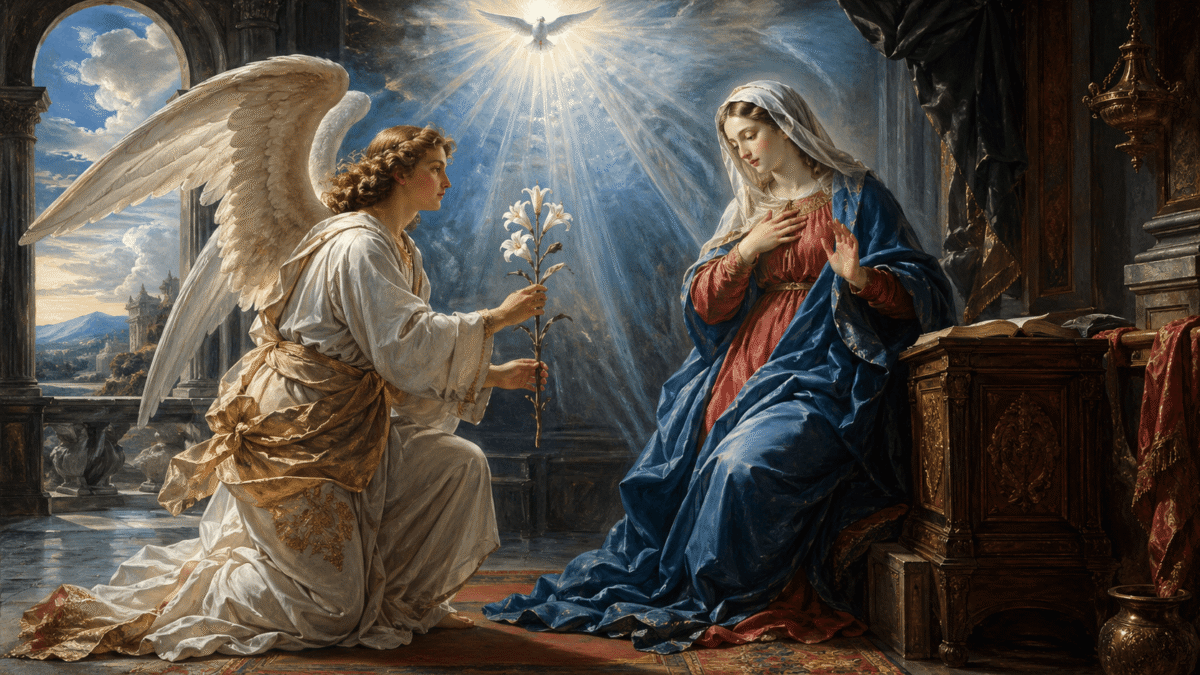
Nolite putare quoniam veni solvere legem aut prophetas: non veni solvere sed adimplere.
Mt 5:17
Non Veni Solvere: Mt 5:17-19 is one of the most debated texts of the Sermon on the Mount: “Do not think that I have come to abolish the Law or the Prophets. I have not come to abolish, but to fulfill. Truly I say to you: until heaven and earth pass away, not one iota or one single stroke will pass from the Law until all is accomplished.” Jesus’ declaration is deliberately set in continuity with the tradition of Israel: He is not a “destroyer” of the Law, but its “fulfiller” (plêrôsai). This position has direct Mariological implications: Mary, who lived her whole life as a faithful daughter of Israel under the Mosaic Law, is the creature who most perfectly and completely “fulfilled” the Law, not as legalistic observance, but as love for the God who gave it.
I. “Adimplere”: Fulfillment as Fullness
Christ’s Non Veni Solvere finds its clearest application in Mary.
The Greek verb plêroô (to fulfill, to complete, to fill to fullness) has a richer meaning than the Portuguese “cumprir” suggests. It is not merely “to obey” or “to carry out”; it is “to bring to its fullness,” “to realize the full potential of.” Jesus does not “fulfill” the Law in the sense of obeying it punctiliously; He “fulfills” it in the sense of revealing it in its deepest intention, of freeing it from the interpretations that had reduced it to a code of rules, and of raising it to the level of the perfect love that was its original aim. The Law that forbade murder is “fulfilled” when the heart is set free from anger (Mt 5:21-22). The Law that regulated oaths is “fulfilled” when the human word is absolutely trustworthy (Mt 5:33-37).
This theology of “fulfillment,” in which the higher does not abolish the lower but raises it to its own fullness, is structurally analogous to the relationship between Mary’s humanity and divine grace. Mary was not sanctified by “abolishing” her humanity or her belonging to Israel; she was sanctified by “fulfilling” her humanity, raising it to the highest degree of readiness for God. Mary’s “fiat” was not the abolition of her human will; it was its fullest “fulfillment”: the human will that, instead of closing in on itself, opens itself completely to the divine will and, in that openness, finds its fullness.
The exegesis of Mt 5:18, “Until heaven and earth pass away, not one iota or one single stroke will pass from the Law until all is accomplished,” has been debated among exegetes: does it refer to the iota and the stroke of the letter of the Mosaic Law, which would then remain definitively valid until the end of time? Or does it refer to the “fulfillment” of the whole Law in Jesus, which makes literal observance obsolete in favor of the observance of love? Tradition has opted for a reading that integrates the two: the “intention” of the Law is absolutely permanent (love of God and of neighbor), but its “form” (the ritual and ceremonial precepts) has found its “fulfillment” in Christ and need not be observed literally by Christians.
The position of Mt 5:17-19 within the Sermon on the Mount is significant: it comes after the Beatitudes and the image of salt and light, and before the six “antitheses” (Mt 5:21-48: “You have heard that it was said… But I say to you”). This “hinge” position indicates that Jesus’ “fulfillment” of the Law is not an abstract theoretical stance; it is the foundation of the antitheses that follow, in which Jesus radicalizes the precepts of the Law by taking them to the level of the heart and of interior intention.
II. Mary, Faithful Daughter of Israel under the Law
Christ’s Non Veni Solvere finds its clearest application in Mary.
The historical Mary lived her whole life within the framework of the Mosaic Law. The Gospel of Luke documents this at several points: the Circumcision of Jesus on the eighth day (Lk 2:21: “according to the Law”), the Presentation in the Temple and Mary’s purification forty days after the birth (Lk 2:22-24: “according to the Law of Moses”), and the annual pilgrimage to Jerusalem for Passover (Lk 2:41: “according to the custom of the feast”). Mary did not “abolish” the Law; she lived it faithfully, as the daughter of Israel that she was.
But Mary’s fidelity to the Law was not legalism; it was love. The distinction between “legalism” (observing the Law out of fear or mere social conformity) and “love” (observing the Law because the Law expresses the will of the God whom one loves) is the heart of biblical spirituality. The Prophets (Jeremiah, Ezekiel) announced a “new covenant” in which the Law would be written “on hearts” (Jer 31:33) and not only on tablets of stone: an interior observance, motivated by love, not by fear. Mary realized this prophetic ideal: her fidelity to the Law was a fidelity of the heart, not of the letter.
The doctrine of the Immaculate Conception, dogmatically defined by Pius IX in 1854, has a dimension that sheds light on Mary’s relationship with the Law: Mary was preserved from original sin, which means that her relationship with God was not distorted by the inclination to evil (concupiscentia) that sin brought in. In this sense, Mary “fulfilled” the Law without the interior conflict that Paul describes in Rom 7:14-23 (“the good that I want to do, I do not do; the evil that I do not want, that is what I do”). For Mary, fulfilling the Law was the natural expression of a heart that loved God without reserve, not a battle against her own inclinations.
This perfect fulfillment of the Law by Mary is not a source of pride or self-sufficiency; it is a gift of God, the grace that prepared her to be the Mother of the Messiah. The Church understands the Immaculate Conception not as a merit of Mary, but as a grace granted in anticipation of the merits of Christ: Mary was saved by the same Christ whom she would bear, but “before” His historical coming, by the anticipated effect of the Redemption. In this sense, the “perfection” of Mary’s obedience to the Law is not her own; it belongs to Christ, who dwelt in her and prepared her from the first instant of her existence.
III. The “Iotas” of Fidelity: Fidelity in Small Gestures
Christ’s Non Veni Solvere finds its clearest application in Mary.
The reference to the “iota” (iôta, the smallest letter of the Greek alphabet, corresponding to the Hebrew “yod,” a small comma in the text) is an image of fidelity in details. Jesus values fidelity “in the least things,” in contrast with the human tendency to care only about great principles while neglecting small details. The spiritual tradition (in particular Ignatian spirituality and the “little way” of Thérèse of Lisieux) developed this intuition: holiness shows itself primarily in small everyday gestures, not in great heroic deeds.
Mary is the model of this fidelity in the “iotas”: what the Gospels record of her life are not great speeches or spectacular deeds, but everyday gestures of fidelity: her readiness before the angel (Lk 1:38), her haste to serve Elizabeth (Lk 1:39), her “keeping” in her heart the words she did not fully understand (Lk 2:19, 51), her discreet intercession at Cana (Jn 2:3). These “iotas” of fidelity are the real fabric of Marian holiness, more than any extraordinary vision or privilege.
The spirituality of “little acts done with great love,” which Thérèse of Lisieux systematized as the “way of spiritual childhood,” has its roots in Mt 5:18 and in the model of Mary. Spiritual greatness is measured not by how spectacular our acts are, but by the depth of the love with which ordinary acts are performed. In the logic of the Gospel, an “iota” of love is worth more than great gestures performed without love. Mary, who sewed, who cooked, who lived the ordinary life of Nazareth with the fullness of love, is the living confirmation of this logic.
Mary, who did not “abolish” the Law of Israel but “fulfilled” it down to the last “iota” with the whole of her love, is the icon of the fidelity that is measured not by the spectacular but by the depth of the heart that loves the God who gave us the Law of life.
References
- Second Vatican Council, Lumen Gentium, no. 56 (1964).
- Pius IX, Ineffabilis Deus (1854): the dogma of the Immaculate Conception.
- U. Luz, Das Evangelium nach Matthäus, vol. I (1985).
- J. Meier, Law and History in Matthew’s Gospel (1976).
Postgraduate Program in Mariology
Would you like to deepen your formation in Mariology? Discover the Postgraduate Program in Mariology of Locus Mariologicus — an academic formation that unites theological rigor, spiritual life, and the living tradition of the Church.
Would you like to study Mariology seriously?
This article grows out of the works in the Locus Mariologicus library. The Postgraduate Program in Mariology takes you to the same source, with academic guidance: Scripture, the Fathers of the Church, and the Magisterium, from the first dogma to contemporary questions.



Responses