Sit sermo vester est, est: Mary and the Word That Does Not Fail
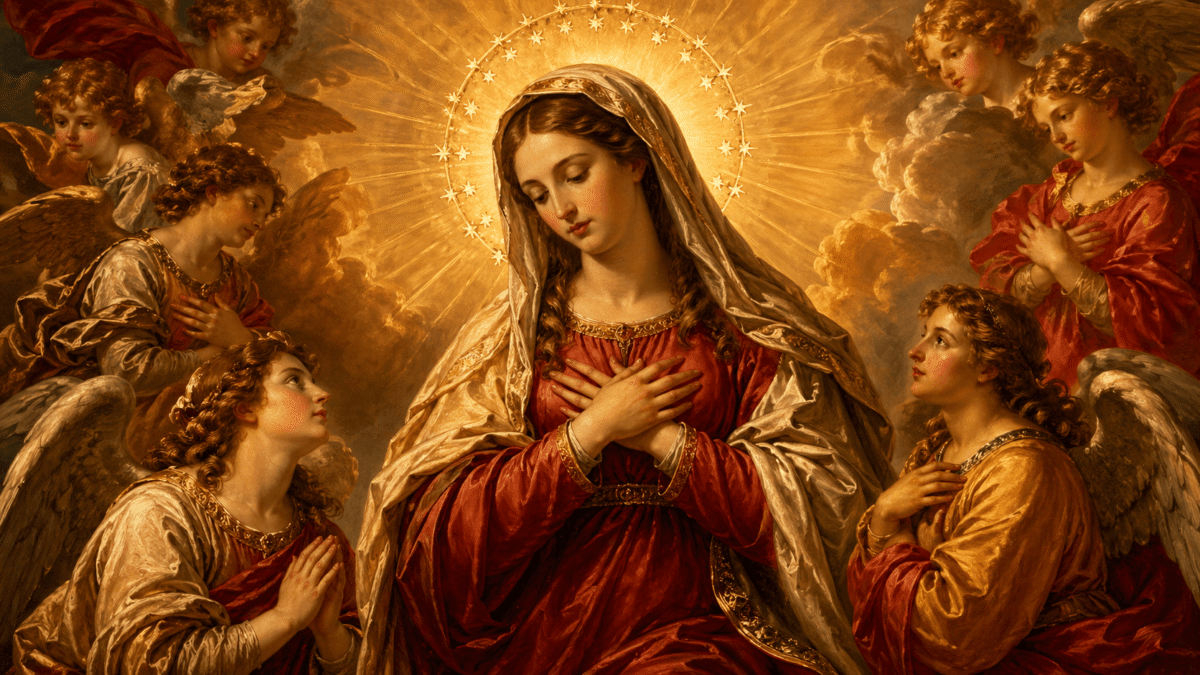
Sit autem sermo vester: est, est. Non, non. Quod autem his abundantius est, a malo est.
Mt 5:37
The third antithesis of the Sermon on the Mount (Mt 5:33-37) radicalizes the prohibition of false oaths: “You have heard that it was said to the men of old: You shall not swear falsely, but shall perform to the Lord what you have sworn. But I say to you: Do not swear at all (…) Let your speech be: yes, yes. No, no. Anything more than this comes from the Evil One” (Mt 5:33-37). Jesus did not simply abolish the oath; He pointed to a level of integrity at which the oath becomes unnecessary: when the human word is absolutely trustworthy, it does not need to be reinforced by oaths. This Saturday, the day the liturgy dedicates in a special way to the Memorial of Our Lady, is the moment to contemplate in Mary the model of this absolute integrity of speech: she whose “fiat” was an eternal and unconditional “yes” to God, she whose words at Cana, “Do whatever he tells you” (Jn 2:5), are the most perfect synthesis of the “est, est” that Jesus asks for.
I. The Antithesis on Oaths: From the Letter to the Spirit
The context of oath-taking in first-century Judaism was complex: there was an entire body of rabbinic jurisprudence on which oaths were binding and which could be circumvented, depending on whether one swore by God, by the Temple, by Jerusalem, or by one’s own head. Jesus cuts this Gordian knot with characteristic radicality: instead of regulating which oaths are valid, He asks for an integrity of speech that makes the oath superfluous. When every word is absolutely trustworthy, there is no need to reinforce it with divine invocations.
Jesus’ “yes, yes. No, no” (estô de ho logos hymôn nai nai, ou ou) can be read as an emphatic doubling (the Aramaic equivalent of “absolutely yes” or “absolutely no”) or as a call for simplicity and straightforwardness: to say what one means, without ambiguity, without evasion, without the “room for maneuver” that the system of oaths allowed. In either case, the demand is the same: the human word must be absolutely reliable, not only when sworn, but always and in every case.
The connection Jesus makes between the need for oaths and the “Evil One” (apo tou ponêrou) is theologically profound: where the human word cannot be trusted, where it must be reinforced with oaths in order to be believed, this is a sign that sin has corrupted human communication. Lying, manipulation, and the evasion of truth are not merely individual moral failings; they are expressions of the reign of the “Evil One,” who has corrupted human language, which ought to be the mirror of divine Truth. The “purity of speech” that Jesus asks for is, ultimately, the recovery of human language for its original function: to manifest the truth, not to hide it.
The tradition of religious life (in particular the Rule of Saint Benedict and the Constitutions of many religious congregations) understood the “yes, yes. No, no” as the basis of the vow of obedience: the word given to the Rule and to the Superior is a word that admits no second interpretation or hidden conditions. But the demand of Mt 5:37 is not limited to religious; it applies to every human word: in contracts, in family promises, in the media, in politics. The contemporary erosion of trust in the public word, in which “spin” and the “narrative” replace the direct truth, is a symptom of the “Evil One” that Mt 5:37 diagnoses with precision.
II. Mary’s “Fiat”: The Yes That Did Not Fail
Mary’s “fiat” at the Annunciation, “Let it be done to me according to your word” (Lk 1:38), is the “yes, yes” of Mt 5:37 in its most absolute form. Mary did not say “yes, with conditions”; she did not say “yes, if circumstances are favorable”; she did not say “yes, but I reserve the right to reconsider.” She said “yes”: absolute, total, without reservation, to the plan of God that the angel had announced to her, a plan she did not fully understand and that entailed consequences she could not foresee.
The theology of the Marian “fiat” has extensively developed its dimension of freedom: Mary said “yes” freely, not under divine compulsion. God “waited” for her “yes,” which implies that a “no” was possible. This possibility of a “no” is what makes the “yes” meaningful: genuine love is possible only where refusal is possible. Mary’s “fiat” is thus the most radical act of freedom in human history: the creature who, able to refuse, says an unconditional “yes” to the Creator, and by that “yes” makes the Incarnation possible.
Mary’s fidelity to her “fiat” over thirty years is the proof that her “yes” was truly “est, est”: without reservation, without retreat, without revision. From the “fiat” of the Annunciation to the “fac quodcumque dixerit vobis” of Cana (“do whatever he tells you,” Jn 2:5), and to the “stabat iuxta crucem” of Calvary (Jn 19:25: “was standing by the cross”), Mary’s “yes” remained absolutely consistent. In the moments when everything seemed to contradict the logic of the initial “fiat” (the flight into Egypt, the failure to understand Jesus in the Temple, the Cross), Mary did not say “no” or “maybe.” Her original “yes” held firm.
III. “Do Whatever He Tells You”: Our Lady’s Saturday
Mary’s last word in the Gospels, “Do whatever he tells you” (Jn 2:5), is the synthesis of her entire spirituality and her entire mission. At Cana, when she addresses the servants at the banquet, Mary is not imposing her own will, nor is she manipulating Jesus to obtain the miracle she wants: she is pointing to the Son and saying, “trust in Him.” This word of Mary is the last act of a life wholly directed toward Christ: she does not place herself at the center, she claims no authority of her own, she does not make herself her own spokeswoman; she is the spokeswoman of the Son.
The dedication of Saturday to Our Lady, present in the liturgy since medieval times and confirmed by the reform of Paul VI, has this theological foundation: Mary is the one who, throughout the whole liturgical week, “keeps and ponders in her heart” (Lk 2:19) the Word that the other days proclaim. Saturday is the day of “rest in God,” and Mary is the model of this rest: not inactivity, but the interior stillness of one who is completely directed toward God and has no need to “run” because she is already where she ought to be.
The practice of the “Five First Saturdays,” proposed by the message of Fatima (1917) as a form of reparation and devotion to the Immaculate Heart of Mary, resonates with Mt 5:37: reparation for the “sins against the Immaculate Heart of Mary” includes sins against the truth (blasphemies, slanders, dishonoring depictions of Mary), the sins that violate the “yes, yes. No, no” of the faithful word. The Saturday devotion is thus a school of integrity of speech: in honoring Mary, whose word was always absolutely faithful, the Christian is invited to make his own word more trustworthy.
IV. The Christian Word in the Culture of the “Narrative”
The demand of Mt 5:33-37 has a particular relevance in a world in which the “narrative” has replaced the truth, in which the credibility of institutions (political, religious, media) has been eroded by the accumulated experience of lying, manipulation, and evasion. The “Evil One” whom Mt 5:37 identifies as the origin of the need for oaths manifests himself today in the omnipresence of “spin,” of “post-truth,” of “alternative truth,” phenomena that corrupt human communication at its root.
The Christian response to this crisis of the word is not the reintroduction of oaths or verification mechanisms; it is the formation of persons whose word is so absolutely trustworthy that it needs no verification. This formation has its model in Mary: an entire life guided by fidelity to the initial “fiat,” a life in which the consistency between what was said and what was done admitted no exceptions. This consistency is not rigidity; it is the integrity of an undivided heart, which says what it feels and does what it says.
The monastic tradition found in Mt 5:37 the basis of the “conversatio morum,” the ongoing conversion of life that religious life promises: not to promise great things all at once, but to promise a permanent orientation toward truth, toward consistency, toward the trustworthiness of one’s word. Mary, who did not promise “great things” at the Annunciation but promised only to be available, and who then lived that availability faithfully to the end, is the model of this “conversatio”: the fidelity of each day which, accumulated, becomes the fidelity of an entire life.
Mary, whose word, from the “fiat” of the Annunciation to the “do whatever he tells you” of Cana, was always the absolute “yes” that needed no oath to be believed, is the model of the disciple whom the demand of Mt 5:37 invites: the one whose word is so faithful that it need not be sworn in order to be believed.
References
- Benedict XVI, Jesus of Nazareth vol. I: “The Sermon on the Mount” (2007).
- John Paul II, Redemptoris Mater nos. 13-14 (1987).
- U. Luz, Das Evangelium nach Matthäus vol. I (1985).
- I. de la Potterie, Maria nel mistero dell’Alleanza (1988).
Postgraduate Program in Mariology
Would you like to deepen your formation in Mariology? Discover the Postgraduate Program in Mariology of Locus Mariologicus, an academic formation that unites theological rigor, spiritual life, and the living tradition of the Church.
Would you like to study Mariology seriously?
This article grows out of the works in the Locus Mariologicus library. The Postgraduate Program in Mariology takes you to the same source, with academic guidance: Scripture, the Fathers of the Church, and the Magisterium, from the first dogma to contemporary questions.




Responses