Our Lady of Hrushiv, the Ukrainian apparitions of 1987
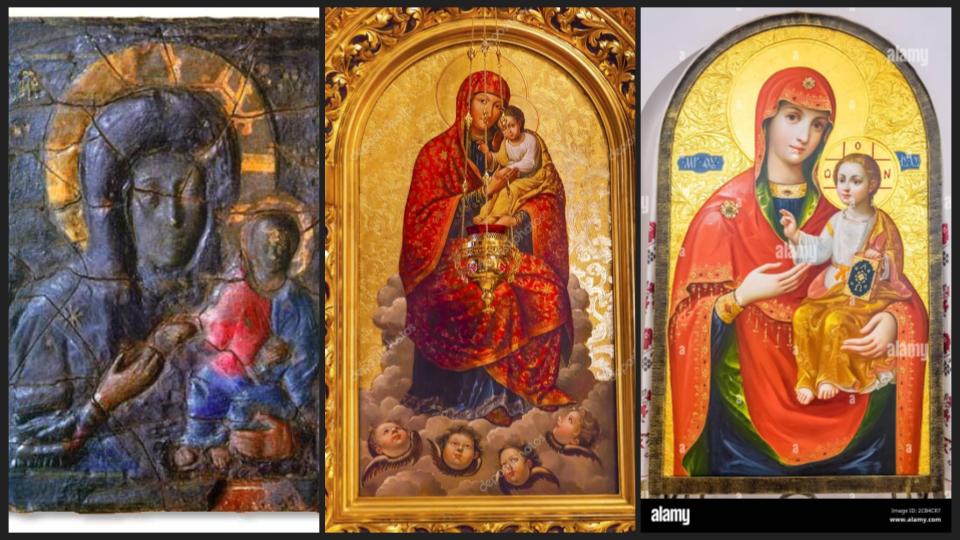
Our Lady of Hrushiv: the village of the apparitions
Hrushiv (in Ukrainian: Грушів) is a small village in the Lviv Oblast, in western Ukraine, then part of the Soviet Union. On April 26, 1987, exactly one year after the Chernobyl nuclear disaster (April 26, 1986), a 12-year-old girl named Marina Kizyn reported having seen Our Lady of Hrushiv above a small chapel, in traditional Ukrainian dress and with the Child Jesus in her arms, in tears.
The vision began at six in the morning and lasted several hours. In the following days, hundreds and then thousands of pilgrims flocked to the village, many traveling long distances on foot under Soviet surveillance. Many reported luminous phenomena, graces, and experiences of conversion, making Hrushiv one of the most significant centers of Marian pilgrimage in Eastern Europe in the twentieth century.
The context: Chernobyl and Soviet Ukraine
The apparitions of Hrushiv took place in an exceptional context. Ukraine was under an officially atheist regime. The Ukrainian Greek Catholic Church had been banned by Stalin in 1946 and its structure forced underground. In April 1986, reactor no. 4 at Chernobyl exploded, causing the largest civil nuclear catastrophe in history.
The Marian apparitions exactly one year later were read as a message of divine consolation to a people who were suffering. For many of the faithful, Our Lady of Hrushiv appeared as a sign that the Mother of God was not abandoning Ukraine in its most difficult hour, and as a confirmation of prophecies attributed to Our Lady of Fatima about the conversion of Russia and of the communist countries.
The messages of Hrushiv
The messages of Our Lady of Hrushiv, according to the accounts of the witnesses, bore on three central axes: penance and conversion of the Ukrainian people, the suffering of the Church persecuted under communism, and the hope of a liberation close at hand. One of the most frequently cited sayings proclaims: “Pray, Ukraine, for your liberation is near”. This message took on prophetic resonance when, in 1991, Ukraine regained its independence and the Greek Catholic Church was legalized once again. For the faithful, the fulfillment of this promise consolidated the credibility of the apparitions as a genuine spiritual phenomenon, worthy of theological and pastoral attention.
Earlier tradition: 1914 and 1954
Local tradition reports earlier apparitions in the same chapel in 1914, coinciding with the beginning of the First World War, and in 1954. These earlier apparitions were not documented as extensively as those of 1987, but they belong to the collective memory of the community. The continuity 1914-1954-1987 has been interpreted as a pattern of intervention by Our Lady of Hrushiv at moments of historical crisis for the Ukrainian people. Each of these dates corresponds to a period of particular suffering, which reinforced, in popular piety, the conviction that this village is a place of special and repeated Marian presence.
Ecclesiastical status
The apparitions of Hrushiv have not received official ecclesiastical approval from the Holy See or from the Ukrainian Greek Catholic Church. They belong to the category of popular religious phenomena in a phase of discernment. The Church does not forbid the devotion, but neither does it officially guarantee it, unlike Fatima, Lourdes, Guadalupe, and Akita, which have formal approval.
In the case of Our Lady of Hrushiv, the canonical process was hampered by the context of ecclesial clandestinity and by the political instability of the Soviet era. The devotion continues to grow in Ukraine, renewed by the suffering of the war after 2022, which has revived the appeal for Marian intercession for peace and for the liberation of the Ukrainian people. For a perspective on the role of Mary in the history of peoples, cf. Redemptoris Mater (John Paul II, 1987).
Deepen your studies: explore Marian apparitions, Our Lady of Akita, Our Lady of La Salette, Mariology and the Postgraduate Program in Mariology.
Postgraduate Program in Mariology
Would you like to deepen your formation in Mariology? Discover the Postgraduate Program in Mariology of Locus Mariologicus – an academic formation that unites theological rigor, spiritual life, and the living tradition of the Church.
See also: Complete guide to the Marian Apparitions approved by the Church
See the complete list of Marian apparitions recognized by the Church.
Would you like to study Mariology seriously?
This article grows out of the works in the Locus Mariologicus library. The Postgraduate Program in Mariology takes you to the same source, with academic guidance: Scripture, the Fathers of the Church, and the Magisterium, from the first dogma to contemporary questions.




Responses