Our Lady of Perpetual Help: Icon, History, and Devotion
The Icon That Crossed the Centuries
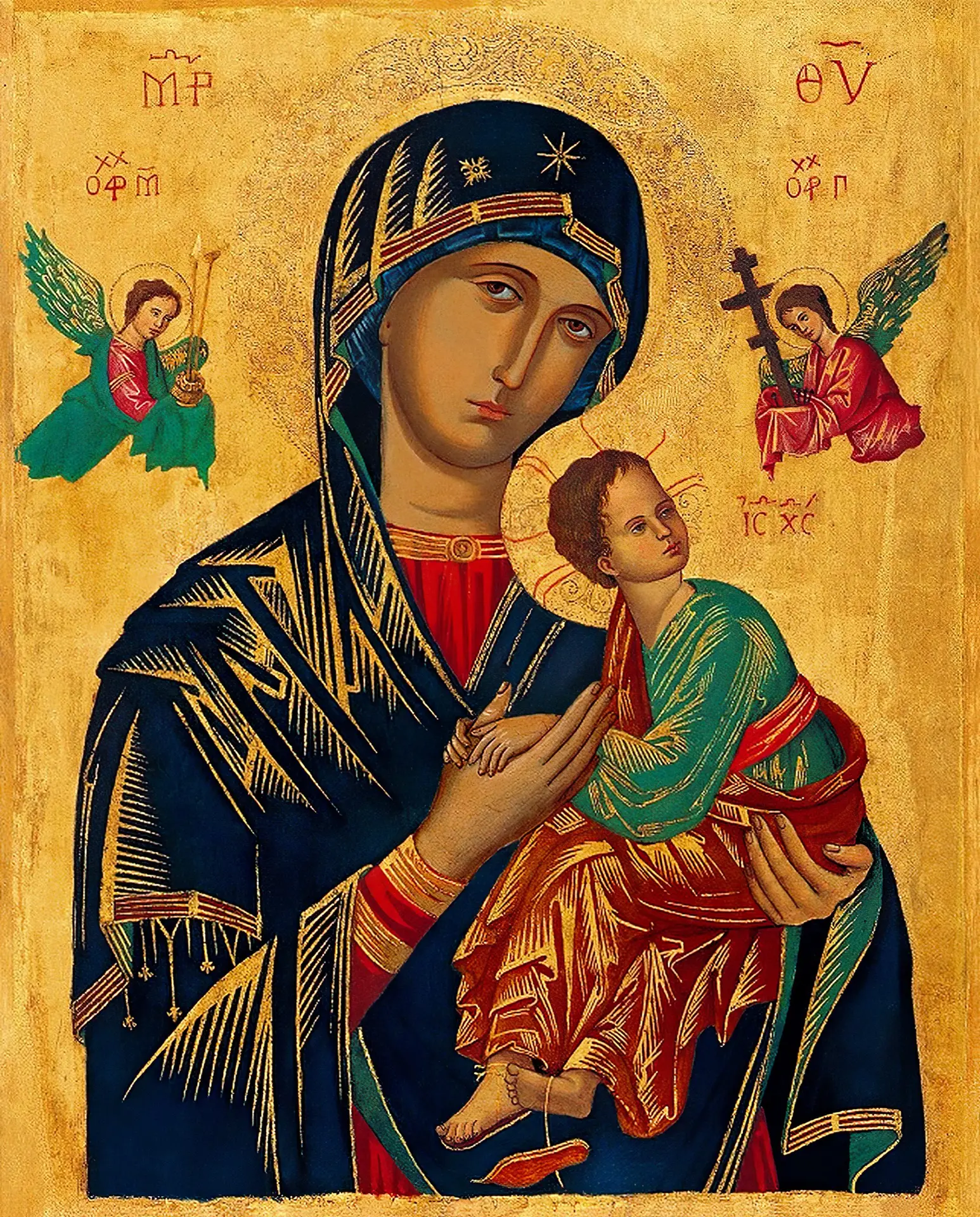
Our Lady of Perpetual Help is venerated through an icon of the Hodegetria type (“She Who Shows the Way”), probably originating in Crete between the 13th and 15th centuries, which arrived in Rome around 1499 and was entrusted by Popes Pius IX and Leo XIII to the Redemptorists in 1865. The icon depicts Mary holding the Child Jesus, who is looking at the Archangels Michael and Gabriel bearing the instruments of the Passion. The iconographic theme brings together motherhood, redemption, and intercession: Mary is the “perpetual help” because her mediation never ceases.
Iconography: The Archangels and the Instruments of the Passion
In the icon, the Archangel Michael (to Mary’s left) holds the lance, the sponge, and the chalice, instruments of the Passion. The Archangel Gabriel (on the right) holds the Cross and the nails. The Child Jesus, seeing the instruments of His future suffering, clings to Mary’s hand so tightly that a sandal has slipped from His foot. This iconographic detail is deliberate: the Son has recourse to His Mother’s help in the face of the mystery of the Cross.
History: From Crete to Rome
The icon was brought to Rome by a Cretan merchant who, mortally ill, asked that it be placed in a Roman church. After several transfers, it remained in the Church of Saint Matthew in Merulana from 1499 to 1798, when Napoleonic troops destroyed the church. The Augustinians kept the icon hidden until 1865, when Pius IX ordered that it be entrusted to the Redemptorist Fathers. Leo XIII solemnly crowned it in 1867.
Theology: “Perpetual Help” as Mediation
The title “Perpetual Help” (Perpetui Auxilii) expresses the belief that Mary’s intercession knows no limits in time or in extent. Lumen Gentium no. 62 provides the doctrinal framework for this devotion: Mary “by her maternal love cares for the brethren of her Son who still journey… until they reach the happy fatherland”. Saint Alphonsus Liguori, founder of the Redemptorists, systematized this doctrine in “The Glories of Mary” (1750).
Devotion in the Portuguese-Speaking World
In Portugal and Brazil, devotion to Our Lady of Perpetual Help is among the most popular, especially in connection with the Redemptorists. Its novena is one of the most widely prayed: “Our Lady of Perpetual Help, I entrust my heart to your protection”. The devotion is bound up with the Lusophone Marian tradition of turning to Mary for maternal support in times of tribulation.
Deepen your studies: explore Mariology, Marian Theology, Marian apparitions, consecration to Our Lady, and the Postgraduate Program in Mariology.
Postgraduate Program in Mariology
Would you like to deepen your formation in Mariology? Discover the Postgraduate Program in Mariology of Locus Mariologicus — an academic formation that unites theological rigor, spiritual life, and the living tradition of the Church.
Discover the oldest Marian image in the Catacomb of Priscilla.
Would you like to study Mariology seriously?
This article grows out of the works in the Locus Mariologicus library. The Postgraduate Program in Mariology takes you to the same source, with academic guidance: Scripture, the Fathers of the Church, and the Magisterium, from the first dogma to contemporary questions.



Responses