St. Michael’s Lent: Its Origin in St. Francis and How to Live It
By Prof. Dr. Daniel C. Afonso · Updated
The Quaresma of Saint Michael is a devotion that runs from the Feast of the Assumption (August 15) to the Feast of Saint Michael (September 29), in memory of the fasting that Saint Francis of Assisi practiced in honor of the archangel. It was during one of these fasts, on Mount Alverne, that Francis received the stigmata. It is not an obligation of the Church, but a practice of piety, and therefore each faithful lives it with freedom, without obligation and without fixed formulas.
In summary
- Origin: The fast of Francis of Assisi in honor of Saint Michael, recounted by Saint Bonaventure and Thomas of Celano.
- Dates: from August 15th (Assumption) to September 29th (St. Michael).
- The Stigmata: Francis received them at Alverne, near the feast of the Exaltation of the Holy Cross, while he was already fasting.
- Nature: a free devotion, of Franciscan origin. It is not a law of the Church nor does it have its own indulgences according to the sources we have read.
- How to live: prayer, fasting and alms-giving, prayer to Saint Michael, Mass and confession.
What is the Lenten Season of Saint Michael?
The name is a bit misleading. This “Lent” is not the liturgical season that prepares for Easter. It is a period of prayer and penance, lasting about forty days, that Christian piety dedicates to Saint Michael the Archangel, between the Assumption of Our Lady and the feast of the archangel. For Michael’s place in faith and liturgy, see also Saint Michael the Archangel: devotion, the Magisterium, and the prince of the celestial militia.
The Origin: Francis on Mount Alverne
The origin lies in the life of Saint Francis of Assisi. The most important source is the Legenda maior, the official biography written by Saint Bonaventure. We read the texts in the Italian edition of the Fonti Francescane, and the translation is ours. We did not consult the Latin.
In the chapter on the stigmata, Bonaventure relates that Francis, two years before his death, was taken to a high mountain, Alverne (in Italian, La Verna). And he adds:
“Here he had begun, as was his custom, to observe Lent in honor of Saint Michael the Archangel, when he began to feel himself overwhelmed with extraordinary sweetness in contemplation.” (St. Bonaventure, Legenda maior XIII, 1)

“Note the ‘as usual’. Fasting was a habit of Francis, which Bonaventure also describes in a previous chapter, about the saint’s devotion to angels:”
“To the angelic spirits […] he was united by an inseparable bond of love. In honor of them he fasted for forty continuous days, beginning with the Assumption of the glorious Virgin, devoting himself unceasingly to prayer.” (Legenda maior IX, 3)
And then follows the reason for the special devotion to Michael: Francis loved him with particular affection “since he has the charge of presenting souls to God.”
Thomas of Celano and Francis’ Fasting
Thomas of Celano, another biographer of Francis, to whom Bonaventure refers, states in the Second Life (ch. 149, n. 197):
“It is often repeated that the blessed Michael should be honored in a more solemn manner, for he has the task of presenting souls to God. Therefore, in honor of Saint Michael, between the feast of the Assumption and his own, he fasted with the greatest devotion for forty days. And he said: ‘Each one, in honor of such a glorious prince, should offer God a tribute of praise or some other special gift.'” (Thomas of Celano, Life II, 197)
The final phrase of Francis shows the spirit: a “special gift” that each offers as they are able.
The Stigmata and Lent of Saint Michael
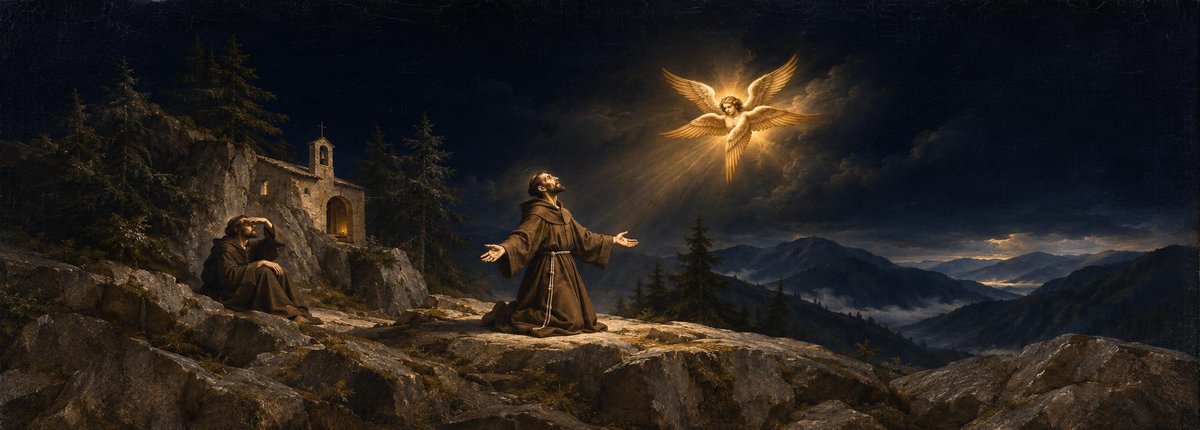
The Legenda maior relates that, during this same retreat, on a morning close to the feast of the Exaltation of the Holy Cross (September 14th), Francis was praying on the slope of the mountain when he saw a seraphim with six wings descend from heaven, between whose wings appeared the image of a man crucified ( Legenda maior XIII, 3). The stigmata of nails were visible in his hands and feet. The Roman Breviary of 1888 recalled the stigmata of Francis on September 17th, in the midst of the fasting of Saint Michael, and the year usually given is 1224, two years before the saint’s death.
The Fioretti, a devoted collection of episodes from Francis’ life, recounts the beginning of this retreat: “As the feast of the Assumption of Our Lady approached, Francis sought an opportunity for a more secluded and secret place where he could observe, more alone, the fast of Saint Michael the Archangel, which began on that feast of the Assumption” (Considerations on the Stigmata 2). Here already appears the name “fast of Saint Michael.” The historical value of the Fioretti is less than that of the biographies.
Forty days or six weeks?
The numbers demand caution. From August 15 to September 29, counting both extremes, there are 46 days, a little more than six weeks. The texts say “forty days” and also say “between the Assumption and the feast of Michael.” The sources we read do not reconcile the two things. The most likely is that “forty” is the name of the time and not an exact count, but that is our reading, not a given from the sources.
A Devotion, Not a Law
The Catechism reminds us that “the Lenten season” and every Friday are “strong moments of the Church’s penitential practice” (n. 1438), and speaks of fasting and abstinence prescribed during times that prepare for liturgical feasts (n. 2043). None of the texts we read presents the period from August 15 to September 29 as a prescribed time, nor as an obligation. It is a practice that originated with the Franciscans, which has since become part of the piety of the faithful.
We also do not find in the sources an indulgence proper to this devotion, and therefore we do not promise it. As for the “promises” that circulate on the networks, we do not find a source for them.
How to Live the Lenten Season of Saint Michael Today
The Catechism teaches that the penance of the Christian can take many forms, and that Scripture and the Fathers insist on three: “fasting, prayer, and alms” (n. 1434). It is a good framework for these forty-plus days. Some suggestions, all free:
Prayer. The prayer most associated with the archangel is that attributed by tradition to Leo XIII, and which Pope Francis encouraged in 2018 to be said at the end of October’s Rosary: “Saint Michael the Archangel, defend us in battle. Against the wickedness and snares of the devil, be our defense. God command it, we pray, and you, Prince of the heavenly militia, by divine power, cast into hell Satan and the other evil spirits that wander through the world to the perdition of souls. Amen.” John Paul II had already invited all to remember it in 1994, although it is no longer said at the end of Mass. Reciting it daily is a good way to live this time.
Fasting. Each one should decide according to his health and state of life, preferably with the advice of a confessor. It can be a simpler meal, or the renunciation of something one enjoys. Those with health limitations should adapt the fast, so as not to harm them. Francis’ fast is a spirit to imitate, not a model to be copied verbatim.
Alms and charity. Francis asked for “a tribute of praise or some other special gift.” This could be the value of a meal given to those in need, or a visit.
Sacraments. Mass and confession at least once during the period are the focus of any time of penance. The Catechism reminds us that human life is surrounded by the protection of angels, from the beginning to death (no. 336).
Frequently Asked Questions
When does the Feast of Saint Michael’s Fasting begin and end?
It begins on the Feast of the Assumption of the Virgin Mary, August 15th, and ends on the Feast of Saint Michael the Archangel, September 29th. Franciscan sources speak of “forty days.”
Is the Feast of Saint Michael’s Fasting mandatory?
No. It is a devotion of Franciscan origin, and the sources we read do not present it as a precept of the Church. Each faithful person lives it freely, according to their health and state of life.
Who created the Feast of Saint Michael’s Fasting?
The practice dates back to Saint Francis of Assisi, who fasted for forty days in honor of Saint Michael from the Feast of the Assumption until the feast of the Archangel. Biographers Thomas of Celano and Saint Bonaventure attest to this.
What is its connection to Saint Francis’s Stigmata?
Francis received the stigmata on Mount Alverne during one of these fasts, on a morning close to the Feast of the Exaltation of the Holy Cross, according to Saint Bonaventure’s Major Legend (XIII, 1 and 3). The Roman Breviary of 1888 remembered it on September 17th.
What prayer should be prayed during the Feast of Saint Michael’s Fasting?
There is no mandatory formula. The most commonly used is the prayer to Saint Michael attributed to Pope Leo XIII and recommended by the Holy See in 2018, to be prayed with the Rosary.
References
- BOAVENTURA. Greater Legend of Saint Francis, chap. IX, 3 and XIII, 1 and 3. In: Franciscan Sources, nos. 1166 and 1223-1225. Italian text, our translation.
- Thomas of Celano. “Second Life of Saint Francis,” cap. 149, n. 197. In: “Fonti Francescane,” n. 785. Italian text, our translation.
- Fioretti, Considerations on the Sacred Stigmata 2. In: Franciscan Sources, n. 1910.
- Catechism of the Catholic Church, nos. 335-336, 1434, 1438, and 2043.
- VATICAN CITY, SEPTEMBER 29, 2018 (VIS).- The Holy See Press Office has released a text in Portuguese, based on the translation “Quis ut Deus”, for the prayer to Saint Michael.
- John Paul II. Regina Caeli, April 24, 1994, n. 4.
- “Who is like God? Saint Michael the Archangel in the sources of faith,” Prolegomena 1.1.3 and Part VI, section 6.5 (verifying the Franciscan sources and the Roman Breviary of 1888, as read by this work).
Responses