Thesaurizate vobis thesauros in caelo: Mary and the Treasures of the Heart
Ubi enim est thesaurus tuus, ibi est et cor tuum.
Mt 6:21
Jesus’ instruction on the two kinds of treasure in Mt 6:19-21 is one of the most penetrating in the Sermon on the Mount. The apparent simplicity of the distinction, do not store up riches on earth, store them up in heaven, conceals a profound analysis of the dynamics of the human heart and of its relationship with what it values. The Greek word thesauros designates both the strongbox and the precious things kept in it. And the sentence that closes the argument, “where your treasure is, there also is your heart,” reveals that what is at stake is not financial management but the fundamental orientation of the person: wherever the heart stakes its love, there lies its deepest identity.
The distinction between earthly and heavenly treasures is not a distinction between matter and spirit in the Platonic sense, as if what is material were evil by nature. Christian tradition has systematically rejected this dualism: matter is good (Gen 1:31), the body will be raised, the Eucharist is bread and wine. What Jesus contrasts is not matter versus spirit, but provisional versus definitive, corruptible versus incorruptible. Earthly treasures are those that rust (brosis), moth (tinea), and thieves (kleptes) can destroy. Heavenly treasures are those that no temporal force can take away: love, justice, and mercy, which build an imperishable reality.
I. The Logic of the Two Treasures
In the Jewish tradition that is Jesus’ starting point, “making treasures in heaven” was a common expression for acts of mercy and justice whose fruits endure for eternity. The Talmud records the expression in several places. The Fathers of the Church adopted it. Alms given to the poor, reconciliation with one’s brother, love of one’s enemy: these acts build a “heavenly treasure,” not because God records transactions in an account book, but because authentic love produces a reality that does not pass away. Love is the only “treasure” that not even death can destroy. It is the only good that grows richer the more it is shared.
The “fundamental decision” to which the Gospel calls, orienting the heart toward the heavenly treasure, was developed by contemporary moral theology as a central concept of Christian ethics. The fundamental option (Grundentscheidung) is not this or that isolated act, but the overall direction of freedom: what the heart has chosen as the supreme good, as its definitive point of reference. Jesus is not asking for a superficial behavioral adjustment: He is inviting us to a metanoia, a reorientation of the heart that transforms what one values. This reorientation, which only grace makes possible, is conversion in the deepest sense.
The parable of the “sound eye and the evil eye” that follows (Mt 6:22-23) belongs to the same context. The “evil eye” (ophthalmos poneros) was a proverbial expression for avarice. The “sound eye” (ophthalmos haplous) designated generosity and simplicity. Two ways of “seeing” reality: with the eye born of possession (which distorts everything in terms of having) or with the eye born of self-giving (which sees the world with the clarity of love). The fundamental orientation of the heart, its “treasure,” determines the “eye” with which one sees everything else.
II. Mary, Who “Kept in Her Heart”
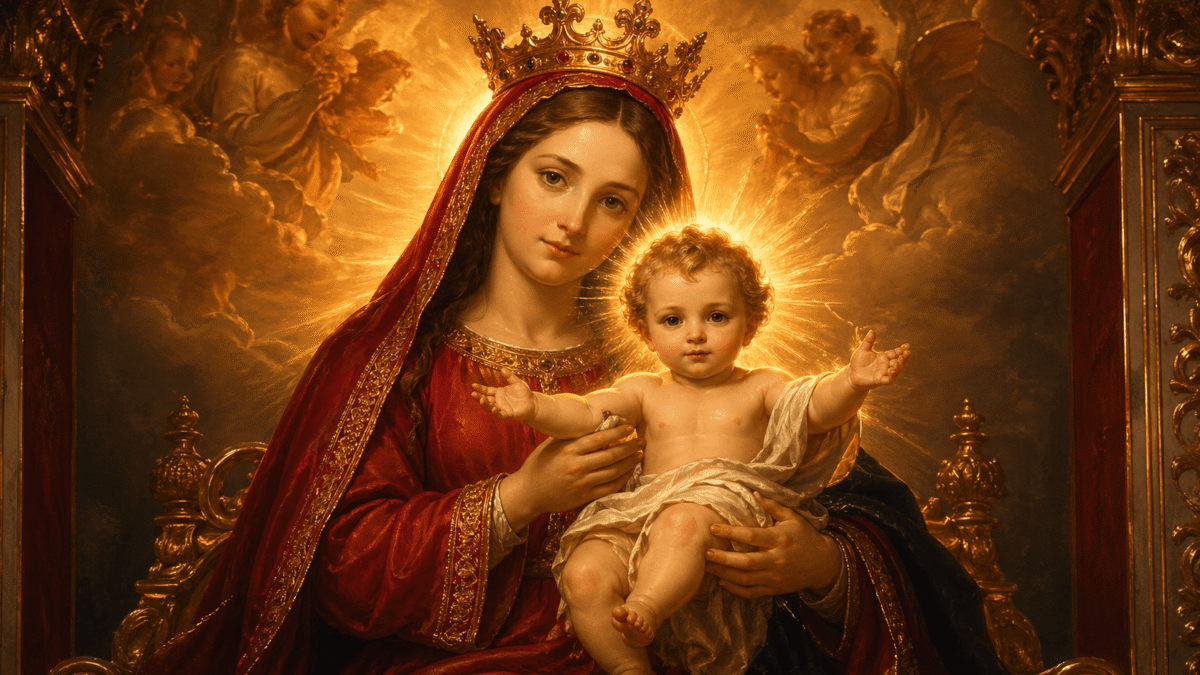
Luke describes Mary’s inner life with the expression “kept all these things, pondering them in her heart” (Lk 2:19; cf. 2:51). This expression is precisely the language of “treasure”: what Mary accumulated in her heart was not material wealth, not prestige, not power, but the Word of God, the events of the mystery of Christ that she contemplated and guarded. Mary’s heart was literally a “heavenly treasure,” filled with the presence of the Son of God whom she carried, cared for, and accompanied all the way to Calvary and to the Resurrection.
Devotion to the “Immaculate Heart of Mary,” celebrated on August 22, has its theological foundation in this Lucan image. Mary’s heart is not a sentimental symbol: it is a symbol of her fundamental freedom, of the total orientation of her person toward God. That her heart is “immaculate” does not mean that she never suffered; Simeon’s prophecy about the sword contradicts that. It means that she never turned aside from her fundamental orientation toward God: even in the sorrow of Calvary, the “treasure” of Mary’s heart remained in heaven, in the Son whom the Cross could not separate from the Father.
Contemplating Mary’s heart as the model of the “heavenly treasure” has a concrete pedagogical value: it shows that accumulating heavenly treasures is not an activity separate from daily life. Mary accumulated her treasure in Nazareth, in domestic service, in raising Jesus, in her presence at Elizabeth’s side, in the thirty years of hidden life. The heavenly “treasure” does not require extraordinary circumstances: it requires ordinary attention and love transfigured by grace. It is the treasure of everyday faithfulness, invisible to the eyes of men but visible to the Father who “sees in secret.”
III. The “Sound Eye” and Spiritual Discernment
The connection between the “sound eye” of Mt 6:22-23 and the mystical tradition of “purity of heart” is explicit in the Beatitudes: “Blessed are the pure in heart, for they shall see God” (Mt 5:8). The heart oriented toward the heavenly treasure develops an “eye” that perceives reality with a clarity that a heart oriented toward earthly treasures cannot have. Contemplation purifies the gaze. Love rectifies vision. This purity is not a human achievement; it is the fruit of grace, which transforms the heart from the inside out.
Meister Eckhart, Johannes Tauler, and the fourteenth-century Rhineland school of mysticism developed at length this theme of “purified vision” as the fruit of union with God. The “eye of the heart” (Eckhart uses the expression Herzensauge), which sees God in creatures and creatures in God, is the “sound eye” that Mt 6:22 describes: the spiritual faculty born of the fundamental orientation toward the heavenly treasure. This mystical tradition recovered a profound insight of the Sermon on the Mount: that the way one sees the world depends on what the heart has chosen as its treasure.
Mary is the model of the “purity of gaze” that corresponds to the “sound eye.” Her gaze upon her Son, described in the Gospels as deep attentiveness and constant meditation, is the gaze of a heart that has accumulated the right treasure. She did not see Jesus merely as her biological son. She saw in Him the Messiah, the Son of God, the Savior of the world. This depth of gaze was born of years of contemplation and prayer: of a life wholly oriented toward the “treasure” that the angel had announced. Her “sound eye” was the fruit of her fundamental option for God.
IV. Where the Heart Is: The Test of a Life
The final sentence, “where your treasure is, there is your heart,” is one of the most psychologically penetrating in the entire Gospel. It reveals that the heart does not freely choose where it becomes attached: it follows the treasure. When someone has invested years of energy and love in a project, a relationship, or an ideal, that is his “treasure,” and his heart dwells in it. That is why Christian conversion is not primarily an act of the will (“I decide to love God above all things”), but a transformation of the heart that comes about by changing what one invests one’s love in.
Christian spiritual pedagogy has understood this logic. Ignatius of Loyola does not ask the beginner in the Exercises to “love God above all things” as a powerless act of the will, but to invest time and attention in prayer, in lectio divina, in service to the poor, and so to let the heart, following the treasure invested, gradually reorient itself. Conversion is a process of “re-attachment”: the heart learns to love God when it begins to invest in its relationship with God. Grace transforms the heart. But freedom invests the treasure.
Mary is the model of the person whose heart was completely reoriented toward the heavenly treasure. Not because she “decided” to be so in a single act of the will, but because her whole life, from the Annunciation to Pentecost, was a process of ever-growing investment of the heart in God. The “fiat” was not an isolated act: it was the ripe fruit of a heart that had, over the years, accumulated its treasure where rust and moth do not reach, where thieves do not break in. And this heart, which “kept in her heart” (Lk 2:19) the most precious treasure, is the model for every disciple who has heard the Sermon on the Mount and responded with his whole life.
Postgraduate Program in Mariology
Would you like to deepen your formation in Mariology? Discover the Postgraduate Program in Mariology of Locus Mariologicus — an academic formation that unites theological rigor, spiritual life, and the living tradition of the Church.
Would you like to study Mariology seriously?
This article grows out of the works in the Locus Mariologicus library. The Postgraduate Program in Mariology takes you to the same source, with academic guidance: Scripture, the Fathers of the Church, and the Magisterium, from the first dogma to contemporary questions.





Responses