The liturgical year

The liturgical year and Mary’s place in the liturgy
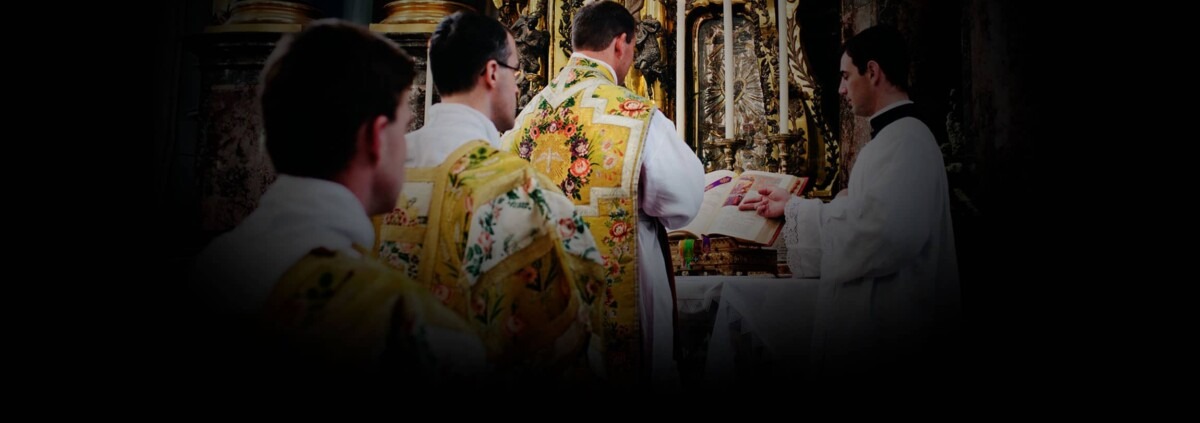
Over the course of this week, we will discuss the liturgical year, so that we may understand the division we have across 12 months for celebrating the mysteries of the life of Christ. The liturgical year celebrates and proclaims God’s loving action on behalf of humanity, carrying out a journey in history that leads us to contemplate the summit of the love that is given in the incarnation of the Word and in the revelation of the intimate life of God in Jesus Christ.

An important principle is to recognize that God reveals Himself to humanity throughout history, and with it establishes a communication, creating a relationship with the human person, manifesting His divine plan of salvation. A plan that was unfolded through the events that culminated in the cross and resurrection of Jesus, whose manifestation of His glory we await.
The covenant that was established throughout the ages is made present for the faithful through the liturgy of the Catholic Church, so that salvation may be communicated to all men. The body of feasts in which the Church annually celebrates the mysteries of the life of Jesus, or the celebration of the mystery of Christ in the rhythm of time and of history, is seen as the ritual translation, understood as a global sacrament, in accordance with present times and the situation of the Church herself.
Set within time, measured in years and days, the sacraments and the feasts structure a time of salvation. That is, God’s communication with His people is not only made present, but lived out in a real and concrete way by the people of the whole Church. That same event proclaimed centuries ago, which revealed God’s plan of salvation for humanity, extends to the present day and transmits the same grace, differing only in mode and intensity. And it is from this reality that the liturgical year is born.
S. Marsili writes: “the liturgical year is nothing other than the moment in which ‘the whole’ of the history of salvation, that is, Christ in His various temporal projections of past-present-future, is brought to a particular human group at a particular time (kairós) within the space of a year. In this sense, the liturgical season does nothing more than emphasize the value of synthesis that is proper to the temporal line of the space of salvation”.
The understanding of the liturgical reform rests on the principle that it is not limited to a simple updating, for it was carried out through theology, which requires that the exposition of the principles governing the liturgical year be preceded by the laying down of its biblical foundations or of its own history (from its birth and its development through the cultural epochs). If these data are not established from the outset, they tend to generate a loss of meaning as to the value the liturgy possesses as a temporal synthesis of the history of salvation, generating also the loss of meaning in relation to the cycles of the liturgical seasons.

Only with an authentic vision of the doctrine of history can one give the reason for the Christian feasts. As well as the dimension and physiognomy of the Marian feasts, which are harmonized with the whole system and depend on that central fact, which is the understanding of the entire history of salvation. By grasping this great event, it will be possible to discover the meaning of the liturgy and of the liturgical year.
As we stand at the threshold of Advent, we would like to know which liturgical season most interests the reader.
To understand Mary’s place in the Liturgical Year, consult the apostolic exhortation Marialis Cultus of Paul VI, a fundamental document on Marian devotion in the liturgy of the Church.
Deepen your studies: explore Mariology, Marian Theology, Marian apparitions and the Postgraduate Program in Mariology.
Postgraduate Program in Mariology
Would you like to deepen your formation in Mariology? Discover the Postgraduate Program in Mariology of Locus Mariologicus, an academic formation that unites theological rigor, spiritual life and the living tradition of the Church.


Responses