“Scientia inflat”: the knowledge that puffs up, the charity that builds up, and the Mother of Mercy
By Prof. Dr. Daniel C. Afonso · Updated
Scientia inflat, caritas vero aedificat. […] Estote misericordes, sicut et Pater vester misericors est.
1 Cor 8:1 and Lk 6:36
Thursday of the Twenty-Third Week in Ordinary Time places charity above knowledge and then shows how far that charity goes. Paul writes a sentence that ought to be engraved in every faculty of theology, “knowledge puffs up, whereas charity builds up” (v.1), and he draws from it a practical consequence that comes at a high price. Luke hands on the heart of the Sermon on the Plain, the commandment to love one’s enemies and the overflowing measure. The two readings say that the Christian’s measuring rod is not what he knows, it is what he bears for the other.
I. The first reading: 1 Cor 8:1b-7, 11-13
The problem in Corinth was concrete and everyday. The meat sold in the market often came from the sacrifices of the temples, and some of the faithful, theologically well formed, ate it without hesitating, because they knew that “an idol is nothing in the world” (v.4). They were right. Paul explicitly grants that they are right and then demolishes their argument.
The demolition is carried out in two stages. First the principle: “if anyone thinks he knows something, he does not yet know as he ought to know” (v.2). There is a way of knowing that is already, in itself, an error, because it separates knowledge from relationship. Then the consequence: there are brothers of fragile conscience, only recently come out of idolatry, for whom that gesture has another meaning, and “by your knowledge the weak one will perish, that brother for whom Christ died” (v.11). The weight of the sentence lies at the end. The fragile brother’s worth does not lie in his theological understanding, it lies in the price that was paid for him. And Paul concludes with a renunciation that has no time limit: “I will never again eat meat, so as not to be an occasion of sin for him” (v.13). He does not give up the truth he defends. He gives up the right to exercise it.
II. The Gospel: Lk 6:27-38
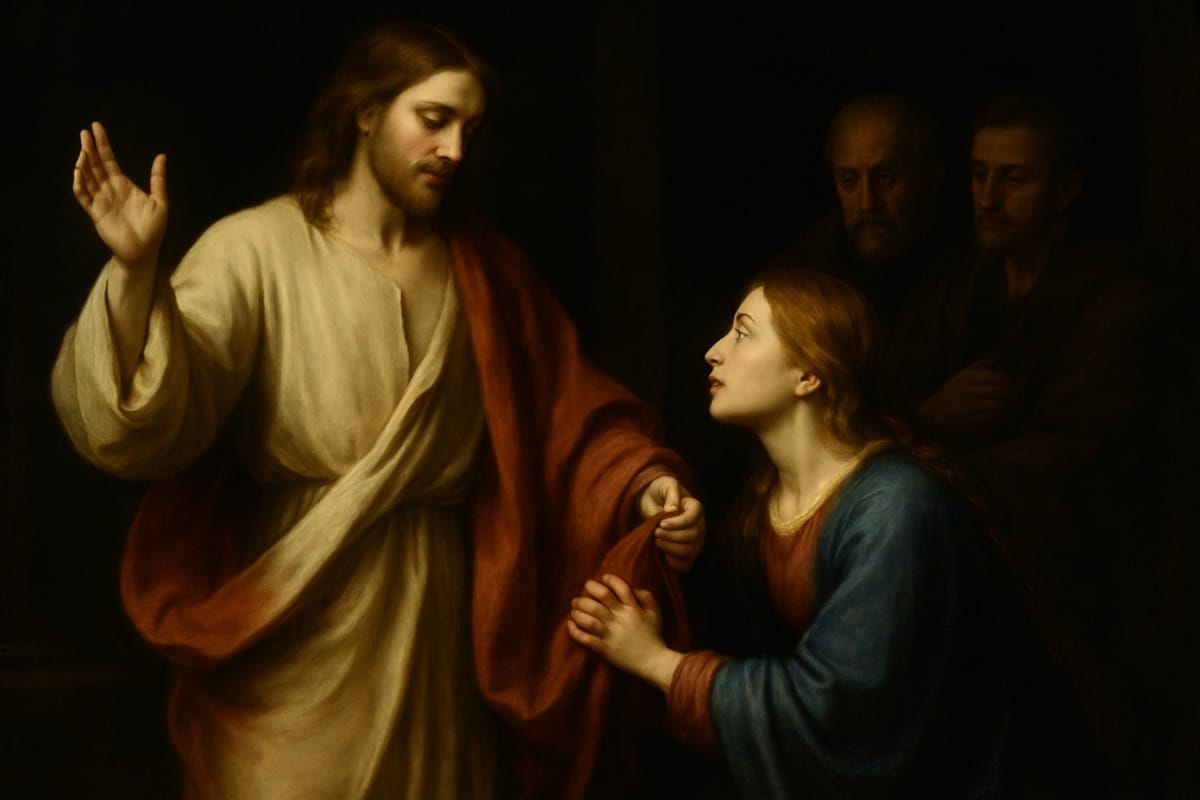
Here the Sermon on the Plain reaches its highest and most impracticable point. “Love your enemies, do good to those who hate you, bless those who curse you, pray for those who insult you” (vv. 27-28). Four verbs that rise in intensity and that do not describe feelings, they describe acts. No one is commanded to like his enemy. What is commanded is to do good to him, to speak well of him and to pray for him.
Then comes the argument that closes off every escape. To love those who love us, to do good to those who do good to us, to lend to those who pay us back, all of this “even sinners” do (vv. 32-34). The Christian novelty does not lie in loving, it lies in loving where no return is expected. And the foundation is not human heroism but likeness to God: “you will be sons of the Most High, who is good even to the ungrateful and the wicked” (v.35). Hence the sentence that Luke places where Matthew places perfection: “be merciful, as your Father is merciful” (v.36).
The passage ends with an image taken from the grain market. The honest seller filled the measure, pressed it down, shook it and filled it again until it overflowed into the lap of the cloak. “The measure you use with others will be used with you as well” (v.38). It is not a threat. It is a description of how a heart works, a heart that narrows or widens according to what it practices.
III. Knowledge that does not build up
The meeting of the two readings is exact. Paul is in the right against the weak of Corinth and renounces exercising that right. Jesus commands us to love those who give nothing back. In both cases, the criterion has shifted from what is owed to what builds up the other.
This is of particular interest to those who study. A solid theological formation is a real good and the Church needs it, but it is a good that carries with it a specific temptation, that of turning competence into superiority and superiority into impatience with the simpler faith of others. Paul does not ask that one know less. He asks that knowledge be governed by charity, which is the only thing that builds. That is why, a few chapters later, he will devote the whole hymn of charity to saying that without it the knowledge of mysteries is nothing (1 Cor 13:2).
IV. Mary, Mother of Mercy and overflowing measure
Luke’s commandment, “be merciful”, has a concrete face in the tradition of the Church, and the prayer most recited in the West after the Our Father calls it by name. The Salve Regina greets Mary as Mater misericordiae, Mother of Mercy, and asks her to turn her merciful eyes toward us. The title is not sentimental. It says that the mercy of the Father took on a human and maternal form in her.
Mary was the first to sing that mercy as the law of history: “His mercy extends from generation to generation upon those who fear Him” (Lk 1:50). The Magnificat does not describe a feeling in God, it describes the way God acts, casting down the powerful and raising up the humble. Whoever sings in this way has already understood what Luke will ask in the Sermon on the Plain, because such a one has recognized that God’s measure is always greater than the one that man deserves.
And there is the overflowing measure. If there is one creature of whom it can be said that she received the measure “pressed down, shaken together, overflowing”, it is the one whom the angel greeted as full of grace (Lk 1:28). Except that the overflow did not remain in her. As soon as she had received it, she set out in haste for the hill country, to serve Elizabeth for three months (Lk 1:39, 56). The measure she received was the measure she used. The Council teaches that Mary’s motherhood in the order of grace endures without interruption until the perpetual consummation of all the elect, and for this reason the Church invokes her under the titles of Advocate, Helper and Mediatrix (LG 62).
Thursday of the Twenty-Third Week therefore leaves a simple question for those who devote themselves to the study of the faith. Has what we have learned built anyone up, or has it only proved us right?
Postgraduate Program in Mariology
Would you like to deepen your formation in Mariology? Discover the Postgraduate Program in Mariology of Locus Mariologicus – an academic formation that unites theological rigor, spiritual life, and the living tradition of the Church.
Responses