The Liturgical Year

By Prof. Dr. Daniel C. Afonso · Updated
The liturgical year and Mary’s place in the liturgy
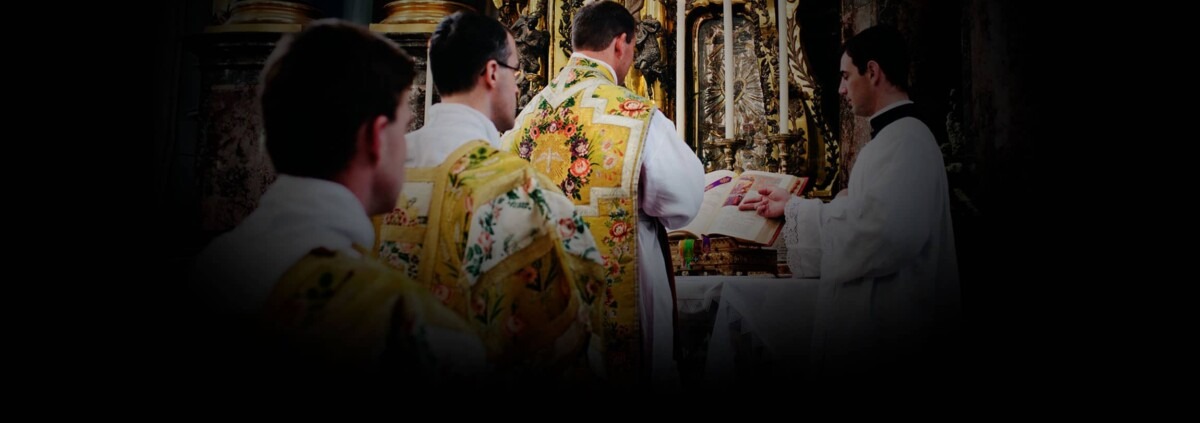
Throughout this week, we will discuss the liturgical year, so that we may understand the division we have over 12 months for celebrating the mysteries of the life of Christ. The liturgical year celebrates and proclaims God’s loving action for humanity, tracing a path through history that leads us to contemplate the summit of love, which is given in the incarnation of the Word and in the revelation of the intimate life of God in Jesus Christ.

An important principle is for us to recognize that God reveals Himself to humanity throughout history and establishes communication with it, creating a relationship with the human person and manifesting His divine plan of salvation. This plan was carried out through the events that culminated in the cross and resurrection of Jesus, whose glorious manifestation we await.
The covenant that was established over the course of time is made present for the faithful through the liturgy of the Catholic Church, so that salvation may be communicated to all people. The set of feasts in which the Church annually celebrates the mysteries of the life of Jesus, or the celebration of the mystery of Christ in the rhythm of time and history, is seen as the ritual translation, understood as a global sacrament, according to the present times and the situation of the Church herself.
Set within time, measured in years and days, the sacraments and the feasts structure a time of salvation. In other words, God’s communication with His people is not only made present but lived in a real and concrete way by the people of the whole Church. That same event announced centuries ago, which revealed God’s plan of salvation for humanity, extends to the present day and transmits the same grace, differing only in mode and intensity. And it is from this reality that the liturgical year is born.
Salvatore Marsili writes: “the liturgical year is nothing other than the moment in which ‘the whole’ of the history of salvation, that is, Christ in His various temporal projections of past-present-future, is brought to a given human group at a determined time (kairós) within the span of a year. In this sense, liturgical time does nothing more than emphasize the value of synthesis that is proper to the temporal line of the space of salvation”.
Understanding the liturgical reform rests on the principle that it is not limited to a simple updating, for it was carried out through theology, which requires that the exposition of the principles governing the liturgical year be preceded by the presentation of its biblical foundations or of its own history (from its birth and its development through the cultural epochs). If these data are not established from the outset, they tend to cause a loss of meaning regarding the value the liturgy has as a temporal synthesis of the history of salvation, also causing a loss of meaning with respect to the cycles of the liturgical seasons.

Only with an authentic view of the doctrine of history can one give the reason for the Christian feasts, as well as the dimension and physiognomy of the Marian feasts, which are harmonized with the whole system and depend on this central fact, which is the understanding of the whole history of salvation. By grasping this great event, it will be possible to discover the meaning of the liturgy and of the liturgical year.
As we stand at the threshold of Advent, we would like to know which liturgical season interests you most.
To understand Mary’s place in the Liturgical Year, consult Paul VI’s apostolic exhortation Marialis Cultus, a fundamental document on Marian devotion in the liturgy of the Church.
Deepen your studies: explore Mariology, Marian Theology, Marian apparitions, and the Postgraduate Program in Mariology.
Postgraduate Program in Mariology
Would you like to deepen your formation in Mariology? Discover the Postgraduate Program in Mariology of Locus Mariologicus, an academic formation that unites theological rigor, spiritual life, and the living tradition of the Church.
Responses