The Earliest History of Mary: Iconography and Art

The Earliest History of Mary in Christian Iconography: The Catacombs of Priscilla (2nd Century), Apsidal Mosaics, and the Virgin Orans
They are the encolpia and the processional crosses of Palestinian art from the sixth century onward, contemporary with the last great epoch of religious literature about Mary, that of the Chalcedonian Assumptionists. Such artifacts not only reveal to us the origin of Marian iconography, but also confirm what has been attested by the sources we have examined. The first iconographic type is that of the Theotókos or Blachernitissa, in which Mary is joined to the Cross. The second is that of the Chalcopratía, in which Mary appears as Co-Redemptrix while the Blood of her Son flows down from the Cross to the skull of Adam kept in the Cave of Treasures of Calvary. The third is that of the Mother Advocate, who on Calvary intercedes for the Church. These models are represented on minor artifacts, such as reliquaries, eulogiae, ampullae, and crosses, either singly or in cycles of five, seven, nine, or twelve scenes, calculated according to the liturgical calendar.
We have, for example, a cycle of five scenes on the lid of a sixth-century reliquary box, obviously Palestinian, once preserved in the Sancta Sanctorum of the Lateran and today in the Vatican. Another similar cycle is found on a silver cross-encolpion of the eighth and ninth centuries, which came from Palestine to Italy and is preserved at Vicopisano. On the lid, around the Chalcopratía, there are Marian images of the Resurrection and the Nativity, of the Ascension and the Baptism of Jesus, grouped in pairs. On the encolpion, again around the same model, we have the Annunciation, the Baptism of Jesus, the Nativity, and the Presentation in the Temple. On the reverse, we have the Madonna attending the Ascension with the Apostles and, in another scene, the Descent into Hell. From this iconography, the report of the Gospel of the Hebrews is confirmed, which in the second century stated that Jesus was baptized at the counsel of His Mother. Moreover, the assertion of an apparition of the Risen One to His Mother is corroborated, as is her presence at the Ascension of her Son, together with her knowledge, in vision, of His otherworldly journey.
Palestinian iconography is replicated in many specimens influenced by it, such as the ampullae of Bobbio or of Monza, as well as various icons of Sinai. For the ampullae of Bobbio, I cite number 17, number 18, and number 19. The first has a cycle of seven mysteries with the Resurrection at the center: on the right, the Crucifixion, the Baptism, and the Visitation are visible; while on the left, now vanished, the Ascension, the Annunciation, and the Nativity were represented. The second ampulla has at the center the Crucifixion, below the Resurrection, above the Ascension, and at the sides the Annunciation, the Visitation, the Nativity, and the Baptism. The third ampulla, also fragmentary, has nine scenes related to the Mount of Olives and not to Calvary, as the other two are: at the center is the Ascension, and around it the Annunciation, the Visitation, the Baptism, the Nativity, the Adoration of the Shepherds and of the Magi. The Crucifixion and the Resurrection are missing, now lost.
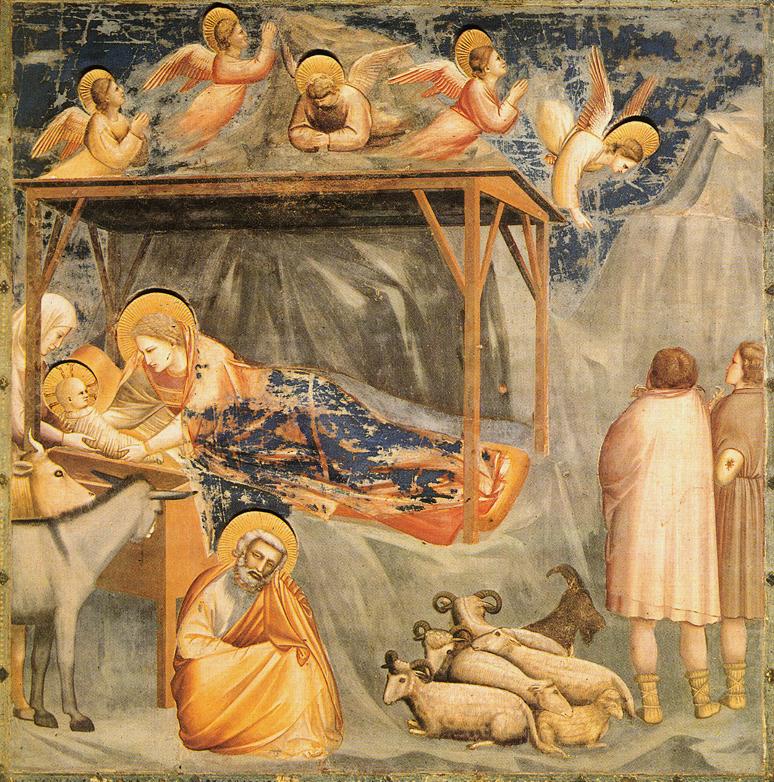
As for the ampullae of Monza, I cite number 2. They come from Bethlehem and contain at the center the Nativity, surrounded symmetrically by the Annunciation and Visitation, Baptism and Crucifixion, Resurrection and Ascension. Corresponding to this ampulla are the enamel cross of the popes Symmachus, Sergius I, and Paschal, preserved in the Vatican, and the fragment of icon B 41 from Sinai. Both come from Bethlehem. They too have the Nativity at the center. On the cross are represented the Annunciation, the Visitation, Mary’s Journey to Bethlehem, the Adoration of the Magi, the Presentation in the Temple, and the Baptism of Jesus. If we add up all these scenes, we have twelve mysteries related to the life of Mary, which were synthesized in the Middle Ages in other representations. The basis was the Palestinian liturgy, which historicized all the mysteries, reliving them in the places where they occurred: Calvary, Bethlehem, the Mount of Olives.
Outside the boundaries of Palestine, late-antique pre-Constantinian Christian art also constitutes an important documentary source. The figurative themes converge with the literary ones and complete them, and are corroborated just as much as the archaeological finds. Catacomb, cemeterial, and funerary art, although by force of circumstances it has a limited number of representative types, draws its inspiration from the Infancy narratives, both biblical and apocryphal, thus attesting to their circulation: the Annunciation, the Nativity, the Adoration of the Magi, the most frequent representation, and the symbolic image of Mary with Balaam/Isaiah. The oldest representations of the Adoration of the Magi and of Mary with Balaam/Isaiah date from the second century, in the Catacomb of Priscilla. According to Origen, the Magi were descended from Balaam, who prophesied about the Messiah in Num 24:17. In general, in typological art, Mary is presented in prayer, without the Child and with her arms raised, as an image of the Church. On a gold glass of the third and fourth centuries, Mary is portrayed between Peter and Paul.
Deepen your studies: explore Mariology, Marian Theology, Marian apparitions, and the Postgraduate Program in Mariology.
To deepen the study of Mary at the origins of Christianity, consult the Encyclical Redemptoris Mater of Pope John Paul II.
Postgraduate Program in Mariology
Would you like to deepen your formation in Mariology? Discover the Postgraduate Program in Mariology of Locus Mariologicus – an academic formation that unites theological rigor, spiritual life, and the living tradition of the Church.
Discover the oldest Marian image in the Catacomb of Priscilla.
Would you like to study Mariology seriously?
This article is born of the works in the library of Locus Mariologicus. The Postgraduate Program in Mariology brings you to the same source, with academic guidance: Scripture, the Fathers of the Church, and the Magisterium, from the first dogma to contemporary questions.




Responses