The Paraclete Spirit: Acts 8:1; 1 Pet 3 and the promise of the Spirit in Jn 14
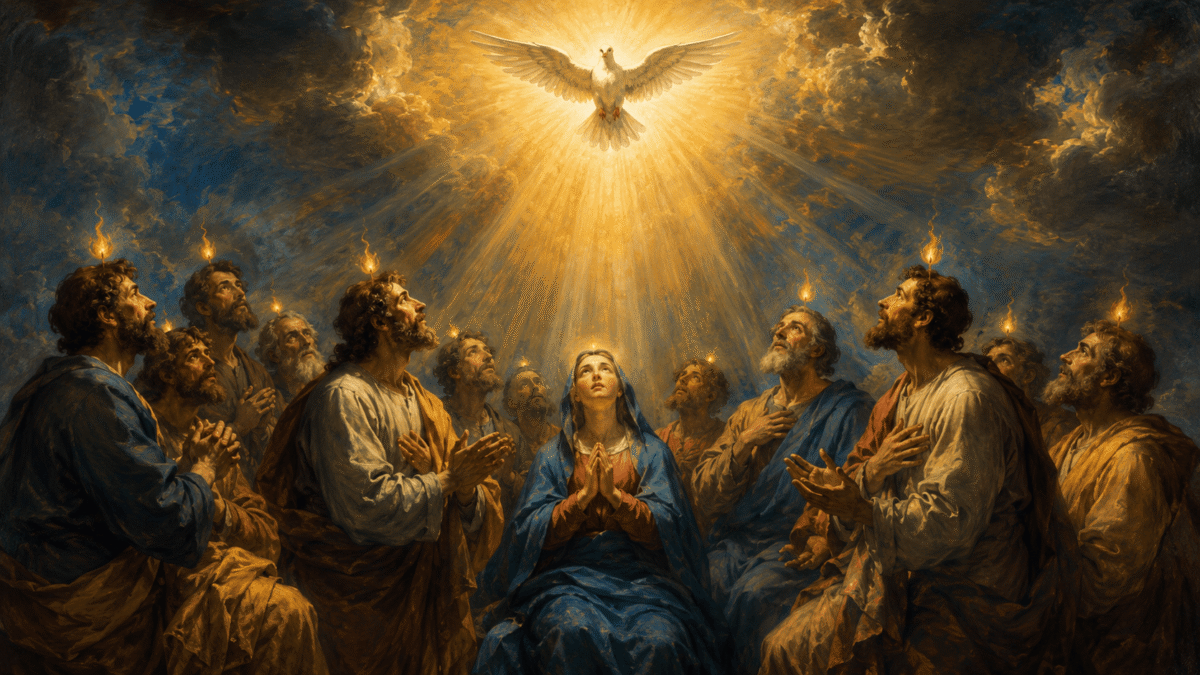
Non relinquam vos orphanos: veniam ad vos.
Jn 14:18
The Paraclete Spirit, promised by Christ to His disciples, is the center of this Sunday’s liturgy. The Sixth Sunday of Easter in Year A stands between the Ascension, which is drawing near, and Pentecost, which is close at hand, and for this reason the whole attention of the liturgy is directed toward the gift of the Holy Spirit that Christ promised to His own. The Gospel pericope belongs to the long Supper Discourse of the Gospel of John (chs. 13-17), spoken on the night in which Jesus was handed over: it is Christ’s spiritual testament to His disciples before the Passion. The first reading (Acts 8:5-8, 14-17) and the second (1 Pet 3:15-18) are chosen in resonance with that same theme. The three readings describe the same fundamental dynamism: Christ’s departure is not abandonment but a transformation of presence, through the mission of the Church and the gift of the Spirit.
The Paraclete, the Greek word Παράκλητος, which designates the one called to another’s side to defend, console, and intercede for him, is the central figure of this liturgy of the Word. The promise Jesus makes to His own (“I will not leave you orphans: veniam ad vos”, Jn 14:18) is the arch that joins the three texts: the Spirit is not an abstraction but a personal, active, transforming presence, who acts in the mission of the Church (Acts 8), sustains the witness of the faithful in time of tribulation (1 Pet 3), and dwells interiorly in those who love Christ (Jn 14).
I. The First Reading: Acts 8:5-8, 14-17
The pericope from Acts is an excerpt from the broader narrative of Philip’s mission in Samaria (Acts 8:4-25). After the stoning of Stephen and the persecution that broke out against the Church of Jerusalem, the disciples were scattered through the regions of Judea and Samaria, and it was precisely that forced dispersion which became the vehicle of mission. Philip, one of the Seven chosen for the service of the tables (Acts 6:5), goes down to a city of Samaria and proclaims Christ to them. The crowds listened to him attentively because they saw the signs he performed: unclean spirits came out of many possessed people with loud cries, and many paralytics and lame people were healed. “And there was great joy in that city” (Acts 8:8). Joy, the paschal theme par excellence, is the fruit of the mission animated by the Paraclete Spirit.
The apostles in Jerusalem, on learning that Samaria had received the Word of God, sent Peter and John. When they arrived, they prayed for those who had received baptism that they might receive the Holy Spirit, for He had not yet come down upon any of them: they had only been baptized in the name of the Lord Jesus. Then Peter and John laid their hands on them and they received the Holy Spirit (vv. 15-17). The mission in Samaria fulfills the program of the Risen One in Acts 1:8: “you shall be My witnesses in Jerusalem, in all Judea and Samaria, and to the ends of the earth”. In Luke, the geographical extension of the mission is inseparable from the extension of the gift of the Paraclete Spirit.
This episode has a particular sacramental density: the faithful had already received Baptism, but the Spirit had not come down upon them. The distinction between the Baptism administered by Philip and the laying on of hands by the apostles Peter and John lies at the root of patristic and conciliar reflection on Confirmation as a sacrament distinct from and complementary to Baptism. The Paraclete Spirit is not automatically conferred by the water: He is a gift that the Church transmits through prayer and the apostolic gesture. Luke thus underlines that the Spirit has a logic of His own, is neither controllable nor reducible to a rite, but acts through the apostles and the community gathered in Christ’s name. It is not by chance that the very pillars of the Church of Jerusalem, Peter and John, are the ones who seal the unity between Philip’s mission in Samaria and the apostolic community: the Spirit does not fragment, He unites.
II. The Second Reading: 1 Pet 3:15-18
Peter’s letter is addressed to Christian communities scattered through Pontus, Galatia, Cappadocia, Asia, and Bithynia (1 Pet 1:1), communities that live as strangers and pilgrims in a world that looks on them with suspicion and, at times, with hostility. The context is not that of official, organized persecution, but of social pressure, mistrust, and marginalization. It is in this context that Peter exhorts, sustained by the strength of the Paraclete Spirit: “Sanctify Christ as Lord in your hearts, always ready to give an answer to everyone who asks you to account for the hope that is in you” (1 Pet 3:15). Christian hope is not private: it must be communicable, explainable, articulable. And that communication must be made “with meekness and respect”, with a clear conscience, not with apologetic aggressiveness, but with the serenity of one who knows in whom he believes.
The foundation of hope is the act of Christ: “Christ also died for sins once for all, the just for the unjust, in order to lead us to God. Put to death in the flesh, He was brought to life in the spirit” (v. 18). Christ’s own pattern is the pattern of the disciple: to suffer while doing good, because the just one who suffers is associated with the suffering of Christ, and the vivification in the spirit that followed is the guarantee of the vivification to come. The disciple does not suffer alone: he suffers in Christ, and therefore his suffering already carries within itself the seed of the resurrection.
The formula “put to death in the flesh, brought to life in the spirit” is one of the oldest antithetical pairs in the Christology of the New Testament, probably of primitive liturgical origin, parallel to other archaic confessions of faith (cf. Rom 1:3-4 and 1 Tim 3:16). The flesh/spirit contrast is not Platonic dualism, as though matter were evil and spirit good, but the Hebrew antithesis between the frailty of the human condition (basar) and the life-giving power of God (ruah). Christ was handed over to death according to the weakness of the flesh and raised by the power of the Spirit of God (cf. Rom 8:11). It is this same Paraclete Spirit who dwells in the faithful and directs them toward the hope of the resurrection. Peter’s exhortation thus builds the bridge between paschal Christology and the ethics of witness: whoever is brought to life by the Spirit accounts for his hope with serenity, because he does not fear the death that Christ has already conquered.
III. Evangelium: Jn 14:15-21
The Gospel text belongs to the Supper Discourse, spoken by Jesus on the eve of His Passion. The disciples are troubled: Jesus has announced that He is going away, that one of them will betray Him, that Peter will deny Him. Thomas’s question (“Lord, we do not know where You are going; how can we know the way?”, 14:5) and Philip’s (“Show us the Father”, 14:8) reveal the group’s disorientation. It is in this context of fear and incomprehension that Jesus promises the Paraclete Spirit: not as compensation for His absence, but as a new form of His presence.
“If you love Me, you will keep My commandments. And I will ask the Father and He will give you another Paraclete to remain with you forever: the Spirit of truth” (Jn 14:15-17). The world cannot receive the Spirit because it neither sees Him nor knows Him. The disciples know Him because He dwells with them and will be in them. “I will not leave you orphans: I will come back to you” (v. 18). Jesus’ departure is not abandonment: the presence of the Spirit is the form of Christ’s presence after the Ascension. “A little while longer and the world will see Me no more, but you will see Me” (v. 19). And He concludes: “Whoever has My commandments and keeps them, he it is who loves Me. Whoever loves Me will be loved by My Father, and I will love him and manifest Myself to him” (v. 21). John’s logic is circular and trinitarian: love generates the keeping of the commandments, which generates the love of the Father, which generates the manifestation of the Son in the Spirit. The Paraclete Spirit is the agent of this circulation of love between the believer and the three divine Persons.
The promise of “another” Paraclete is theologically dense. Jesus is Himself the first Paraclete (cf. 1 Jn 2:1), the defender and intercessor of the disciples before the Father. The Spirit who is to come will be another, but not different: He will continue and deepen the mission of Christ, teaching, consoling, defending, interceding. John uses the Greek term allos (another of the same kind) and not heteros (another of a different kind), thus signaling the essential continuity between Christ and the Spirit in the economy of salvation. The Spirit brings no new revelation and does not replace Christ: He recalls, deepens, and makes present what Christ revealed (cf. Jn 14:26 and 16:13-14). His presence is therefore the prolonged and interiorized presence of Christ in the life of the disciples and of the Church, not an exterior and visible presence like that of the historical Jesus, but an intimate presence, which acts from within each of the faithful and within the community gathered in His name.
IV. Mary and the First Gift of the Spirit
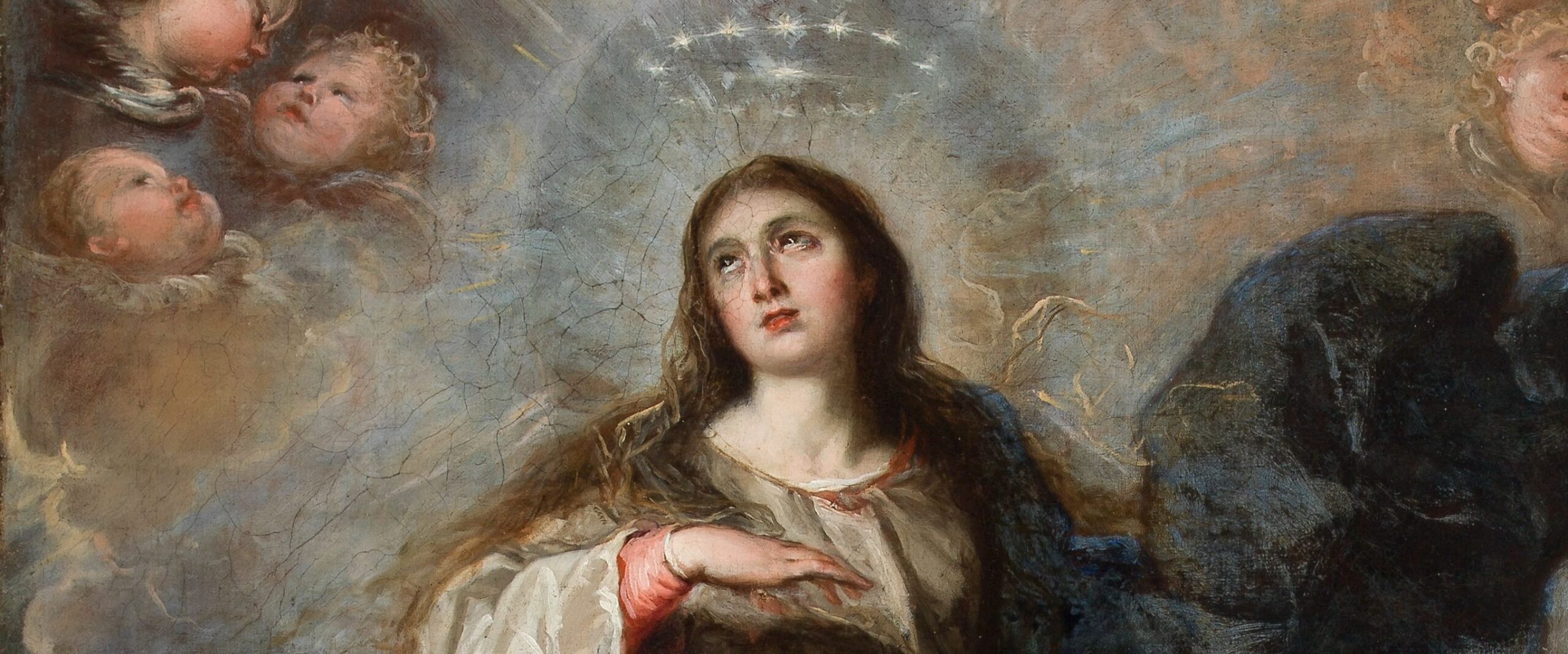
Jn 14 promises the Paraclete Spirit whom the Father will send in Christ’s name. The Mariological tradition recognizes in Mary the creature who first received the Spirit in this full and transforming way: when the angel announced that “the Holy Spirit will come upon you and the power of the Most High will overshadow you” (Lk 1:35), the first outpouring of the Spirit in the new covenant took place. Before any apostolic laying on of hands, before any sacramental structure of the nascent Church, the Spirit came down upon Mary at the Annunciation. Mary is, in this sense, the sacrament of the Spirit prior to the sacraments: the place where the Spirit dwelt fully and permanently before dwelling in the Church.
Acts 8 recounts that, when Peter and John arrived in Samaria and laid on hands, the baptized received the Spirit. The parallel with the Visitation is revealing: when Mary arrived at Elizabeth’s house, before any laying on of hands, before any apostolic mediation, “when Elizabeth heard Mary’s greeting, the child leaped for joy in her womb, and Elizabeth was filled with the Holy Spirit” (Lk 1:41). Mary’s greeting functions like the gesture of Peter and John: where she arrives, the Spirit acts. This parallel is not fortuitous: Luke is the only evangelist who narrates both the episodes of Jesus’ infancy, where Mary functions as the first “place” of the outpouring of the Spirit, and the expansion of the Church in Acts, where the apostles transmit that same Spirit. The Lucan narrative structure invites the reader to see in Mary the perfect type of the apostolic mission: bearer of the Spirit before the apostles were, mediator of His outpouring before the Church had a visible structure.
1 Pet 3 exhorts us to account for the hope that is in us with meekness and joy. Mary’s Magnificat (Lk 1:46-55) is precisely that: the account of the hope of Israel that was fulfilled in her, sung with the meekness and the joy of one who recognizes the work of God in her own life. Mary does not argue or defend: she proclaims. And that proclamation is already the witness of the hope of which Peter speaks, given not with pride but with thanksgiving, not with power but with the silent strength of one who has been visited by the Most High.
The Sixth Sunday of Easter looks ahead to the Ascension and to Pentecost. Mary will be present at both moments, as she had been at the Annunciation and at the Visitation. In the Upper Room, among the one hundred and twenty disciples who await the promise of the Father (Acts 1:14), there she is, the one who had received the Spirit before all others, the one who had mediated Him before any apostle. Her presence in the Upper Room is not marginal: it is the sign that the Church awaiting Pentecost already has within herself, in the person of Mary, the pledge and the model of the gift she hopes to receive. Before Pentecost, she is already Pentecost in person.
V. Conclusion: Departure as the Transformation of Presence
The three readings of the Sixth Sunday of Easter converge in a single theological movement: Christ’s departure is not the end of presence, but its transformation and deepening. In Acts 8, that presence is transformed into ecclesial mission: the Spirit acts through the Church that proclaims, baptizes, and lays on hands, carrying paschal joy as far as the once-excluded Samaria. In 1 Pet 3, it is transformed into hope lived and communicated: the believer who suffers while doing good shares in the paschal dynamism of Christ, put to death and brought to life, and becomes a living witness of the resurrection in the midst of a world that questions him. In Jn 14, it is transformed into interior indwelling: the Spirit is not only among the disciples, but in them, making each one the place where Christ manifests Himself to the world that no longer sees Him.
Mary anticipates and recapitulates this threefold movement: she received the Spirit before any visible ecclesial structure (the Annunciation), she mediated Him before any laying on of hands (the Visitation), and she remained at the heart of the praying Church that awaits His fullness (the Upper Room). Jesus’ promise, “I will not leave you orphans”, was fulfilled first in her: she who was never left an orphan because she never ceased to keep the commandments of Christ, never ceased to love with the love of the Father, and never ceased to receive the manifestation of the Son in the gift of the Spirit. The disciple who reads this Gospel is invited to travel the same path: from love to obedience, from obedience to the love of the Father, from the love of the Father to the indwelling of the Son, from the indwelling of the Son to the gift of the Spirit, and thus, from presence to presence, to the fullness that Pentecost announces.
Postgraduate Program in Mariology
Would you like to deepen your formation in Mariology? Discover the Postgraduate Program in Mariology at Locus Mariologicus, an academic formation that unites theological rigor, spiritual life, and the living tradition of the Church.



Responses