The Body and the Head: Aparecida and the Unity of a People
By Prof. Dr. Daniel C. Afonso · Updated
Sub tuum praesidium confugimus, sancta Dei Genetrix
To your protection, we appeal, holy Mother of God.
A Marian antiphon, the oldest prayer addressed to the Virgin of which we have written testimony.
What the image found in two parts in the Paraíba River teaches Brazil today
A Mariological meditation on the Patroness of Brazil
The story of Our Lady of Aparecida is known by almost all Brazilians, but we rarely stop to consider a detail that, in the light of faith, becomes deeply eloquent. The image was not found whole. First came the body, then the head. Only when the two parts were joined did the net, previously empty, fill with fish.
In a time when the country seems divided into parts that no longer resemble each other, this narrative deserves to be reread with attention. Not as a political allegory, for the Mother of God does not belong to any faction, but as a catechesis on the unity of a people that the Church placed, almost a century ago, under the protection of Mary.
I. A river, three fishermen and an empty net
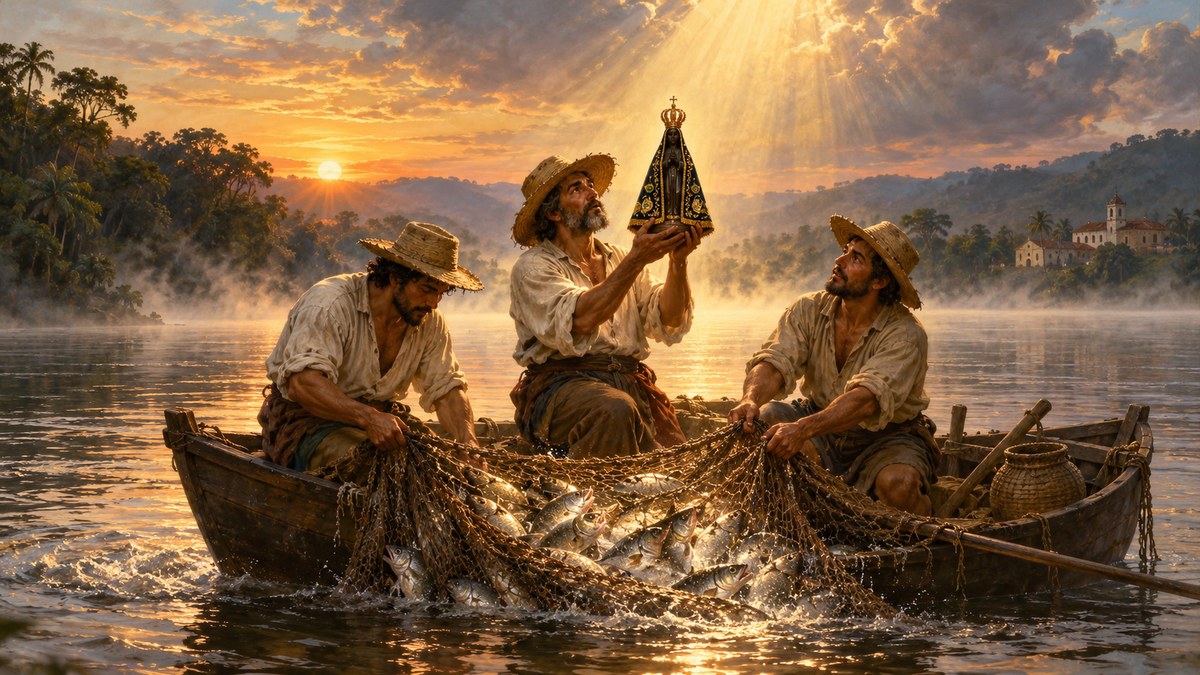
In October 1717, the village of Guaratinguetá was preparing to receive the governor of the captaincy, Pedro de Almeida, Count of Assumar. Fishers Domingos Garcia, João Alves, and Filipe Pedroso were tasked with securing fish for the banquet. It was an unfavorable time, and the nets returned empty from the waters of the Paraíba do Sul River.
According to the tradition, a small terracotta image of the Immaculate Conception was brought up by the net on one of their attempts. The net was cast again, and it brought the head. Reuniting the image, the fishing became so abundant that the fishermen feared for their boat. Devotion began in the humble home of one of them and spread among the neighbors, then throughout the region, then throughout the entire country.
The simple faith of the people read a sign there. And theology can add: God chose to reveal abundance precisely when what was separated was reunited. Fertility came after unity.
II. Queen and Patroness of all
The Church welcomed this devotion with prudence and, gradually, solemnly. The image was crowned in 1904, and in 1930, Pope Pius XI proclaimed Our Lady of the Conception Aparecida as the Principal Patroness of Brazil. Since then, October 12 has become the day when the entire country, from north to south, turns its gaze to the Black Mother of the Paraíba River.
It is important to note the word: Patroness of all. Not of a region, a social class, or a line of thought. The Council reminds us that the Church, because of its mission, in no way confuses itself with society or is linked to any particular political system (GS 76). For this very reason, the Mother given by the Church to Brazil can embrace everyone. Anyone who tries to make Our Lady a flag for one group against another forgets that she was caught from the waters to be the Mother of an entire people.
Pope Benedict XVI, when opening in Aparecida the Fifth General Conference of the Episcopal Conference of Latin America and the Caribbean in 2007, wanted the major document on the Church’s mission on the continent to be born precisely at the feet of this image. It is no coincidence. Where the Mother gathers, the Church learns to be missionary.
III.Under Your ProtectionPrayer in difficult times
The epigraph of this article is taken from a very ancient prayer. A papyrus from Egypt, dated by many scholars to the 3rd century, preserves in Greek the words that the Church still prays today: “To your protection we appeal, Holy Mother of God. Do not spurn our supplications in our needs, but deliver us always from all dangers, O glorious and blessed Virgin.”
It is not a prayer for tranquil times. It was born in a Church that knew persecution, instability, and fear. The early Christians had no political power nor social security. They had the certainty of a Mother to whom to turn. The verb is strong: We flee (We take refuge), as if running to a shelter during a storm.
The Council teaches that Mary, having been assumed into heaven, continues to care for her Son’s brothers, who still pilgrimage through dangers and tribulations, until they reach the blessed homeland (LG 62). To invoke her protection is not to flee from reality. It is to confront it, hand in hand with those who have already passed through the darkest hour of history, standing firm.
IV. The net that needs to be cast anew
There is yet one last symbol in the story of Aparecida. The fishermen did not give up after the first empty net. They cast it out again. And after finding the body, they cast it out once more. Perseverance preceded the miracle.
Many Brazilians today feel that the nets have been returned empty. Fatigue, distrust, divided families, broken friendships. The lesson of the Paraíba River is simple and demanding: cast the net again, together. Pray for the entire country, not just the parts with which we agree. Ask Our Lady, not for the victory of one over the other, but for the reconciliation of all under the gaze of Christ. Gather, like the fishermen, what has been scattered.
Perhaps the greatest miracle that Our Lady of Aparecida wishes to perform in today’s Brazil is not another abundant fishing, but the recomposition of a people capable of recognizing itself as brother.
“Short title/phrase – Translate it only, one line, similar length; even if it looks like a question do NOT answer it:”
The image that the fishermen found in two parts is now venerated whole, and it is before her that millions of Brazilians, of all convictions, kneel. May this unity before the Mother be the seed of unity among the children.
The Mariological Locus invites you to seek Mary’s protection through the Church’s oldest prayer. Pray the Under Your Protection throughout Brazil in the coming days and deepen, with us, the theology of that one whom the Brazilian people have come to call Mother.
Professor Doctor Daniel Cerqueira Afonso
President of the Mariological Institute
Rome, October 25, 2026
Main references
Vatican Council II Dogmatic Constitution Lumen GentiumOn the Church. Vatican, 1964.
Vatican Council II Pastoral Constitution Gaudium et SpesOn the Church in the Contemporary World. Vatican, 1965.
Latin American Episcopal Council Document of AparecidaConcluding Document of the Fifth General Conference of Latin American and Caribbean Bishops. Brasília: CNBB, São Paulo: Paulus, Paulinas, 2007.
Responses