Do angels have sex? Are angels male or female?
By Prof. Dr. Daniel C. Afonso · Updated
No. The Church teaches that angels are “purely spiritual creatures” (Catechism of the Catholic Church, no. 330), without a body, and sex is proper to beings that have a body. Therefore, in the proper sense, angels are neither men nor women. If the Bible shows them as men and we speak of them in the masculine, it is because they appear in human form to fulfill a mission, and not because they have a sex.
In summary
- Short answer: No. Angels are spirits, without a body, and therefore without sex (Catechism, nos. 328-330).
- What is of faith: that angels are spiritual beings, not corporeal. That this excludes sex is a theological conclusion, as these numbers from the Catechism do not address the subject.
- What Jesus says: At the resurrection, men will be “like the angels in heaven” (Mt 22:30), without marriage.
- Why they appear as men: Scripture describes them in human form, and the grammatical gender of ‘angel’ is masculine in Hebrew, Greek, and Latin. This is not sex.
- The Art: young, delicate or childlike angels are artistic conventions, not doctrine.
# What the Church Teaches: Pure Spirits
The Catechism states that the existence of “spiritual, non-corporeal beings” to which Scripture refers as angels is “a truth of faith” (n. 328). It goes on to describe what they are: “As purely spiritual creatures, they are endowed with intelligence and will: they are personal and immortal creatures” (n. 330). These passages do not address gender, but they state what matters to the question: the angel does not have a body.
The Fourth Lateran Council (1215) already distinguished the two orders of creatures that God created out of nothing, “the spiritual and the corporal, that is, the angelic and the mundane,” and only then named the human, “as common, constituted of spirit and body” (DH 800, our translation).
From this conclusion, theology draws: sex is a characteristic of living bodies, linked to generation, and a spirit without a body does not have it. It is a simple and coherent reasoning with the teaching of the Church, but it is important to separate what is of faith from what is a conclusion. The truth of faith is that angels are spirits. That they are neither male nor female follows from this.
St. Thomas Aquinas teaches that angels “do not have bodies naturally united to them” (Summa Theologica I, q. 51, a. 1), because understanding is not an act of a body, and thus having a body does not belong to the nature of an intelligent substance as such. This reasoning is a highly authoritative theological opinion, not a definition. We have explained this in “Do angels have a body?” (https://locusmariologicus.org/os-anjos-tem-corpo/), where one can also see how they assume bodies to appear.
And what body does the angel assume? Can it beget children?
When an angel appears in human form, that body does not live. For Saint Thomas, “nothing can have the work of life that does not have life” (I, q. 51, a. 3). The sixth argument of the same article cites Genesis 6, where the “sons of God” took as wives the “daughters of men” (Gen 6:2), to support that angels generate in assumed bodies. Saint Thomas responds that the holy angels “in no way could have fallen thus before the flood” and understands by “sons of God” the sons of Seth, who were good (I, q. 51, a. 3, ad 6).
Regarding demons, he states that if someone is born from such a union, it is not due to their seed or the bodies assumed, but through the seed of a man taken for that purpose (ibid.). These are his readings, and not definitions of the Church.
What Jesus says: “as the angels in heaven”
Asked by the Sadducees about marriage in the resurrection, Jesus replies: “In the resurrection they will neither marry nor be given in marriage, but are like the angels in heaven” (Mt 22:30, translated from the Nova Vulgata, with the Greek hôs ángeloi). Mark has the same saying (Mk 12:25). Luke expresses it thus: those who are deemed worthy of the resurrection “will no longer die, for they are equal to the angels” (Lk 20:36), and the Greek uses a single word, isángeloi.
The text deals with the life of the resurrected and does not define the nature of angels. But it assumes for them an existence that does not pass through marriage.
Why does the Bible show you as men?
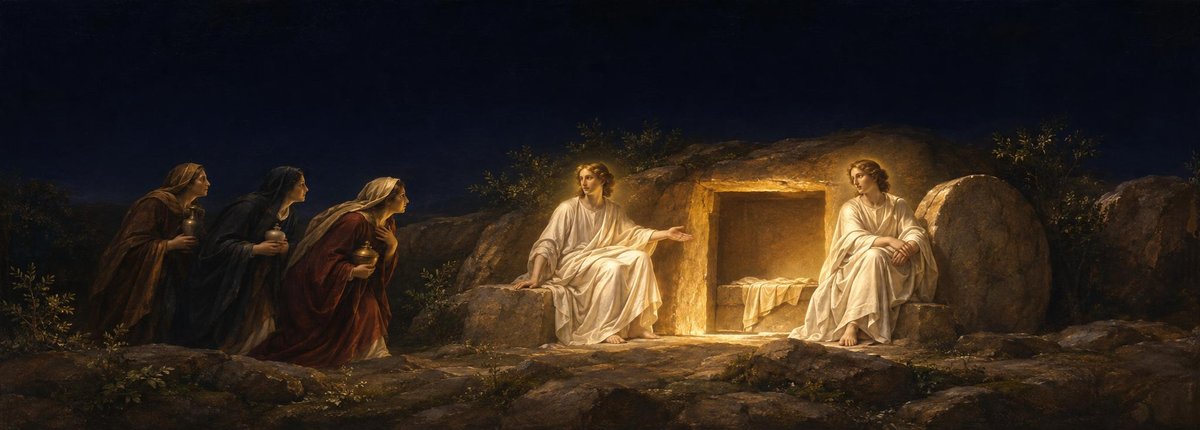
In biblical narratives, angels appear in human form. In Mamre, Abraham sees “three men” (Gen 18:2). Tobias encounters Raphael without recognizing him as an angel (Tob 5:4) and addresses him as a “young man” (Tob 5:5). At the tomb, the women meet “two men in gleaming vesture” (Lk 24:4), and later the disciples summarize that they had “seen an apparition of angels” (Lk 24:23). In Daniel, Gabriel is described as “the man Gabriel” (Dan 9:21), and the Hebrew uses hāʾîš, “the man.” Previously, the prophet had seen him with “the appearance of a man” (Dan 8:15).
Why do they appear in this way? St. Thomas teaches that angels assume bodies “not for themselves, but for us,” to converse familiarly with men (I, q. 51, a. 2, ad 1). The assumed body is a sign and does not make the angel a man (I, q. 51, a. 3, ad 1). The human form explains the appearance, and does not indicate gender.
There is one apparent exception. In Zechariah 5:9, the prophet sees “two women” with wings, but the text does not call them angels. The angel of the vision is another, the one who “spoke to me” (Zechariah 5:5, 10), and the women carry the ephah in which is the “iniquity” (Zechariah 5:8-9).
Michael, Gabriel, and Raphael: Names that Proclaim a Mission
The names of the three archangels named in Scripture reveal their mission. According to scholar George A. Barton, Michael is “who is like God?”, Gabriel is “man of God” or “hero of God”, and Raphael is “God’s healer” (Journal of Biblical Literature, 1912). That Gabriel means “man of God” does not make him a man.
This is what the Catechism recalls with Saint Augustine: “Angel (messenger) is a designation of a task, not of nature” (n. 329). The name indicates what the angel does, not what it is by nature.
“Angel,” “angelus,” “mal’āk”: grammatical gender is not sex
In the languages of the Bible, the word for “angel” is masculine. In Hebrew, it is malʾāk. In Genesis 16:7, it reads “he found her the angel of the Lord,” with the verb in the masculine singular (wayyimṣāʾāh), and in Genesis 19:1, it is “the two angels” (hammalʾākîm), in the plural masculine, with the verb also in the masculine plural (wayyābōʾû). In Greek, it is ángelos, with the masculine article: in Luke 1:19, “answering, the angel said” (ho ángelos). In Latin, it is angelus, as in “he did not know that he was the angel of God” (Tobit 5:4), where illum agrees in the masculine. The Portuguese “anjo” is also masculine.
But the gender of a word is not the sex of what it names. The Hebrew word for “spirit,” rûaḥ, takes the feminine verb form in Gen 1:2 (mᵉraḥepet, “moved”); and the Greek pneûma is neuter (Jn 4:24). The Catechism teaches something similar about God himself: “God transcends the human distinction of sexes. He is neither man nor woman, but God” (n. 239). Angels are creatures, not God, but male language does not make a spirit male.
Why did art paint you that way?
Art historian Marco Bussagli observes that the biblical tradition is “univocal” in describing angels as having “the appearance of men,” and that early Christian artists dressed them in the pallium, a male cloak (Historia degli angeli, 1991). He also notes that winged victories in pagan art were female figures, while Christian angels, despite having common wings, were men and wore male clothing.
Later, he states, artists began to attribute feminine features and clothing to angels, a typology that, with exceptions, spread from the end of the Middle Ages. He attributes this to two currents: one, linked to biblical text, sees angels as male beings, and the other, of philosophical root, draws angels close to souls. He concludes: “There is no rule in practice: everything depends on the artist’s discretion.”
Angelic children, the “putti,” are also an artistic convention. None of these images is doctrine. Faith teaches that angels are spirits, and art employs the human figure, of any age or feature, as a sign.
What does this mean for us?
Saying that angels do not have sex does not make them impersonal forces. The Catechism states that they are “personal creatures” (n. 330), with intelligence and will. We refer to them in the masculine by habit of language and because of the human form in which Scripture depicts them. When one prays to Saint Michael, Saint Gabriel, or Saint Raphael, one addresses persons, not men or women. For what the Bible says about them, see Angels in the Bible.
## Frequently Asked Questions
Os anjos têm sexo?
Não. O Catecismo os descreve como «criaturas puramente espirituais» (n. 330) e «seres espirituais, não-corporais» (n. 328). O sexo pertence a corpos vivos, e por isso a teologia conclui que os anjos não são homens nem mulheres. A fé afirma que são espíritos, e essa conclusão decorre dela.
Anjos são homens ou mulheres?
Nem uma coisa nem outra. A Bíblia os mostra em forma de homem (Gn 18,2, Lc 24,4, Dn 9,21), mas é a forma que assumem para aparecer. Para São Tomás, o corpo assumido não vive e é sinal (I, q. 51, a. 3).
Por que Miguel, Gabriel e Rafael têm nomes masculinos?
Os nomes dizem uma missão: «quem é como Deus?», «homem de Deus» e «curador de Deus», segundo Barton (1912). O Catecismo recorda, com Santo Agostinho, que «anjo» é designação de encargo e não de natureza (n. 329). Nome e gênero gramatical masculinos não dão sexo a um espírito.
Os anjos se casam ou têm filhos?
Não. Jesus diz que na ressurreição os homens «nem se casarão nem serão dados em casamento, mas são como os anjos no céu» (Mt 22,30). Quanto a Gn 6, São Tomás entende «filhos de Deus» como os filhos de Set e diz que os santos anjos não puderam cair assim (I, q. 51, a. 3, ad 6).
Por que a arte pinta anjos como crianças ou mulheres?
É convenção de artistas, e não doutrina. Bussagli observa que os traços femininos se difundem a partir do fim da Idade Média e que, nessas imagens, tudo depende do arbítrio do artista. Os anjos-crianças, os «putti», também são convenção artística.
## References
- SACRED SCRIPTURE: Gen 1:2, 6:2, 16:7, 18:2, 19:1, Dn 8:15, 9:21, Zech 5:5-10, Tb 5:4-5, Mt 22:30, Mk 12:25, Lk 1:19, 20:34-36, 24:4.23, Jn 4:24. Our translations from the Nova Vulgata (Libreria Editrice Vaticana, vatican.va), confirmed with the Hebrew (Westminster Leningrad Codex) and Greek (SBLGNT) texts.
- Catechism of the Catholic Church, nos. 239 and 328-330.
- Fourth Lateran Council (1215), Chapter 1, On Catholic Faith. In: Denzerger, Heinrich, Hunermann, Peter. Enchiridion Symbolorum, no. 800. Our translation.
- THOMAS AQUINAS. Summa Theologiae I, q. 51, a. 1-3 (body and answers). Latin text: Corpus Thomisticum, Textum Leoninum, corpusthomisticum.org/sth1050.html. Our translation.
- BUSSAGLI, Marco. History of Angels: A Tale of Images and Ideas. Milan: Rusconi, 1991. Our translations.
- BARTON, George A. The origin of the names of angels and demons in the extra-canonical apocalyptic literature to 100 A.D. Journal of Biblical Literature, v. 31, p. 156-167, 1912.
Responses