“Woman, Why Are You Weeping?”: Mary and the Paschal Joy Born of Tears
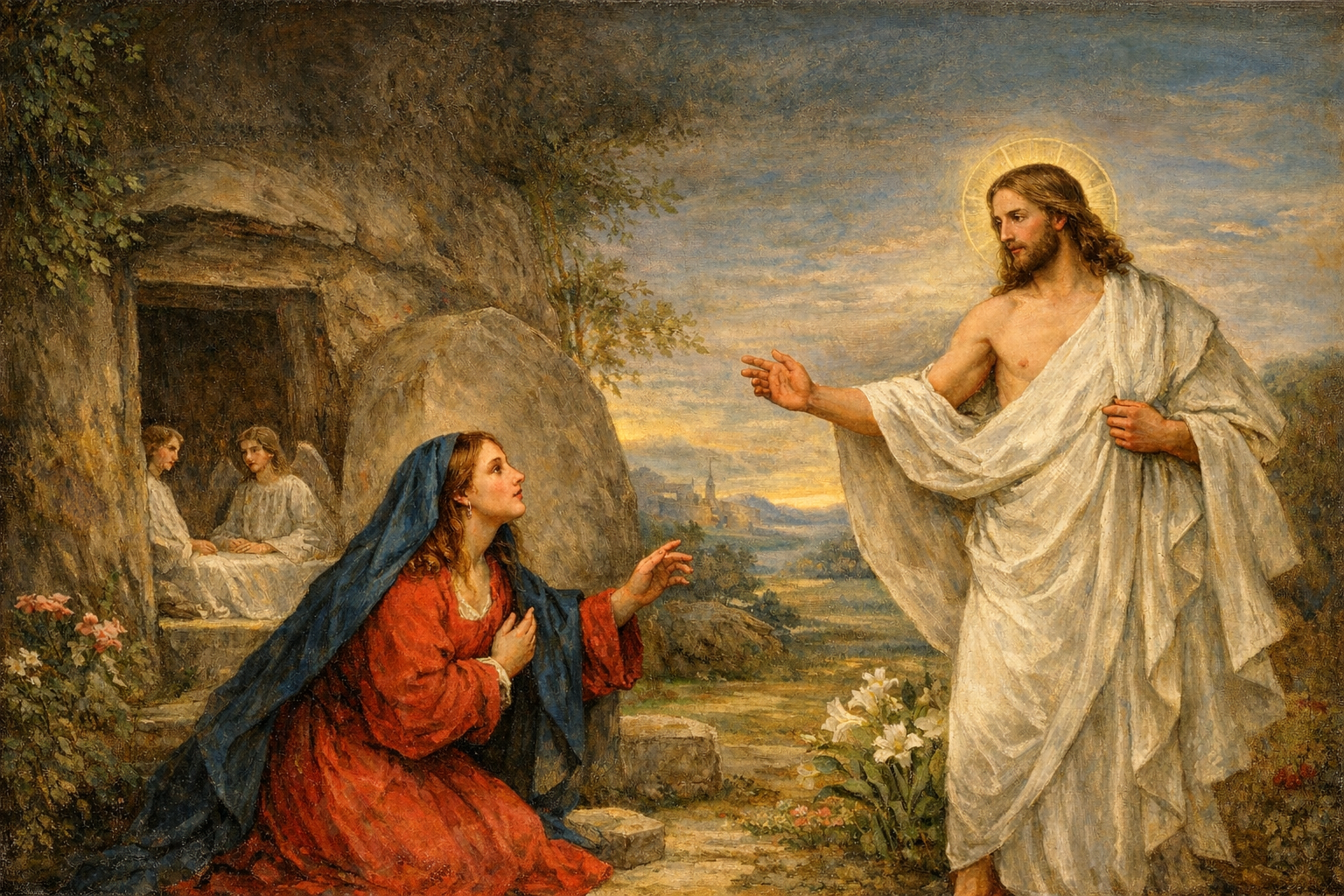
“Woman, why are you weeping? Whom are you looking for?”
Jn 20:15, Gospel for Easter Tuesday
A Mariological meditation on the readings for Easter Tuesday
Mary, Paschal joy, the joy born of tears, lies at the heart of Easter Tuesday. Its liturgy centers on an encounter that Christian tradition has contemplated with unceasing wonder: the appearance of the Risen One to Mary of Magdala beside the empty tomb (Jn 20:11-18).
The question “Woman, why are you weeping? Whom are you looking for?” (Jn 20:15) is not merely a challenge belonging to the past: it is the question that the glorified Christ continues to address to the Church and to every soul that, amid tears, still seeks the Living One among the dead. Paschal Mariology discovers in this Johannine text a profound echo of the mission of Mary, Paschal joy: the Mother who kept all things in her heart (Lk 2:19, 51) is also the Mother who teaches her children to recognize in the voice of the Son the life that no stone can contain.
I. Mary, Paschal joy: the metanoia of Acts 2:36-41
The liturgy opens with Peter’s Pentecost discourse: “Let the whole house of Israel know that God has made this Jesus whom you crucified both Lord and Christ” (Acts 2:36). The metanoia that Peter demands in response to the kerygma is the first Paschal fruit. Mary of Nazareth was present in the Upper Room when this discourse resounded (cf. Acts 1:14). The Encyclical Redemptoris Mater teaches that “Mary, by believing, preceded the disciples in faith” (RM 26). In Mary, humanity learned to recognize in the Crucified One the Lord and the Christ.
The Directory on Popular Piety and the Liturgy recalls that “Mary is a figure of the Church, which continually begets the children of God” (no. 9). The Church “learns from Mary to be a mother” (Redemptoris Mater 43). Paschal metanoia is, at its deepest root, the fruit of Mary, Paschal joy, the joy that Mary transmits to all those who turn their tears into faith.
II. The Gospel: Jn 20:11-18 and the pedagogy of Paschal mourning
John paints a scene of utter mourning: Mary of Magdala “stood outside by the tomb, weeping” (Jn 20:11). And it is precisely when she turns, “she turned around” (v. 14), that she sees the Risen One. This physical turning is the figure of the spiritual conversion that Easter brings about: the Living One is not found by looking at the tomb.
Rupert of Deutz (d. 1130) identified in Mary Magdalene the type of the Church as Bride weeping for the Bridegroom. Mary of Magdala “goes to announce” (Jn 20:18) only because she herself was evangelized by the Risen One. This is the fundamental Mariological pattern: to receive before transmitting. This is Mary, Paschal joy: receiving Paschal joy from Mary in order to be able to proclaim it.
III. Noli me tangere: the new presence and the faith that does not imprison
The command of the Risen One, “Do not touch me, for I have not yet ascended to the Father” (Jn 20:17), has been meditated upon by tradition as the weightiest statement on the nature of Paschal faith. The Noli me tangere is not a rejection: it is a pedagogy. Mary of Magdala recognizes Jesus when He calls her by name: “Mary” (Jn 20:16), the same pattern as the Good Shepherd (Jn 10:3). Mary of Nazareth, who heard the name “Mary” from the mouth of the angel (Lk 1:28), is the model of one who responds to the voice before seeing the face.
IV. Mary Magdalene, apostola apostolorum, and the motherhood of Mary
The mandate entrusted to Mary of Magdala: “Go to my brothers and tell them: I am ascending to my Father” (Jn 20:17). Tradition has honored her with the title apostola apostolorum. But this title presupposes the uniqueness of Mary of Nazareth: if Mary Magdalene can proclaim the Resurrection, it is because the One who rose was born of a Woman who said yes before any apostle. Redemptoris Mater states that “the Virgin Mary is present in the Church as Mother of the Lord and continues to intercede for her children” (RM 40).
What is the Mariological meaning of the question “Woman, why are you weeping?” in Jn 20:15?
The Risen One’s question to Mary of Magdala, “Woman, why are you weeping? Whom are you looking for?”, is read by Mariology as an invitation to turn mourning into Paschal joy. The address “Woman” echoes Jn 19:26, where Christ uses the same vocative for His Mother on Calvary, establishing a typology: the “woman” who wept at the Cross is the same one who is called to bear witness to the Resurrection. Paschal joy is always born of tears: this is the spiritual itinerary that Mary teaches the Church.
What does “Noli me tangere” mean in Marian spirituality?
“Do not touch me” (Jn 20:17) is interpreted by the patristic and Mariological tradition as an invitation to a new form of presence and of faith. Rupert of Deutz identified in Mary of Magdala a figure of the Church that still seeks Christ in the mode of the physical presence prior to the Resurrection. Mariology sees a teaching here: Mary the Mother was the first to live this faith without attachment to sensible presence, keeping the Word in her heart. Mature faith does not hold on, but sends forth: “Go and proclaim!”
Why is Mary of Magdala called “apostola apostolorum,” and what is her place in Mariology?
The title “apostola apostolorum” (apostle to the apostles), given to Mary of Magdala by the Fathers of the Church, underlines that she was the first to announce the Resurrection to the Twelve (Jn 20:18). Paschal Mariology distinguishes the two Marys: Mary the Mother, who kept the faith during Holy Saturday without needing to see the empty tomb, and Mary Magdalene, who receives the mandate to proclaim. Together, they represent the two poles of the ecclesial vocation: faithful contemplation and proclaiming mission.
Deepen your studies: explore Mariology, Marian Theology, Marian apparitions, and the Postgraduate Program in Mariology.
Mary, Paschal joy, invites us to learn from Mary of Magdala to transform mourning into proclamation. The garden of the tomb is the garden of the new creation: there where mourning is transformed into the name spoken aloud. And the name that changes everything is always the same: “Mary”. As Redemptoris Mater (no. 20) recalls, Mary is the first to receive Paschal joy. See also: The Burning Heart, Mary and Emmaus: Recognizing the Risen One and Pax vobis, Mary: Paschal Peace.
Prof. Daniel Afonso,
Rome, Easter Tuesday, April 7, 2026
Postgraduate Program in Mariology
Would you like to deepen your formation in Mariology? Discover the Postgraduate Program in Mariology of Locus Mariologicus, an academic formation that unites theological rigor, spiritual life, and the living tradition of the Church.
Would you like to study Mariology seriously?
This article grows out of the works in the Locus Mariologicus library. The Postgraduate Program in Mariology takes you to the same source, with academic guidance: Scripture, the Fathers of the Church, and the Magisterium, from the first dogma to contemporary questions.





Responses