Caro meus very est cibo: Mary and the Truth of the Eucharist
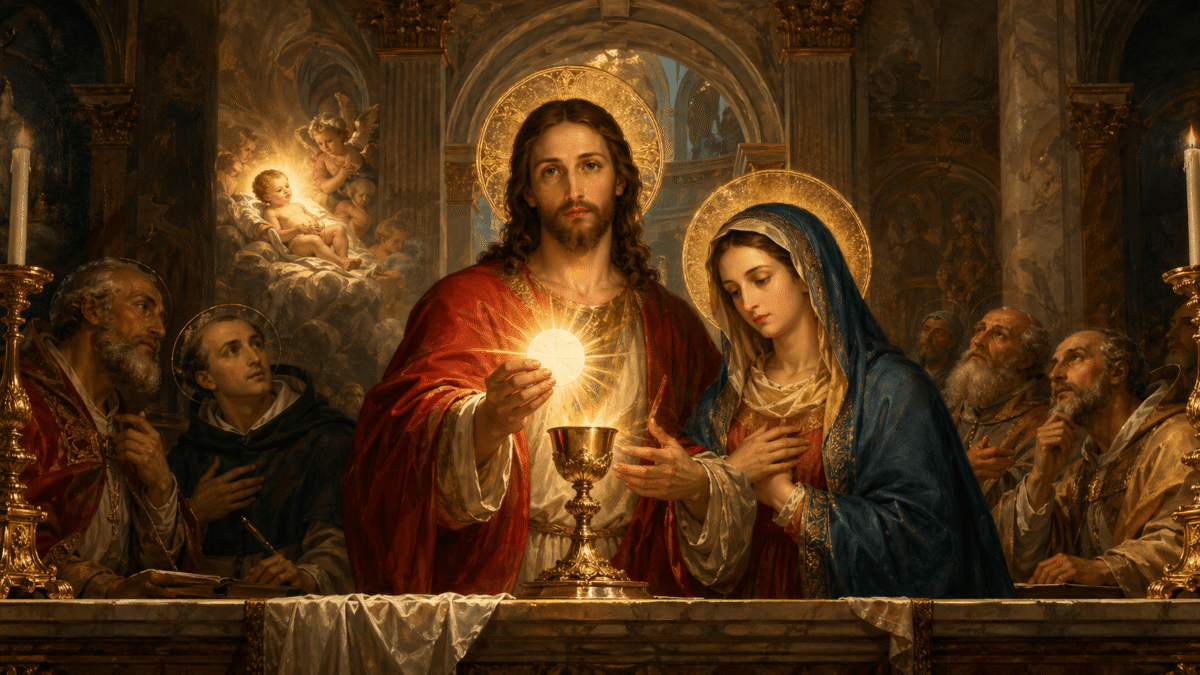
Caro mea vere est cibo, et sanguis meus vere est potus.
Jn 6:55
“My flesh is truly food, and my blood is truly drink.” With this verse of Jn 6, Jesus intensifies His discourse on the Bread of Life to such a degree that many of His disciples abandon Him: “This is a hard saying. Who can listen to it?” (Jn 6:60). Here lies the densest, most unbearable, and most glorious core of the fourth Gospel: the Son of God offers His flesh as food and His blood as drink. Mariology finds in this Eucharistic mystery its deepest foundation: the flesh that Jesus offers is the flesh He received from Mary.
I. The Word “Truly”: Eucharistic Realism and the Incarnation
Jn 6:55 uses the adverb alethōs, “truly,” twice: Jesus’ flesh is truly food, His blood is truly drink. This “truly” is an anti-Docetic affirmation: the Son of God does not have an apparent or symbolic flesh; He has real, human flesh, which can be eaten as real food. The force of this affirmation can be understood only against the historical background of the controversy with Docetism, which denied the reality of Jesus’ flesh.
The Eucharistic “truly” points directly back to the “truly” of the Incarnation. The flesh that Jesus offers as food is the same flesh He assumed in Mary’s womb: human flesh, with all its dimensions of frailty, history, and temporality. The Eucharist is not the presence of some generic divinity; it is the presence of Jesus of Nazareth, the son of Mary, with His particular history, with His concrete and unrepeatable humanity.
The Fathers of the Church explored this connection in depth. Ignatius of Antioch, resisting Docetism, insisted that the Eucharist is “the flesh of our Savior Jesus Christ, the flesh that suffered for our sins and that the Father, in His goodness, raised up.” This risen flesh is the same flesh that was born of Mary: glorified, but not dehumanized. The resurrection does not suppress the humanity of Jesus: it transfigures it and elevates it, yet preserves it as the permanent mediation of the encounter with God.
The connection between the Incarnation and the Eucharist is one of the great themes of patristic and medieval Eucharistic theology. St. Thomas Aquinas, in the Summa Theologiae III q.73-83, developed the idea that the Eucharist is the culmination of the Incarnation: the Son of God not only assumes humanity in Mary but makes His humanity the permanent food of the Church. The Incarnation is the presupposition of the Eucharist. The Eucharist is the dynamic prolongation of the Incarnation.
II. The Flesh of Mary: Foundation of the Eucharistic Flesh
From early on, Mariological theology formulated the intuition that there is a direct connection between the flesh of Mary and the Eucharistic flesh of Jesus. The most direct Latin expression comes from Pseudo-Augustine, but the intuition runs through the whole tradition: “caro Christi, caro Mariae,” the flesh of Christ is the flesh of Mary. The Son of God did not bring His flesh from Heaven: He received it from Mary by the action of the Holy Spirit.
In the eleventh century, St. Peter Damian exclaimed: “What we eat at the altar is what was born of Mary, what grew up in Nazareth, what was crucified on Calvary.” This identity is not merely biological; it is theological, soteriological, Eucharistic. The flesh that Jesus received from Mary is the same flesh He offers to the Church as food: not a generic flesh, but a flesh with a history, with a face, with a mother.
Eadmer of Canterbury, a disciple of Anselm, deepened this intuition in the context of the debate over the Immaculate Conception: if the Eucharistic flesh of Jesus comes from Mary, then Mary’s holiness has direct implications for the holiness of the Eucharist. The Mother who provided the Son with His flesh could not be less pure than the dignity of the mystery she brought forth demanded. From this came the argument from fittingness for the Immaculate Conception: the Son who makes Himself food for the Church deserved a Mother whose flesh was immaculate.
The liturgy has expressed this connection in the Solemnity of Mary, Mother of God (January 1), and in the ancient votive Masses of Mary, where contemplation of the Mother led to contemplation of the Eucharistic Son. Advent, which prepares for the coming of the Son, is the Marian season par excellence, and the Eucharist is the “permanent presence of Advent,” the mystery in which the Son continues to “come” into the world through His flesh.
III. “Whoever Eats My Flesh Abides in Me”: Eucharistic communio and the Marian Model
Jn 6:56: “Whoever eats my flesh and drinks my blood abides in me, and I in him.” The theme of “abiding” (menein), central to the fourth Gospel, appears here in a Eucharistic context. The Eucharist is the sacrament of abiding: whoever receives it enters into a real and stable communio with Christ, which persists beyond the sacramental moment and progressively conforms the believer to the Lord.
Mary, who for nine months carried the Son in her womb, is the most perfect image of this Eucharistic communio. She was the first “tabernacle,” the first to “receive” the Body of Christ in the most literal sense. The Fathers explored this analogy with great fruitfulness: Mary’s womb is the most sacred “temple,” where the Word “dwelt,” eskēnōsen, in a full and unrepeatable way (Jn 1:14).
Medieval Eucharistic mysticism, particularly that of St. Bonaventure, St. Gertrude of Helfta, and Blessed Angela of Foligno, developed a contemplation of Mary as the model of Eucharistic communion. To receive the Eucharist is, in a certain sense, to repeat Mary’s “fiat”: to open one’s heart to the coming of the Son, to become a “place” where He dwells. Eucharistic communion is not a passive act; it is an active welcome, a renewed “yes” to the Son who comes.
The expression Anima Christi, the ancient Eucharistic prayer, asks to be “absorbed” into the body of Christ: “In hora mortis meae voca me, et iube me venire ad te” (“In the hour of my death call me, and bid me come to You”). This desire to “abide” in Christ to the very end is precisely what Mary accomplished in an exemplary way: she who always lived in communion with the Son, who never drew away from Him, neither at the Cross nor in the Upper Room, is the model of the Christian who “eats the flesh” of Christ and “abides” in Him.
IV. The Eucharist and the Hope of the Resurrection: Mary Assumed and the Glorified Flesh
Jn 6:54: “Whoever eats my flesh and drinks my blood has eternal life, and I will raise him up on the last day.” The Eucharist is not merely food for the present; it is the seed of the future resurrection. The glorified flesh of Christ, received sacramentally, transforms the body of the believer from the inside out, directing it toward its definitive glorification.
From this perspective, the Assumption of Mary is the anticipated fulfillment of the Eucharistic promise. She who bore in her body the flesh of the Son, flesh that would become Eucharistic, was herself taken up body and soul into glory. Mary’s body, which was the first “tabernacle” of the Eucharist in a broad sense, was the first to share in the glorification that the Eucharist promises to all the faithful.
The theology of the Assumption and Eucharistic theology thus converge profoundly: both affirm the dignity of human flesh as destined for transfiguration and glory. Both resist the spiritualism that devalues the body. Both are grounded in the real Incarnation of the Son of God. The flesh that Jesus took from Mary, that He offers in the Eucharist, and that He glorified in the Resurrection and in the Assumption of Mary, is always the same flesh: not a symbol, but a reality.
Eucharistic contemplation thus leads naturally to Marian contemplation: to look at the Host and remember where that flesh comes from. Remembering Mary when celebrating the Eucharist is not a sentimental devotion; it is a theological requirement: the flesh of Christ in the Eucharist is the flesh He received from Mary, and to contemplate it without remembering the Mother is to forget an essential dimension of the mystery of the Incarnation.
“Caro mea vere est cibus”: the flesh that Jesus offers is the flesh He received from Mary. To contemplate the Eucharist is to contemplate the mystery of the Incarnation in the Virgin’s womb.
References
- St. Thomas Aquinas, Summa Theologiae III q.73-83.
- Pius XII, Munificentissimus Deus, no. 14 (1950).
- John Paul II, Ecclesia de Eucharistia, chap. VI: “At the School of Mary, ‘Woman of the Eucharist’” (2003).
- Ignatius of Antioch, Ad Smyrnaeos 7.
- Eadmer of Canterbury, De Excellentia Virginis Mariae.
Postgraduate Program in Mariology
Would you like to deepen your formation in Mariology? Discover the Postgraduate Program in Mariology at Locus Mariologicus – an academic formation that unites theological rigor, spiritual life, and the living tradition of the Church.
Would you like to study Mariology seriously?
This article grows out of the works in the Locus Mariologicus library. The Postgraduate Program in Mariology takes you to the same source, with academic guidance: Scripture, the Fathers of the Church, and the Magisterium, from the first dogma to contemporary questions.





Responses