Miserére nobis, fili David: Saint Maximilian Kolbe, Compassion, and Mary Immaculate
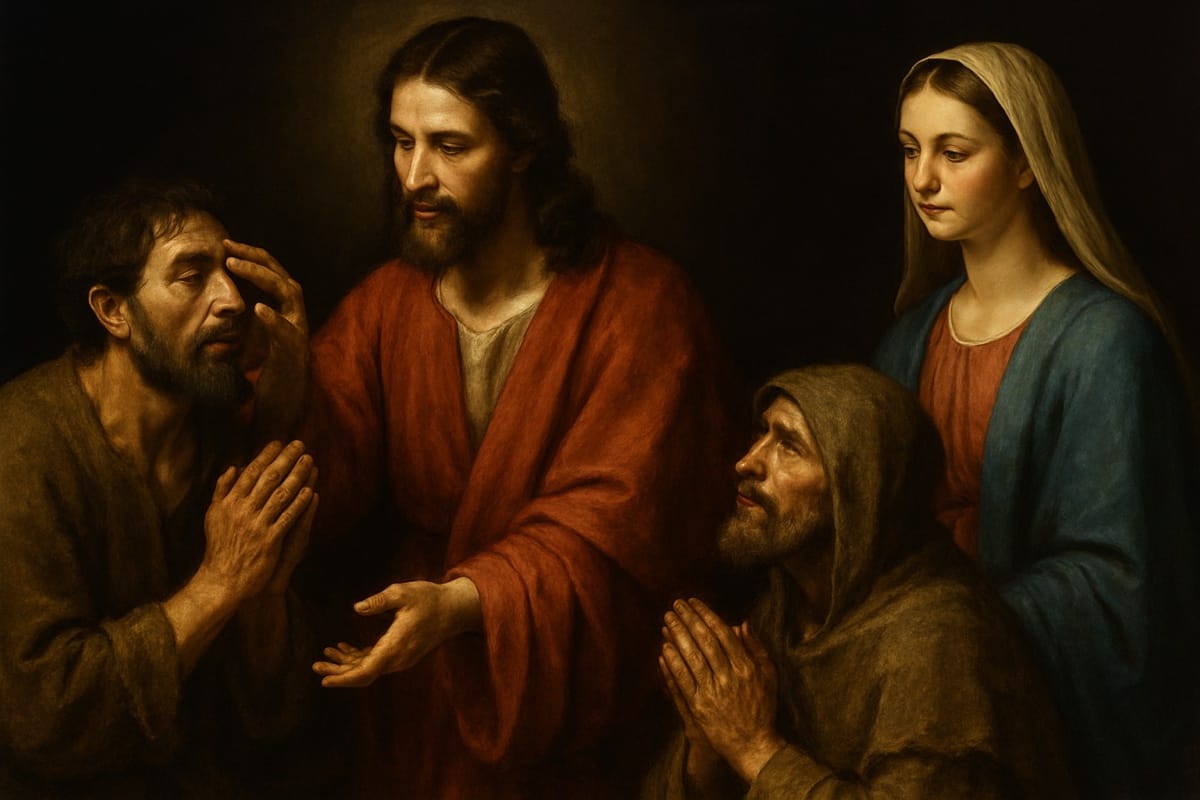
Et ecce duo caeci sedentes secus viam, audientes quia Iesus transiret, clamaverunt dicentes: Domine, miserere nostri, fili David! […] Misertus autem eis Iesus, tetigit oculos eorum. Et confestim viderunt et secuti sunt eum.
Mt 20:30-34
Mt 20:29-34, the healing of the two blind men of Jericho, is the last miracle in Matthew before the triumphal entry into Jerusalem. Its position is theologically significant: Jesus, who has just taught service as the law of the Kingdom (Mt 20:28), immediately performs the most concrete service, the healing of the blindness of two anonymous men at the roadside. The “miserere nostri”, “have mercy on us”, is the cry that runs through centuries of Christian prayer: the awareness of one’s own frailty that implores the compassion of Jesus.
On August 14 the Church celebrates the Memorial of Saint Maximilian Mary Kolbe (1894-1941), a Polish Franciscan priest, martyred in the Auschwitz-Birkenau concentration camp. Maximilian voluntarily offered his life in place of a fellow prisoner condemned to death by starvation, Franciszek Gajowniczek, a father of a family. This offering is the most radical “miserere nostri”: not merely the cry of one’s own need but the surrender of one’s own life for the need of another.
I. “Miserere nostri”: The Cry of the Blind Men and the Response of Jesus
The two blind men of Jericho cry out, “Lord, have mercy on us, Son of David!” and the crowd rebukes them so that they will be silent. The crowd’s rebuke, which wants to see Jesus pass by in silence, without interruptions, is the temptation to silence the cry of those who suffer: the anonymous, the marginal, the one who has no institutional voice. But the blind men “cried out all the more” (Mt 20:31), the persistence of desperation that does not yield to social pressure. Jesus stops, calls them, and asks: “What do you want Me to do for you?” (Mt 20:32), the question that respects the specificity of each need.
“Lord, let our eyes be opened” (Mt 20:33), the answer of the blind men is the most elementary prayer of the human being: the awareness of one’s own blindness and the request to see. “Jesus, moved with compassion, touched their eyes” (Mt 20:34), the verb “moved with compassion” (ἐσπλαγχνίσθη, literally “he was moved in his inmost being”) describes the most visceral reaction of Jesus before human suffering. The healing is not a distant gesture but a touch, the physical contact that communicates divine compassion.
Those who were healed “followed Him” (Mt 20:34), the healing is not an end in itself but an opening to discipleship. To see with open eyes means to see Jesus, to follow Jesus, to walk the road that Jesus walks, the road that leads to the Cross. The disciple who has received healing is invited to see what he did not see before: that the way of the Messiah passes through suffering, and that the mercy he has received he is called to exercise toward others.
II. Saint Maximilian Kolbe: The “Miserere” Lived unto Death
Maximilian Kolbe was born in 1894 in Poland and entered the Conventual Franciscan Order. In 1917, in Rome, he founded the “Militia Immaculatae” (MI), a movement of Marian apostolate that became one of the largest lay organizations in the Church of the twentieth century. He returned to Poland and founded the shrine-city of Niepokalanów (1927), the largest Franciscan friary in the world, with more than 700 friars and a printing house for the apostolate.
In 1939, with the German invasion of Poland, Maximilian remained at Niepokalanów to help the refugees, including thousands of Jews. Arrested in February 1941, he was sent to Auschwitz. In July 1941, after an escape, ten prisoners were condemned to death by starvation as a reprisal. Maximilian asked to take the place of Franciszek Gajowniczek, who was weeping for his children. The commandant accepted. Maximilian died on August 14, 1941, after three weeks, from an injection of phenol.
III. Mary Immaculate: The Center of the Spirituality of Saint Maximilian
The Marian devotion of Maximilian Kolbe was not a peripheral element of his spirituality, it was its center. The Militia Immaculatae had as its aim “the conversion of sinners through the intercession of Mary Immaculate”. The choice of the title “Immaculate” is theologically precise: Mary without original sin is the model of sight without blindness, the one who always saw the mystery of God with clarity because the “blindness” of sin never affected her.
Maximilian developed an original Marian theology: Mary as “the Immaculate Conception”, not only the one who was conceived immaculately but the one who is, in a certain way, the personification of the Immaculate Conception as an eternal act of God. This intuition draws close to the theology of Duns Scotus and to the Franciscan spirituality that sees in Mary the most perfect Creature that came forth from the hands of God. The “miserere nostri” of Mt 20:30 has in Mary its privileged mediation: she who is “immaculate” intercedes for those who are “blind” through sin.
The offering of Maximilian’s life for Franciszek Gajowniczek is the concrete application of his Marian devotion: Mary who intercedes for sinners (as the Magnificat proclaims, “his mercy from generation to generation”) finds in Maximilian her human instrument. The “miserere nostri” that the blind men of Jericho address to Jesus, Maximilian addresses by proxy to another: “have mercy on this father of a family, I will take his place”.
IV. “Aperti sunt oculi eorum”: The Sight That Saint Maximilian Opened
Those healed by the “miserere” of Jesus “saw and followed Him” (Mt 20:34), the healing of blindness opens onto discipleship. Maximilian “opened the eyes” of millions of people: the Militia Immaculatae today numbers more than three million members throughout the world. Niepokalanów continues to function as a publishing and spiritual center. The “fruit” of his life, and of his death, far exceeds human calculation, like the grain that falls into the earth and yields hundreds of fruits.
Beatified in 1971 and canonized in 1982 by John Paul II, himself a Pole and a devotee of Mary, Maximilian was canonized as a “martyr of charity”: he died not merely for a cause but for a person. This specificity is theologically important: Christian mercy is not abstract but concrete, love for this particular human being, with a name and children. The “miserere nostri” of Mt 20:30 has this concreteness: not “mercy for the blind in general” but for these two who are here.
The vigil of the Assumption on which Maximilian died is theologically eloquent: he who lived wholly consecrated to Mary Immaculate died on the day before the feast on which Mary is exalted in the body into glory. The “blindness” of Auschwitz was answered by a man who saw with eyes opened by mercy: who saw in the other not the tattooed number but the face of a brother, and who said “miserere nostri” not for himself but in the name of another.
Postgraduate specialisation in Mariology
Would you like to deepen your formation in Mariology? The Locus Mariologicus postgraduate programme is a specialisation that brings together theological rigour, spiritual life and the living tradition of the Church. The next class begins in 2027.
Would you like to study Mariology seriously?
This article grows out of the works in the Locus Mariologicus library. The Postgraduate Program in Mariology takes you to the same source, with academic guidance: Scripture, the Fathers of the Church, and the Magisterium, from the first dogma to contemporary questions.



Responses