I am the gate: Acts 2, 1 Pet 2, and the Good Shepherd in Jn 10 (Fourth Sunday of Easter)
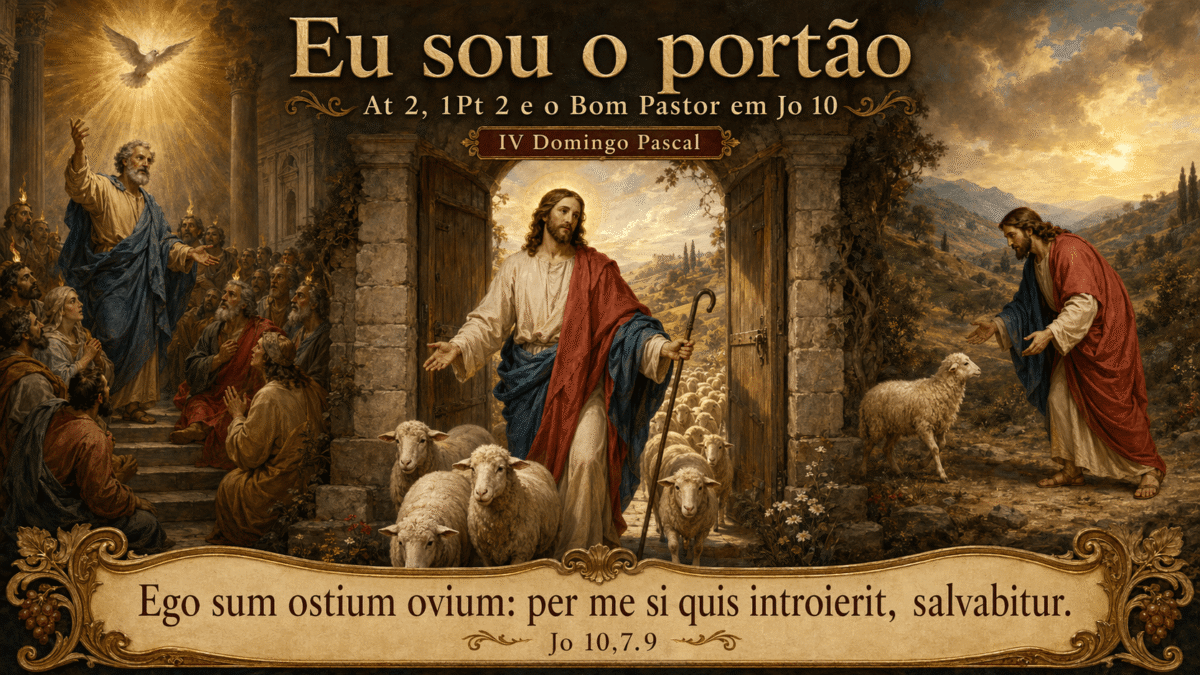
Ego sum ostium ovium: per me si quis introierit, salvabitur.
Jn 10:7, 9
The Fourth Sunday of Easter of Year A, Good Shepherd Sunday, brings together three texts around the figure of the shepherd and the sheep. Acts 2:14a, 36-41 concludes Peter’s discourse at Pentecost: God has made both Lord and Christ the Jesus whom you crucified. The crowd, cut to the heart, asks what it must do, and Peter invites them to baptism. 1 Pet 2:20b-25 presents Christ as the model of innocent suffering and as the Shepherd to whom the straying sheep return. Jn 10:1-10 offers the parable of the shepherd and the gate: Jesus is the gate of the sheep through which one enters to be saved and to find pasture. The three texts describe the same reality: the Risen Lord who calls, who receives, who feeds those who enter through the one door.
I. The First Reading: Acts 2:14a, 36-41
Peter concludes the Pentecost discourse with a solemn affirmation: “Let the whole house of Israel know for certain that God has made both Lord and Christ this Jesus whom you crucified” (Acts 2:36). The proclamation of Christ’s lordship is the core of the primitive kerygma. The crowd is cut to the heart and asks: “What are we to do, brothers?” (v. 37). Peter answers: “Repent, and let each one of you be baptized in the name of Jesus Christ for the forgiveness of your sins, and you will receive the gift of the Holy Spirit” (v. 38). The promise is for them, for their children, and for all whom the Lord will call. On that day, about three thousand people were baptized (v. 41). The Pentecost discourse is the historical birth of the Church: from the proclamation of the resurrection to baptism, in a single day, through the opening worked by the Holy Spirit.
II. The Second Reading: 1 Pet 2:20b-25
Peter exhorts Christians to bear unjust suffering, presenting Christ as the model: “If you suffer for doing good and bear it patiently, this is a grace before God” (1 Pet 2:20b). Christ suffered for you, leaving you an example that you might follow in His steps: “He committed no sin, nor was there deceit in His mouth; when He was insulted He did not answer with insults. When He suffered He did not threaten, but handed Himself over to the One who judges justly” (vv. 22-23). He bore our sins in His body upon the tree so that, dead to sin, we might live for righteousness. “You were like straying sheep, but now you have returned to the Shepherd and guardian of your souls” (v. 25). The figure of the shepherd and the straying sheep comes from Is 53, the song of the Suffering Servant: Christ is the shepherd who is at the same time the sheep sacrificed for all the others.
III. Evangelium: Jn 10:1-10
Jesus uses an image from the pastoral world of Palestine. The one who enters through the gate of the sheepfold is the shepherd: the gatekeeper opens the door to him, the sheep hear his voice, he calls his own sheep by name and leads them out. They follow him because they know his voice (Jn 10:3-4). The Pharisees do not understand the image. Jesus makes it clear: “I am the gate of the sheep” (v. 7). Those who came before Him were thieves and robbers: the sheep did not follow them. “I am the gate: if anyone enters through Me, he will be saved. He will be able to come in and go out and will find pasture” (v. 9). The thief comes only to steal, to kill, and to destroy. Jesus came “that they may have life and have it in abundance” (v. 10). The parable describes the relationship between Jesus and each of the faithful with three elements: mutual knowledge (the shepherd knows the sheep by name, the sheep recognize the shepherd’s voice), security (to come in and go out through the gate is to be protected), and fullness (not mere survival but life in abundance).
IV. Mary and the Sheep That Never Strayed
1 Pet 2 cites Is 53, saying that Christians were like straying sheep before they returned to the Shepherd. Mary is the singular exception: the sheep that never strayed. By the grace of the Immaculate Conception, Mary never followed the path of the lost sheep, never needed to be won back. Jn 10 says that the shepherd calls his own sheep by name and they recognize his voice: at the Annunciation the angel called Mary by name, “full of grace,” and she immediately recognized the voice of the eternal Shepherd of Israel. Mary’s response on being called by name was the fiat: the sheep that follows the shepherd without hesitating. Acts 2 recounts the birth of the Church at Pentecost with three thousand baptized: Mary was present in that Upper Room (Acts 1:14), Mother of the community that was being born. Each of those three thousand was entering through the gate of Christ, whom Mary received into her womb thirty-three years before. Good Shepherd Sunday invites the disciple to recognize the voice of the One who calls him by name, as Mary recognized it, and to enter through the gate that gives life in abundance.
Postgraduate Program in Mariology
Would you like to deepen your formation in Mariology? Discover the Postgraduate Program in Mariology of Locus Mariologicus – an academic formation that unites theological rigor, spiritual life, and the living tradition of the Church.





Responses