The multitude of all saints: Rev 7; Jn 3, and the Beatitudes in Mt 5
By Prof. Dr. Daniel C. Afonso · Updated
Blessed are the poor in spirit, for theirs is the kingdom of heaven.
Mt 5:3
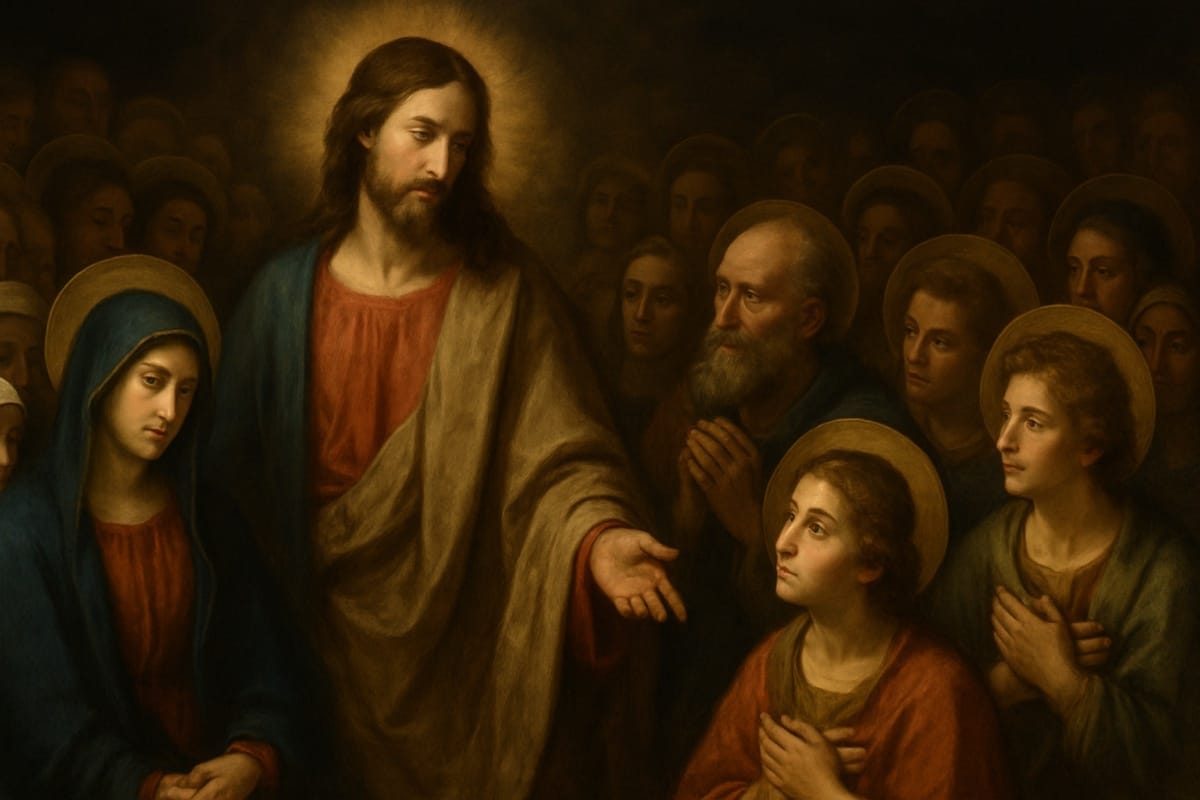
The feast of All Saints brings together three texts around the identity and destiny of those who belong to God. Revelation 7:2-4.9-14 describes an innumerable multitude from every nation and language, dressed in white, standing before the throne and the Lamb: they are the ones who have come out of the great tribulation and washed their robes in the blood of the Lamb. 1 John 3:1-3 proclaims that we are children of God, who have not yet appeared what we will be, but when he appears, we will be like him because we will see him as he is. Matthew 5:1-12a presents the Beatitudes: the poor in spirit, the meek, those who mourn, the hungry and thirsty for justice, the merciful, the pure in heart, the peacemakers, the persecuted. The three texts converge: saints are those who lived the Beatitudes, who went through tribulation, who now see God and are like him.
I. The first reading: Revelation 7:2-4.9-14
John sees an angel ascending from the east with the seal of the living God, sealing the servants of God on their foreheads: one hundred forty-four thousand, twelve thousand from each tribe of Israel. Then he sees a different crowd: “A great multitude, which no one could count, from every nation, tribe, people and language” (Rev 7:9). One of the elders explains: “These are the ones who have come out of the great tribulation; they have washed their robes and made them white in the blood of the Lamb” (v.14). The crowd of saints is not an elite: it is immense, innumerable, from every corner of the world. The white robe is not the result of human effort: it is the blood of the Lamb that makes them white. And tribulation is not the opposite of holiness: it is the path through which the saints have passed. All saints knew tribulation. None reached glory without having gone through it.
II. The second reading: 1 John 3:1-3
John proclaims with admiration: “Behold, what love the Father has given us, that we should be called children of God!” (1 Jn 3:1). The world does not recognize us as children of God for the same reason it did not recognize the Son: God’s logic is not the world’s logic. But what we are now already is true, even if it is not yet complete: “Beloved, we are now children of God, but what we will be has not yet appeared” (v.2). What will come is the vision: “When he appears, we will be like him, for we will see him as he is” (v.2). The practical consequence: “All who have this hope in him purify themselves, just as he is pure” (v.3). The hope of seeing God brings present purification. Saints are those who purified themselves because they hoped to see God.
III. The gospel: Matthew 5:1-12a
Jesus ascends the mountain, sits down, and his disciples draw near. He begins with eight beatitudes, which are both a description and a promise. “Blessed are the poor in spirit, for theirs is the kingdom of heaven” (Mt 5:3). “Blessed are the meek, for they shall inherit the earth” (v. 5). “Blessed are those who mourn, for they will be comforted” (v. 4). “Blessed are those who hunger and thirst for righteousness, for they will be satisfied” (v. 6). “Blessed are the merciful, for they shall obtain mercy” (v. 7). “Blessed are the pure in heart, for they will see God” (v. 8). “Blessed are the peacemakers, for they will be called sons of God” (v. 9). “Blessed are those persecuted for justice’s sake, for theirs is the kingdom of heaven” (v. 10). The beatitudes are not a new moral code: they are the portrait of the saints. Anyone who has read the multitude in Rev 7 recognizes their faces in the beatitudes: those who washed their robes in tribulation are the persecuted for justice’s sake. Those standing before the Lamb are the pure in heart who now see God.
IV. Mary and the First of Saints
Theology and liturgy both recognize Mary as the first and most perfect of saints: not one among many, but the model that all others reflect. 1 John 3 states that we will be like God when we see him as he is. Mary, through her Assumption and her presence in glory, already sees God as he is: she is the creature who fully realized what 1 John 3 promises. The beatitudes describe her journey: she was poor in spirit (the servant of the Lord who did not hold back anything), meek (she learned from Christ to be meek and humble), mourned (under the Cross), had hunger and thirst for righteousness (waiting for the resurrection of the Son), was merciful (interceding without ceasing), pure of heart (sinless, she generated the Son), peaceful (not using violence, even under the Cross), persecuted (flight to Egypt, sword of Simeon, Calvary). Revelation shows a multitude dressed in white: the same source, Rev 12, shows the woman dressed in the sun, the figure that the Church has read as Mary. She is at the center of all the saints because, within her, the Lamb whose blood whitens them took flesh.
Postgraduate specialisation in Mariology
Would you like to deepen your formation in Mariology? The Locus Mariologicus postgraduate programme is a specialisation that brings together theological rigour, spiritual life and the living tradition of the Church. The next class begins in 2027.
Responses