The woman clothed with the sun: Rev 12, 1 Cor 15 and Lk 1, solemnity of the Assumption of Our Lady
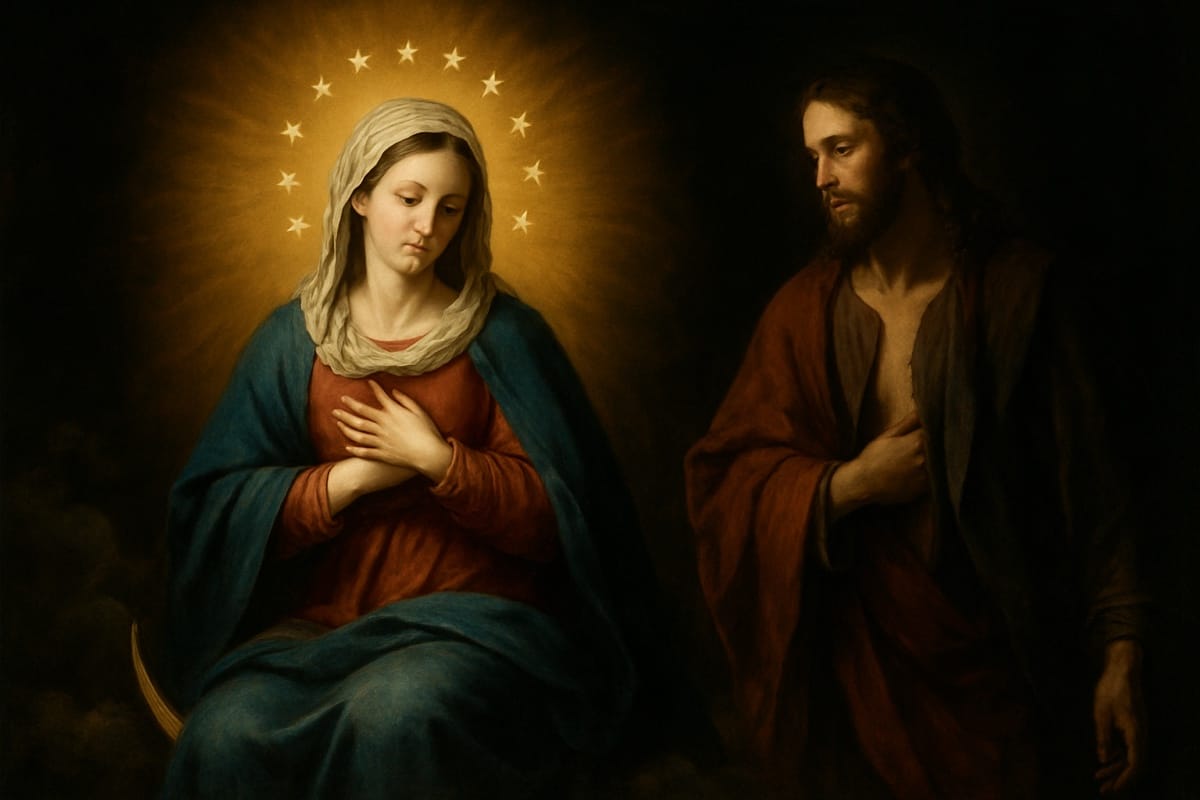
Signum magnum apparuit in caelo: mulier amicta sole.
“A great sign appeared in heaven: a woman clothed with the sun”. (Rev 12:1)
I. The woman clothed with the sun and the dragon defeated
The first reading of the Solemnity of the Assumption of Our Lady belongs to the Book of Revelation and presents one of the most magnificent visions in all of Scripture. “A great sign appeared in heaven: a woman clothed with the sun, with the moon beneath her feet and a crown of twelve stars on her head. She was with child and cried out in the pangs of childbirth and in the anguish of giving birth”. This cosmic woman, robed in solar light and crowned with stars, has been interpreted in different ways throughout the history of exegesis. She is at once an image of Israel who gives birth to the Messiah, a type of the Church who bears children in faith, and a figure of Mary.
The red dragon with seven heads and ten horns waits to devour the child as soon as it is born. But the child is caught up to God and to His throne. And the woman flees into the desert, where God has prepared a place of refuge for her. The cosmic conflict between the woman and the dragon evokes the promise of Genesis: “I will put enmity between you and the woman, between your offspring and hers. She shall crush your head”. The woman of Revelation is the New Eve, she who in Christ definitively overcomes the ancient defeat of the garden.
The final proclamation of the vision, “now have come the salvation, the power, and the kingdom of our God and the authority of His Christ”, situates the woman’s destiny within the context of Christ’s eschatological victory. The Assumption of Mary is not an isolated event. It is an integral part of Christ’s victory over death and sin. The woman who gave birth to the Son who reigns over all the nations shares, by a singular grace, in the glorification of the Son who rose from the dead. Where the Son has arrived, the Mother has been brought in.
II. Christ the firstfruits, Mary the firstfruits of the glorified Church
The second reading, from the First Letter to the Corinthians, presents the Pauline theology of the resurrection as the foundation of the Assumption of Mary. “Christ has been raised from the dead as the firstfruits of those who have died. For as death came through a man, so through a man has come the resurrection of the dead. For as all die in Adam, so also all will be brought to life in Christ. But each one in his own order: Christ as the firstfruits, then those who belong to Christ, at His coming”. This Pauline sequence, the risen Christ as firstfruits and then those who belong to Christ, is the theological framework within which the Assumption of Mary is set.
Paul affirms that the resurrection is a reality that began in Christ and extends to all who are in Christ. The Assumption of Mary, dogmatically defined by Pius XII in the apostolic constitution Munificentissimus Deus of 1950, affirms that Mary has already been brought into the bodily glorification that all Christians await at the end of time. She is the first among “those who belong to Christ” to share fully in the victory of the resurrection. In Mary the Pauline promise has already been fulfilled: what was corruptible has put on incorruptibility, what was mortal has put on immortality.
Christ destroys every principality, every authority, and every power, placing His enemies beneath His feet. “The last enemy to be destroyed is death”. The Assumption of Mary is the sign that this enemy has truly been conquered. Mary’s body, formed by the Holy Spirit to be the tabernacle of the Son of God, could not remain subject to the corruption of the tomb. The same logic that grounds the resurrection of Christ grounds the Assumption of the Mother: where the love of God arrives, death does not have the last word.
III. The Magnificat on the day of the Assumption: joy fulfilled
The liturgy of the Assumption chooses the Magnificat as the Gospel of the day, placing on Mary’s lips, on the day of her glorification, the same words she spoke at the Visitation. This choice is of extraordinary beauty and theological depth. The Magnificat that Mary sang at the time of Elizabeth’s pregnancy is now read in the light of her Assumption into heaven: what she proclaimed as hope has been definitively fulfilled. “The Mighty One has done great things for me”. Yes. The Mighty One has done in Mary the greatest things He has ever done in a human creature.
“From now on all generations will call me blessed”. This prophecy of the Magnificat is fulfilled in every generation that celebrates the Assumption, in every rosary prayed, in every Marian shrine visited, in every prayer addressed to Mary as “blessed”. The Magnificat is at once the canticle of the young woman who received grace and the canticle of the glorified one who entered into the fullness of what grace promised. The continuity between Mary of Nazareth and Mary Assumpta is the continuity of fidelity: she who said “let it be done” at the Annunciation is now in the place where God’s “let it be done” has been fulfilled forever.
The Magnificat proclaims that God has filled the hungry with good things and sent the rich away empty-handed. The Assumption is the definitive confirmation of this truth: the humble, those who waited, those who did the will of God without calculating rewards, are exalted. Mary, who was the most humble and the most faithful, was the most exalted. Her Assumption is not a privilege that separates her from the other faithful. It is the anticipation of the destiny that God prepared for all who love His name.
IV. The Assumption in Mariology, body and soul into glory
The dogmatic definition of the Assumption of Mary, proclaimed in 1950 by Pius XII, affirms that Mary was “assumed body and soul into heavenly glory” after having completed the course of her earthly life. The formulation is deliberately precise about the bodily dimension and carefully open about the question of death: it does not define whether Mary died before being assumed or whether she was assumed without dying. The Eastern tradition speaks of “dormition” (koimesis), the Western tradition tends to speak of “death”, but the dogmatic definition does not settle the debate.
What the definition affirms with full authority is the bodily glorification of Mary. This point is of fundamental importance for Christian theology: the body is a constitutive part of the human person, and the destiny of the body is part of the eternal destiny of the human being. The resurrection of Christ and the Assumption of Mary are the first two historical instances of this bodily glorification that all Christians await. They are not exceptions to the rule but the anticipated fulfillment of what the rule promises.
The Solemnity of the Assumption is the richest feast of the Marian calendar and one of the most widely celebrated in all of Christian liturgy. It invites each of the faithful to look upon Mary assumed as upon the mirror of his own destiny: what happened to Mary is what God wants to happen to each of His children. The Magnificat that she sings eternally in glory is the invitation to begin singing already, in faith and in hope, that same song. For the victory of Christ over death, of which the Assumption of Mary is the first ripe fruit, extends to all who believe.
Postgraduate specialisation in Mariology
Would you like to deepen your formation in Mariology? The Locus Mariologicus postgraduate programme is a specialisation that brings together theological rigour, spiritual life and the living tradition of the Church. The next class begins in 2027.
Would you like to study Mariology seriously?
This article grows out of the works in the Locus Mariologicus library. The Postgraduate Program in Mariology takes you to the same source, with academic guidance: Scripture, the Fathers of the Church, and the Magisterium, from the first dogma to contemporary questions.




Responses