Holy Mary, Fountain of Light and Life
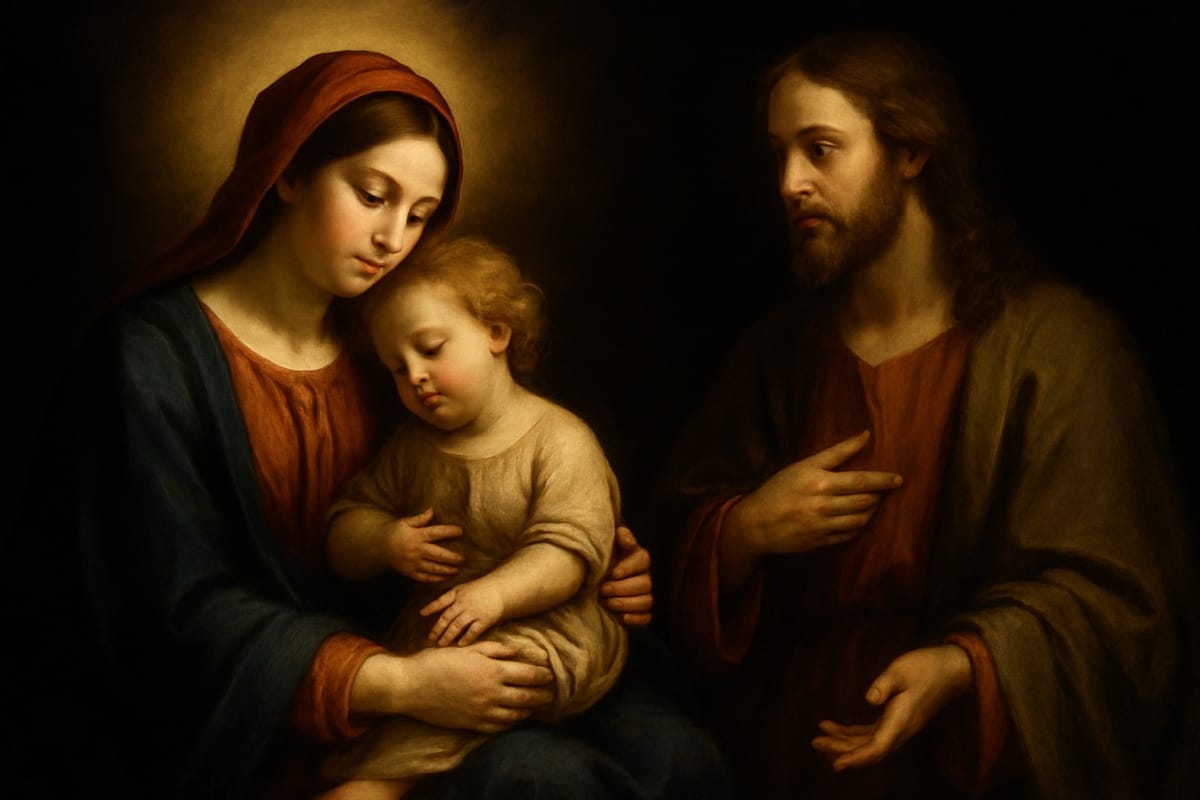
“Ego lux in mundum veni, ut omnis qui credit in me, in tenebris non maneat”. “I have come as light into the world, that whoever believes in me may not remain in darkness”. (Jn 12:46)
I. The Discourse of Pentecost: The Light That Illumines History
Peter’s discourse on the day of Pentecost, recounted in the Acts of the Apostles, is the first public proclamation of the Gospel after the outpouring of the Holy Spirit. Peter, who days before had denied his Lord three times, now rises before the crowd gathered in Jerusalem and proclaims with a clarity and a boldness that only the Spirit can explain: “Let all the house of Israel therefore know for certain: God has made both Lord and Christ this Jesus whom you crucified” (Acts 2:36). The proclamation is direct, without attenuation: those who heard are the ones responsible for the crucifixion of the Messiah, and the response asked of them is conversion and Baptism for the forgiveness of sins and the gift of the Spirit (Acts 2:38).
The woman who gave birth to the Light of the world is present at this founding moment of the Church, gathered in the Upper Room with the disciples (cf. Acts 1:14). The light that John had proclaimed in the prologue of his Gospel, “the true light that enlightens every man” (Jn 1:9), continues to illumine now through apostolic preaching and the outpouring of the Spirit. Mary is the human fountain of this light: she who first received the Word of God in her womb, she who was first illumined by the grace that needed to take a human body, she who accompanied the Light throughout her earthly life and who now waits in prayer for this same Light to be poured out upon all peoples.
II. “I am the light of the world”: The Johannine Revelation
The twelfth chapter of John stands at a decisive turning point in the ministry of Jesus: the Greeks who wish to see Him signal the arrival of the hour in which the “grain of wheat” must fall into the earth and die in order to bear much fruit (Jn 12:24). It is in this context of paschal imminence that Jesus speaks the words that constitute the Gospel of this Mass: “I have come as light into the world, that whoever believes in me may not remain in darkness” (Jn 12:46). Jesus’ self-revelation as the light of the world is not a metaphorical statement about His wisdom or about His teaching: it is an ontological statement about His person, who shared eternally in the divine light before manifesting Himself in the flesh.
The faith that Jesus requires is faith in Himself as Light: not merely the intellectual acceptance of a teaching, but the existential conversion that changes the direction of a life, that abandons the darkness of self-enclosure and turns toward the Light that illumines, that sets free, that transforms. “He who sees me sees him who sent me” (Jn 12:45): to see Jesus is to see the Father, because the Light that He is, is the Light of God Himself manifested in the flesh. And Mary, who saw Him with the eyes of the flesh from the very first moments, is the first to have contemplated the Light of God in the face of the Son.
III. Mary, the Dawn That Precedes the Light
The Christian spiritual tradition frequently uses the image of the dawn to designate Mary in her relation to Christ: she is the dawn that precedes the Sun, that announces His coming, that divides the night from the day. The image is biblical: in the Song of Songs, the bride is described as “fair as the moon, bright as the sun, terrible as an army in battle array” (Song 6:10). Mary is the most luminous creature in history, not by a light of her own, but by the radiance of the Light that dwelt in her. She who for nine months was the “temple” in which the Son of Light grew, she who gave Him light with her maternal milk and the warmth of her arms, she who received from Him, refracted through her perfect humanity, the divine brightness that transfigured her from within.
When Peter announces at Pentecost that God has made this Jesus both Lord and Christ, he proclaims what Mary had known since the Annunciation: that the Son she had conceived was the Lord of all history. The difference is that Mary knew without being able to announce it yet, keeping in her heart what the time did not yet allow her to proclaim in public. At Pentecost, the light that Mary had kept privately for decades burst forth publicly upon the whole world: the Spirit who had overshadowed her in Nazareth now covers all humanity with His grace.
IV. Mary, Fountain of the Light That Illumines the Church
The sixteenth Mass of the Collection contemplates Mary as Fountain of Light and Life, a title that the Mariological tradition recognizes as one of the most beautiful and most precise that Christian piety has attributed to the Mother of God. “Fountain of light” because from her was born the one whom John proclaims as “the true light” (Jn 1:9). “Fountain of life” because from her was born the one whom the same John designates as He who came so that those who believe in Him “may have life and have it in abundance” (Jn 10:10). The twofold designation is not redundant: to illumine and to give life are the two fundamental actions of the Spirit of God, and Mary, filled with the Spirit who had overshadowed her, shares in His illuminating and life-giving function.
The Church that celebrates this Mass in the Easter Season is invited to renew her awareness of her origin: we are children of the light that Mary brought into the world, we are given life by the life that received human form from her, we are baptized into Him whose Light Peter had proclaimed at Pentecost. And Mary, who was in the Upper Room when the Spirit descended, continues to be the fountain of light and life for the Church of every age, because she continues to intercede for the gift of the same Spirit whom she received in the fullest and most perfect of the forms that a human creature can receive.
Postgraduate specialisation in Mariology
Would you like to deepen your formation in Mariology? The Locus Mariologicus postgraduate programme is a specialisation that brings together theological rigour, spiritual life and the living tradition of the Church. The next class begins in 2027.
Would you like to study Mariology seriously?
This article is born of the works in the library of Locus Mariologicus. The Postgraduate Program in Mariology brings you to the same source, with academic guidance: Scripture, the Fathers of the Church, and the Magisterium, from the first dogma to contemporary questions.




Responses