Catacomb of Priscilla: The Oldest Image of Our Lady
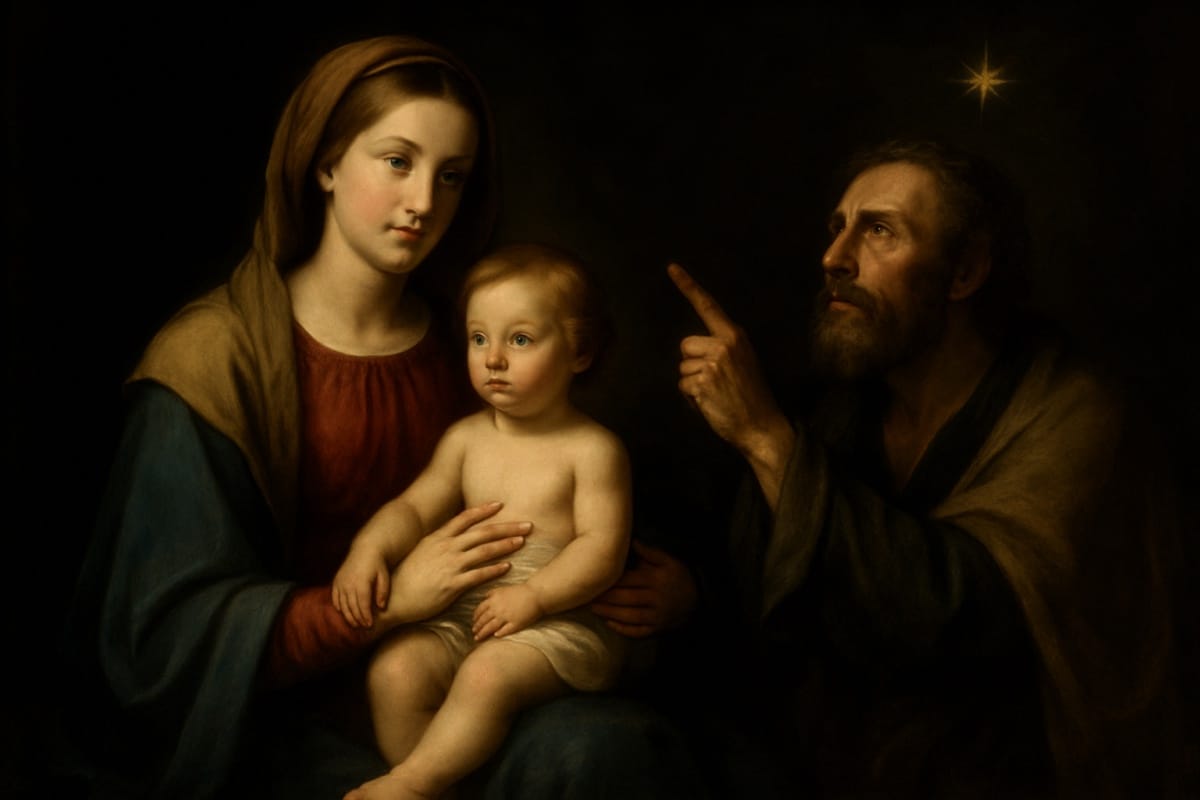
In the Catacomb of Priscilla, dug along the Via Salaria in Rome, is found the oldest known image of Our Lady. The frescoes, datable to the third century – and with faith in Mary’s privileges already inscribed on the walls in the second century – make this cemetery a precious witness: devotion to the Mother of the Lord is as old as the Church herself.
What Is the Catacomb of Priscilla?
It is one of the most important underground cemeteries of early Christianity, on the Via Salaria in Rome. For the richness and antiquity of its paintings, it was called Regina Catacumbarum, the “Queen of the Catacombs.” There the first Christians buried their dead and, on the walls, left the images of their faith – among them, the first representations of the Virgin Mary.
The Oldest Image of Mary
In the so-called “cubicle of the Velata,” a fresco from the end of the second century or the beginning of the third shows Mary with the Child on her lap, beside a male figure pointing to a star – usually identified with the prophet (Balaam or Isaiah), who announced the star risen from Jacob and the “Emmanuel” born of the Virgin. It is the oldest Marian image that has come down to us, earlier than the Christianization of the Empire.
The Context: Death, Baptism, and Resurrection
These images arise in a sepulchral context, and that is theologically decisive. They point back to the baptismal font and to the Sunday Eucharist, that is, to the first and chief prophecy fulfilled in Christ: the resurrection of the dead (cf. 1 Cor 15:3-4). To represent Mary with her Son, beside the tombs, was to confess the hope of the new life that comes from Christ, born of her.
The Prudence of the Early Church
Just as, during this period, the cross was rarely shown openly – being expressed instead through symbolic signs, such as the anchor – so too the veneration of the Blessed Virgin was not made too evident. It was pastoral prudence: it kept the catechumens, still in formation, from misunderstanding those truths. The image said much to those who already had the faith; it remained discreet for those who were still preparing.
Mariological Importance
The Catacomb of Priscilla belies the idea that Marian devotion was a late invention. On the contrary: even before the great conciliar definitions, the Christians of Rome were already painting the Mother of God on the walls where they placed their hope in the resurrection. Archaeology confirms, in stone and in color, what Tradition has always affirmed.
See also
Explore this theme more deeply through all our articles in the Marian Iconography archive.
Frequently Asked Questions
Where is the Catacomb of Priscilla?
On the Via Salaria in Rome. It is a Christian cemetery of the first centuries, known as Regina Catacumbarum.
Why is the Catacomb of Priscilla important for Mariology?
Because it preserves the oldest known image of Our Lady (3rd cent.), bearing witness to the antiquity of Marian devotion.
Which is the oldest image of Mary?
The fresco of the Virgin with the Child and the prophet pointing to the star, in the Catacomb of Priscilla, from the end of the 2nd cent. / beginning of the 3rd cent.
Text of the Locus Mariologicus Institute, founded in Rome. Scientific direction by Prof. Dr. Daniel Cerqueira Afonso (PhD, Marianum).
See also
Would you like to study Mariology seriously?
This article grows out of the works in the Locus Mariologicus library. The Postgraduate Program in Mariology takes you to the same source, with academic guidance: Scripture, the Fathers of the Church, and the Magisterium, from the first dogma to contemporary questions.





Responses