Sublime beauty in Mariological aesthetics

Mary and sublime beauty in Mariological aesthetics
The Mariologist is the fruit of the patiens divina, that is to say, for there to be Mariology, an experience of faith is necessary. And if one wishes to walk the path of beauty in the elaboration of a Mariology, it is necessary that beauty be discovered in the experience of faith. And in the experience of faith in Christ, the Incarnate Word, Son of Mary, whose only possible beauty is sublime beauty. Then, following a line of thought that has run through our Christian culture down the centuries, beauty is characterized by form, the sublime by force. The beautiful favors the relation with the true, the sublime with the good. The beauty that we really find in Christian iconography, above all the Marian, celebrating the faith, has its own connotations if we compare it with other forms of beauty: it is clearly a sublime beauty.
Christian art is not beautiful in the way that classical art is, but neither is it ugly, because it expresses above all not the sentiment of the beautiful, but that of the sublime. This fundamental difference between the aesthetic character of the two arts is the chief reason that has prevented us, and still prevents us today, from grasping the characteristic features of Byzantine art. That is why our purely descriptive judgments neglect the heart of the problem and even, when they are praiseworthy, lack, if not sincerity, at least consistency. Critics can grasp and describe different elements of this art, for example its decorative tendencies, the picturesque quality of its ornamentation, or its search for dematerialization, but they never manage to establish a relation among these elements or to show that they are the necessary consequence of an artistic ideal whose expression springs from a spontaneous sentiment. This is what arises from the aesthetic category of the sublime, a sentiment different from the one that arises from the aesthetic category of the beautiful. The sentiment of the sublime is the source of all Christian art. According to the conditions of place and time, according to the psychology and the spiritual tendencies of a people, this art has found each time a specific and original style and expression.
It seems that in Christian iconography, whose foundation is the incarnation of God, the beautiful emphasizes the humanization of God, while the sublime emphasizes the divinization of man. The beautiful and the sublime thus appear as relative categories, whose complementarity visibly expresses the hypostatic union of the human and divine natures in the one person of the Word of God made man. And the two categories receive motivation and subsistence from the same source: the Incarnate Word born of woman (Gal 4:4), who reveals the face and the word of the Father, for the word and the face of Jesus are entirely directed to the Father, while he pours out upon him his good pleasure in the Son who always remained a Son even in the flesh of man. Therefore,
“as soon as he was baptized, Jesus came up out of the water: and behold, the heavens were opened and he saw the Spirit of God descending like a dove and coming upon him. And behold, a voice from heaven said: ‘This is my beloved Son, in whom I am well pleased’” (Mt 3:16-17).
In fully accepting the disturbing presence of the Son as the “image of the invisible God” (Col 1:15), not only do beauty and the icon acquire their own legitimacy, freeing themselves from any idolatrous fall, but they even come to have a special sacramental meaning. Beauty then becomes almost the most effective and credible witness of the mystery of God’s incarnation in the frail realities of the world. Among the many names of God, the one that has most concretely become incarnate in the body of the Word is precisely the beautiful.
A bold and restless thinker such as Simone Weil grasped, with the radicalism that distinguishes her, the crux of the question through dazzling mystical intuitions:
“the presence of beauty in the world is the experimental proof of the possibility of the incarnation” and this essentially because with Christ “love came down into this world in the form of beauty”. In other words, “the beauty of creation is the smile of tenderness that Christ addresses to us through matter. He is really present in the beauty of the universe”.
The essence of the iconic face, which springs from the mystery of the Incarnation, reveals itself as a true epiphany of the self-giving love of Christ, renewing the invitation to participate in the transfiguration of the whole creation with personal and communal existence. This is the ascetical path toward the glory of God and the salvation of man, toward the incandescent light of the three Persons, toward the light without setting. In the encounter with the symbol-icon of beauty, thought illumined by grace opens itself to glory, transfigured existence tears the veil of the invisible and attains the face-to-face vision of him who is not only word, but also icon of the Invisible, and who in the gift of love to the end (Jn 13:1) completes his glory. The Incarnation sets in motion the immense circulation of glory; Christ was transfigured on Mount Tabor and made resplendent the original and already final beauty of the beginning and of the end. This Beauty liberates our freedom. In the heart of Christ shines the sun of love, his eyes cast rays of light, of wisdom, of strength that are directed to men, awakening in their hearts the response of faith. Bound to this tenuous thread of love, in perfect freedom, lies the possibility of being pierced through by those rays of transfiguring light, as his Mother is.
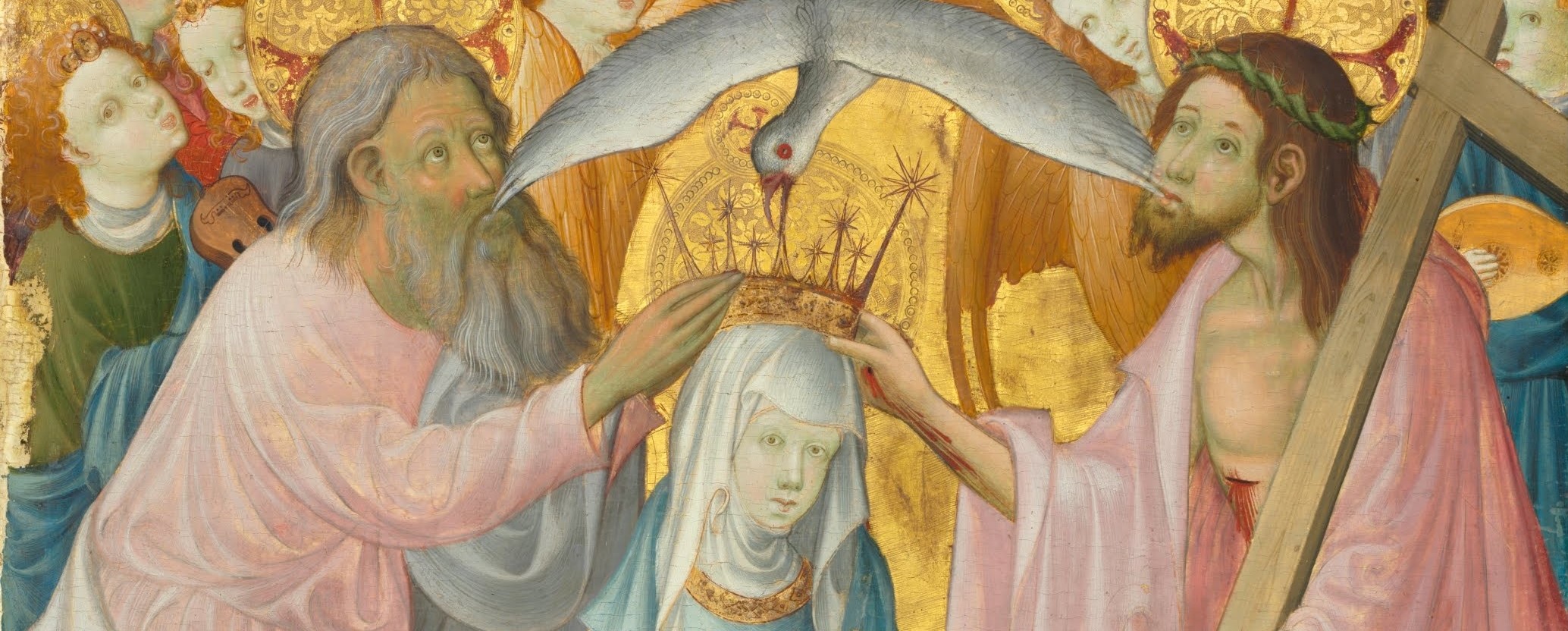
This Mariological foundation of transfiguring love is the same that governs the profound relation of Trinitarian love, so much so that the Holy Spirit, who crowns the love of the Father and of the Son, is also the object and the organ of the contemplation of beauty. A reality, therefore, that goes far beyond any aestheticizing reduction, for the beauty of the Son springs from a precise source of origin: the beauty of the Trinity, which is to say the beauty of love, and in this relation is found the intimacy of Mary at the Annunciation.
The light of divine knowledge does not follow privileged paths, but the ascetical path toward the eternal truth of a purified heart, the only heart that can receive within itself the ineffable light of the divinity and become beautiful. The same light radiating from the good of the purified person, a radiant light that illumines the face of many biblical figures, unceasingly evoked in the life of the holy ascetics and confirmed by the halo that illumines the sacred faces of the icons. Interior light of grace, of the pneumatophoric personality, which has in Mary its admirable model.
The light of the beauty of the Theotokos is the visible presence of the invisible Spirit. In reality, it was necessary that she who would give birth to the most beautiful of the sons of men should herself be of a marvelous beauty. In the Mother of God, according to the Eastern tradition, there is this ontological beauty which derives from the presence of the Holy Spirit and which is possible to a created being. The breath of life in the Mother of the Word traced its fullness upon this earth. The final glory of the Mother of God is the eschaton realized before the end of the world in a created person.
To deepen your reflection on the beauty of Mary from the theological perspective, consult the encyclical Redemptoris Mater of John Paul II, which contemplates Mary as the most beautiful creature because she is the closest to the mystery of God.
Deepen your studies: explore Mariology, Marian Theology, Marian apparitions, and the Postgraduate Program in Mariology.
Postgraduate Program in Mariology
Would you like to deepen your formation in Mariology? Discover the Postgraduate Program in Mariology of Locus Mariologicus – an academic formation that unites theological rigor, spiritual life, and the living tradition of the Church.
Discover the oldest Marian image in the Catacomb of Priscilla.



Responses