What is Catholic demonology? A complete guide
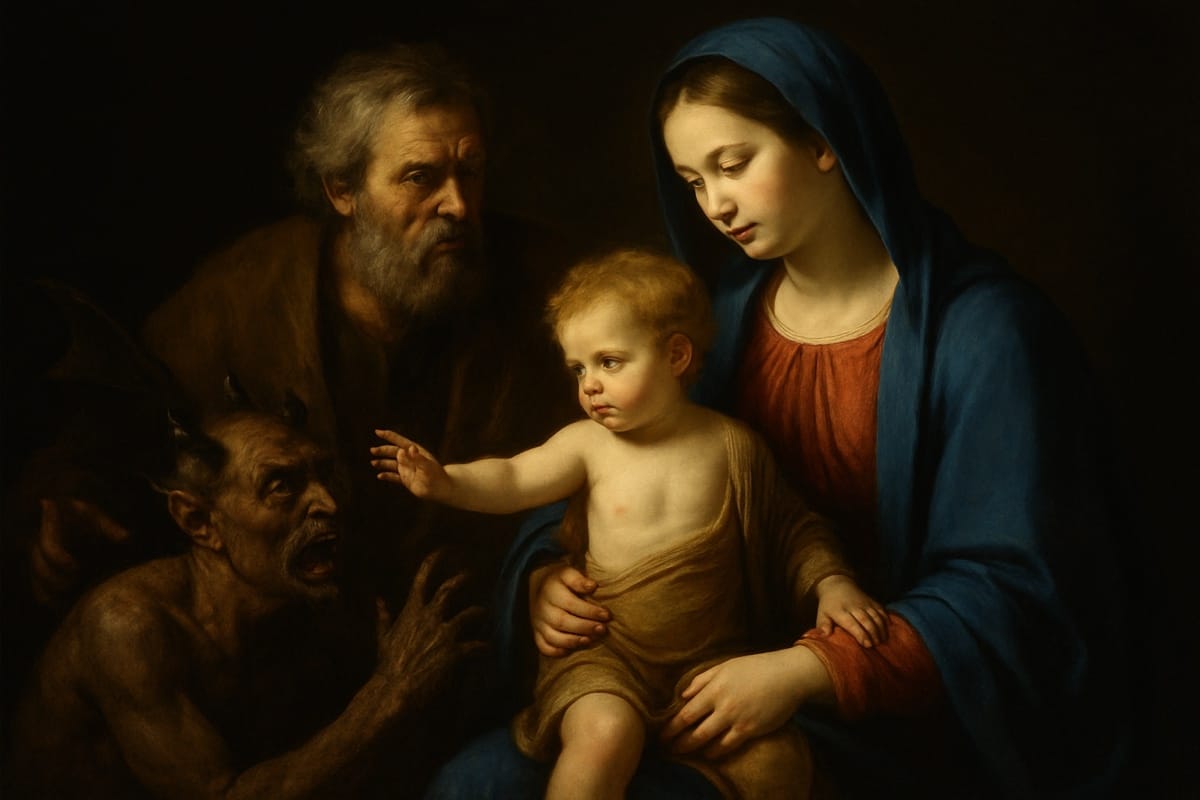
Catholic demonology is the branch of theology that studies, in the light of Revelation and of the Magisterium of the Church, the nature, the origin, and the action of the demons — the angels who, created good by God, became evil by their own choice. It is not curiosity about the occult nor an autonomous science: it is a chapter of angelology and of the theology of creation, with personal evil always subordinate to the sovereignty of God and to the victory of Christ.
While angelology studies the angels in general, demonology focuses on the fallen angels — the two are inseparable, because the demons are not a principle of evil opposed to God, but creatures that perverted an original good.
Demonology is not superstition
The first concern of Catholic demonology is to distinguish itself from superstition, sensationalism, and dualism. The Church has never placed the Devil on the level of God: evil is neither eternal nor creative. For this reason she condemned Priscillianism (First Council of Braga, 561) and Catharism (Third Lateran Council, 1179). Sound demonology maintains three balances: the real existence of the demons (against rationalism), their total subordination to God (against dualism), and pastoral sobriety (against obsession and fear).
Biblical foundations of demonology
In the Old Testament
Scripture presents the tempter progressively: the serpent of Gen 3, the satan (the accuser) in the Book of Job and in Zechariah, and the affirmation of Wis 2:24 — through the envy of the devil death entered the world. The Old Testament never grants evil a divine status: there is only one Creator.
In the New Testament
Jesus confronts the kingdom of evil directly: He is tempted in the desert (Mt 4), He casts out demons as a sign of the coming of the Kingdom (Mk 1:23-27; Lk 11:20), and He describes Satan as a murderer from the beginning and the father of lies (Jn 8:44). The victory of the Cross and the Resurrection is the center: for this the Son of God appeared, to destroy the works of the devil (1Jn 3:8).
Demonology in the Magisterium of the Church
- Fourth Lateran Council (1215) — the constitution Firmiter credimus defines that the Devil and the demons were created good by God and became evil by themselves.
- Council of Florence — the bull Cantate Domino (1442) — reaffirms the original goodness of the spiritual creatures and the fall through free will.
- Catechism of the Catholic Church (nn. 391-395) — the current synthesis: the real but limited power of Satan and trust in Providence.
- Paul VI — Credo of the People of God (1968) — professes the Devil as a personal being, not as a mere symbol.
- John Paul II — catecheses of 1986 — take up in an organic way the doctrine on the angels and the demons.
The Fathers of the Church and the fall of the angels
Origen, in the Peri Archon (I,5), systematized the contrary powers for the first time; Saint Augustine explained the fall by pride and by the free refusal of God’s love. The Second Council of Constantinople (553) fixed a decisive point: the fall of the angels is irrevocable — there will be no apocatastasis, that is, no final salvation of the demons. Why do demons exist? Because God created free beings: the demon is an angel who, in a definitive and lucid act, said no to God.
Exorcism and discernment
Demonology flows into the pastoral practice of exorcism, which has accompanied the Church from the beginning: already the Traditio Apostolica of Hippolytus (c. 215) describes the baptismal exorcisms. The Rituale Romanum regulates the solemn exorcism, always under the authority of the bishop and with prudence, distinguishing demonic action from natural and psychological causes. Emblematic is the prayer to Saint Michael the Archangel, composed by Leo XIII (1886) together with the Exorcismus in Satanam (1890). The permanent criterion is the discernment of spirits: not everything is the action of the demon, nor should his existence be denied.
Demonology, angelology, and Mariology
Demonology is fully understood only in relation to its sister disciplines: with angelology, it shares the study of the spiritual creatures; with Mariology, it meets the woman who crushes the head of the serpent (Gen 3:15) — Mary, Queen of the Angels and victorious over evil by the grace of Christ; and it points to Josephology, for Saint Joseph is invoked as Terror daemonum.
Frequently Asked Questions
What does Catholic demonology study?
It studies the nature, the origin, and the action of the demons — fallen angels — in the light of the Bible, the Fathers, and the Magisterium, always subordinate to the sovereignty of God.
Is demonology the same as occultism?
No. Occultism seeks contact with or power over the invisible; demonology is theology, which studies the subject with doctrinal criteria and subordinates it to faith in Christ.
Does the Church affirm that the Devil really exists?
Yes. The Credo of the People of God (Paul VI, 1968) and the Catechism (nn. 391-395) profess the Devil as a real personal being, not as a symbol.
Can the demons be saved?
No. The Second Council of Constantinople (553) condemned apocatastasis: the choice of the fallen angels is irrevocable.
Who can perform an exorcism?
The solemn exorcism can be performed only by a priest with a mandate from the bishop, after careful discernment that excludes natural causes.
See also:
Would you like to study angelology and demonology in depth?
This article comes from the Locus Mariologicus library. The postgraduate specialisation in Angelology and Demonology (360 hours, fully online) studies angels and demons in Scripture, the Fathers and the Magisterium, with a whole area on practical demonology, exorcism and deliverance prayer. The new class begins on 18 January 2027. Classes are taught in Portuguese.





Responses