Mary and the Word, grace and dabar

The Annunciation: Mary and the word
Having briefly specified what the Word is, we can now begin to understand how the person of Mary is related to the event of the Word. We all know that many texts of the New Testament, although they touch on the Marian question, are above all christological.
The author who offers the most direct information about Mary is Luke. In his account of the Annunciation, Lk 1:26-38, he introduces statements that concern Mary directly and exclusively:
a) the one full of grace in v. 28,
b) the handmaid of the Lord of v. 38,
c) or the words about the Holy Spirit and Mary of v. 35.
For this reason we will go through the pericope of Lk 1:26-38, the narrative of the Annunciation. Initially it presents the presence of the angel, which points directly to the Word, while the narrative presents itself as an exchange of words and silences, of proposals and responses.
The term that qualifies Mary here is not the Word, but grace, charis: Mary is presented as full of grace, kecharitomene, as the one who found grace before God. Certainly different, the two terms are not foreign to each other: grace is a personification of that God “merciful and compassionate, slow to anger and rich in grace and faithfulness, who keeps His favor for a thousand generations” and refers to His nature as the God “rich in mercy and immense love”. Even the Word is a personification of God that designates His action and His communication.
John will explain that the fullness of grace, from which we have all received, is found in that Son whom he will indicate as the Word, as the Word who “became flesh and dwelt among us”. In practice, hesed and dabar, grace and word, are two theological personifications of one and the same God. For this reason, the fact that in Luke’s text the Word is at the service of grace does not seem to us an obstacle to our theme, but, in some way, a detail of the utmost importance.
The interweaving of the two terms has the advantage of obliging us to return quickly to the first meaning of grace, the one that speaks more of God than of Mary, more of the one who gives grace than of her who receives it, because this is what qualifies the Virgin Mary, the one available to receive the gratuitous and free gift of the Trinitarian God. Without this precision of language and mariological clarification, grace can imperceptibly end up indicating its opposite, that is, gain, quantity, the benefit of the divinity and not the intimate dialogue of the event that reveals itself by creating to the extent that the Word manifests itself.
The Annunciation: a history that is no longer individual
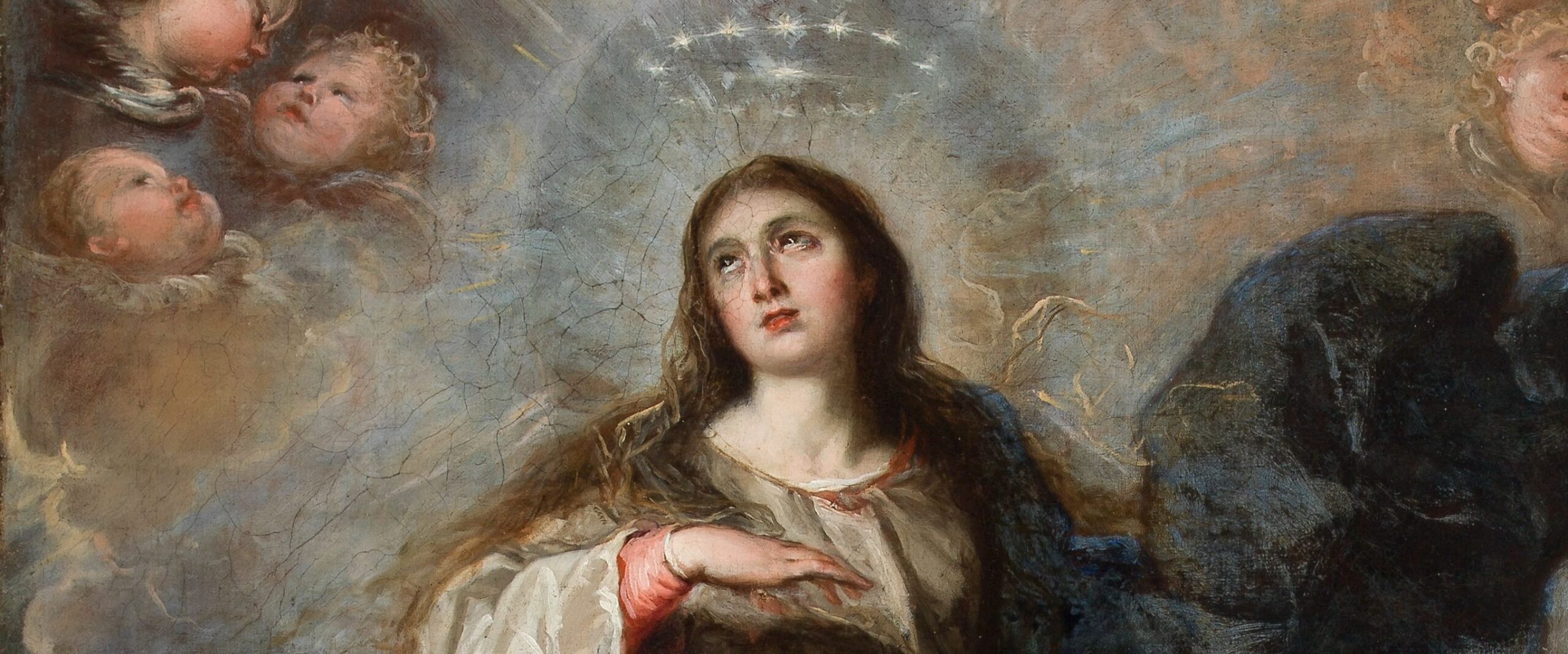
Luke’s account begins by bringing onto the scene, with the angel, a young woman, “a virgin betrothed to a man of the house of David, named Joseph. The name of the virgin was Mary”. The intervention of the angel in the private affair of these two young people gives an unexpected turn to their story: their story is set within a wider context, of a communal character required by the presence of the angel.
It is a matter of the fulfillment of God’s messianic design: this is why Mary is asked, v. 28, in terms that recall the daughter of Zion, the personification of Israel. In itself, the gift of divine salvation rests only on the goodness of that God who is love and would not need a human contribution. Nevertheless, it is part of God’s way to make use of righteous men. So, when this plan reaches its highest point with the sending of the eternal Word in human form, then the human mediation of Jesus needs to be historicized, it needs a birth of woman, under the law (Gal 4:4). Nevertheless, it must be kept in mind that Mary cannot be the cause of what is happening, but only a condition freely chosen by God and a sign of the prodigality of the new beginning.
Mary is this unique figure who makes possible the ‘becoming flesh of the Word’. At the same time, as representative of the daughter of Zion, Mary is the summit of the faith of Israel and the beginning of the people of the kingdom. In this way, she represents both the humanity that relates to God through the law and worship of Israel and the humanity that draws near to God through the beatitudes and faith in that Jesus who made divine life truly available to all.
In this context, there is no direct attention to Mary’s femininity. Although her being-woman is naturally present, theological attention is centered on the universality of a relationship determined by the fact of entering into relation with that divine fatherhood which is determined exclusively by its relation to the Son. Mary too is therefore included in a saving process that is universal, that concerns everyone.
The Annunciation: a singular motherhood
The content of Mary’s role lies entirely in the words of the angel: you will conceive a son, you will give birth to him and you will call him Jesus. Both Matthew and Luke trace this conception back to the work of the Spirit. That is, this motherhood is not primarily the work of a woman and her freedom, but is wholly qualified by the Son to whom she gives life through the Spirit. Only by understanding this Son and the mystery of His birth will it be possible to understand who the mother is.
While Matthew and Luke will interpret this conception and this birth as a messianic and virginal motherhood, Paul will frame it within the kénosis, that is, within that particular condition of which being born of a woman would be a sign. Traditionally, kénosis is derived from the verb kenóo and read as emptying, as renunciation. Perhaps the moment has come to read it positively as revelation, as the fullness of a love that makes self-dispossession the most evident sign of self-giving.
In a still different way, Saint Irenaeus will argue that, since the first Adam was born without being conceived of human seed, it was fitting that the second Adam should also be born in that way. The sense of these indications is to call our attention to the fact that there are many patterns for reading this motherhood, many ways of understanding it: what matters is that they refer to the concreteness of a singular motherhood.
Nevertheless, it can be said that the mother-son relationship that unites Mary and Jesus goes far beyond the human project and seems to be the personal act of the Word who, maintaining a profound relationship with the other divine persons, makes of His happening as flesh the self-gift of the Father and of the creating love of that Spirit, in order to bring to birth a life totally abandoned to God.
In reality, it is not Mary who makes Christ her son, but it is Christ who makes Mary His mother. It is from the Word that Mary received her singular motherhood. The humanity of Jesus is generated and exists only at the moment in which the Word assumes it and makes it His own, and that moment, which constitutes and contains the saving mystery of the Incarnation, belongs to God alone.
To deepen your reflection on Mary and the Word of God within the biblical horizon, consult the encyclical Redemptoris Mater by John Paul II, which illuminates how Mary received the divine dabar with total faith and full grace.
Deepen your studies: explore Mariology, Marian Theology, Marian apparitions and the Postgraduate Program in Mariology.
Postgraduate Program in Mariology
Would you like to deepen your formation in Mariology? Discover the Postgraduate Program in Mariology of Locus Mariologicus – an academic formation that unites theological rigor, spiritual life and the living tradition of the Church.
Would you like to study Mariology seriously?
This article is born of the works in the library of Locus Mariologicus. The Postgraduate Program in Mariology leads you to the same source, with academic guidance: Scripture, the Fathers of the Church and the Magisterium, from the first dogma to contemporary questions.



Responses