Mother of the sons of Zebedee: the mother of James and John, and Mary, mother of the servant.
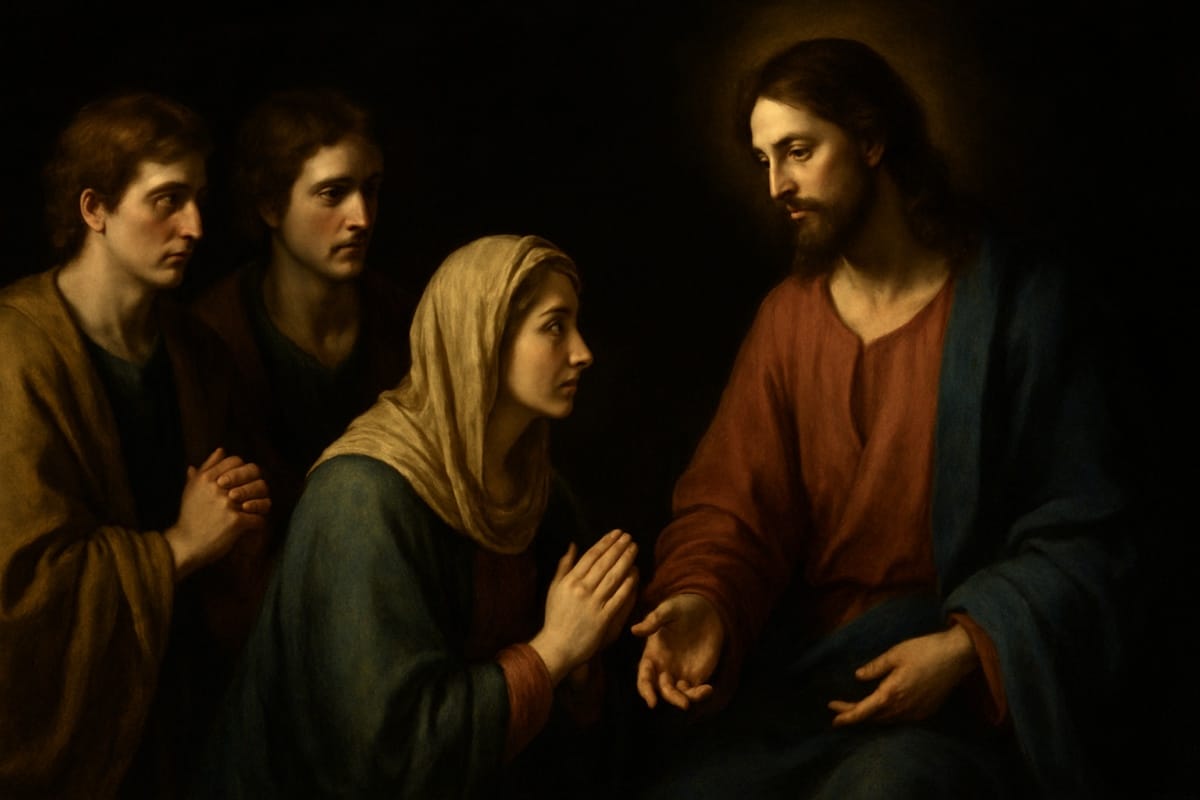
Quotation:> “He said to him, ‘I tell you the truth, you do not know what you are asking.’” (Matthew 20:22)Text Analysis:The Feast of Saint James the Apostle (July 25th) features the Gospel pericope from Matthew 20:20-28, where the mother of Zebedee’s sons, James and John, approaches Jesus requesting that her children sit at His right and left in His Kingdom. This scene is one of the most humanly understandable moments in the Gospels: a mother seeking the best for her children, taking advantage of a moment of privileged access to request honorable positions. Yet, it also reveals profound misunderstanding about what God’s Kingdom entails: requesting glory for her sons shows that the mother, and the children she sends, have not yet grasped the logic of inversion Jesus proclaimed (“the last shall be first,” Matthew 20:16).Jesus’ response, “You do not know what you are asking” (Matthew 20:22), is both kind and decisive. The question is misplaced because it is based on a flawed image of the Kingdom. The “cup” Jesus will drink and the “baptism” He will undergo (Matthew 20:22-23) refer to His Passion, not the glory the mother envisions. James and John may indeed share Jesus’ “cup” (and in fact, they do; James was martyred, and John was exiled), but the positions “at His right and left” are not to be granted by Jesus but by the Father.I. “Make these my sons sit…” – The Request for Glory:> “Then the mother of Zebedee’s children approached Jesus with her children, and she knelt to ask Him for a favor.” (Matthew 20:20)The prostration is an act of adoration and supplication. The mother uses religious language of veneration to make a request of significant ambition. The tension between the gesture (prostration in worship) and the content of the request (glorified positions) reveals a confusion between genuine devotion and the instrumentalization of the sacred for family advancement.> “Make these my two sons sit, one at your right hand and one at your left in your Kingdom.” (Matthew 20:21)The mother requests what any ambitious mother might ask for her children: the most honorable positions, access to power, proximity to the “King.” The request is humanly understandable, and precisely this understandability makes it pedagogically valuable. Jesus does not reject the mother but educates her understanding of what the Kingdom is.This episode implicitly contrasts with Mary of Nazareth: where the mother of Zebedee’s children “asks” for her sons to have glorified positions, Mary did not ask anything for Her Son. Rather, in Cana, “Do whatever He tells you” (John 2:5) was not a request for advancement but an acknowledgment of Jesus’ mission. Mary did not use her maternal closeness to request glory; she used it to serve Jesus’ mission.II. “You do not know what you are asking…” – The Cup and Baptism:“Can you drink the cup that I am going to drink?” (Mt 20:22), Jesus’ response radically reorients the request: the positions “to the right and to the left” in the Kingdom of God are not positions of honor in the human sense, but the positions occupied by the two thieves on the Cross (cf. Mt 27:38). The tragic irony of Matthew is that the mother asked for the positions “to the right and to the left,” and what is “to the right and to the left” of Jesus at the climactic moment is precisely the extreme humiliation.“You will be baptized with the baptism with which I am baptized,” the anticipation of James’ martyrdom (Act 12:2: beheaded by Herod Agrippa I) and John’s suffering (exiled on Patmos) shows that the brothers’ response (“we can,” Mt 20:22) was, without their knowledge, a prophecy of what would actually happen. They shared the “cup” not in the glory they imagined but in the suffering they did not anticipate.Mary “drank the cup” before the sons of Zebedee: the “cup” of Simeon’s sword (Lk 2:35) that pierced her soul on the Cross is the shared cup that unites her to the Son’s suffering. But Mary did not ask for this “cup,” she accepted it. The difference between the mother of the sons of Zebedee (who asks for glory and does not understand that glory passes through the cup) and Mary (who does not ask for glory but accepts the cup) is the difference between two modes of motherhood: ambitious motherhood and oblative motherhood that surrenders to the Son’s mission even when that mission costs.III. “He who would be great among you must be your servant”: the inversion of the kingdom“It shall not be so among you, but whoever would be great among you must be your servant, and whoever would be first among you must be a slave to all” (Mt 20:26-27), the inversion of the Kingdom that Jesus proclaims is not merely ethical (humility is better than pride) but ontological: in God’s Kingdom, greatness is defined by service, not power. The “great” in God’s Kingdom is not he who has more power but he who serves most, and the supreme model of this service is Jesus Himself: “The Son of Man did not come to be served but to serve and give his life as a ransom for many” (Mt 20:28).The “inversion of the Kingdom” in Mt 20:26-28 is the corollary of the parable in Mt 18:1-4 (“Whoever humbles himself like this little child is greatest in the kingdom of heaven”) and anticipates the escatological discourse about “what you did to the least of my brothers” (Mt 25:31-46). Greatness in God’s Kingdom is measured by service, especially service to the “least.”Mary is the model of this greatness in service: “Behold, I am the servant of the Lord” (Lk 1:38), the title Mary chose for herself is the title of greatness in God’s Kingdom. Not “queen of heaven” (a title given to her by the Church), not “Mother of God” (a title defined by the Church at Ephesus), but “servant,” one who serves, one who is available, one who does not claim positions but accepts a mission. The “mother of Zebedee’s sons” asked for glory for her children. Mary accepted the position of servant, and precisely because of this she is “exalted” in the Magnificat (“all generations will call me blessed,” Lk 1:48).IV. “Saint James and the Chalice”: The feast of those who drank the chaliceJames was the first of the apostles to be martyred, beheaded by Herod Agrippa I around the year 44 (Acts 12:2). The brother who responded “we can” to Jesus’ challenge drank the Lord’s cup earlier than any other apostle. The feast of Saint James is the feast of one who, without knowing when he made the promise, fulfilled it radically: he shared the Lord’s cup not in the glory his mother imagined but in the martyrdom anticipated by the Lord.The trajectory of James, from “son of thunder” (Mk 3:17, an epithet Jesus gave him with John, suggesting a tempestuous temperament) to martyr, is the archetype of transformation through following Christ: the disciple who began with ambitions of glory ended as a witness who gave his life. Grace does not eliminate temperament but transforms its energy: James’ impetuousness became apostolic fervor, his ambition for glory became availability for the cup.Mary accompanied this transformation as mother of the nascent Church praying with the apostles in the Upper Room (Acts 1:14). Mary’s prayer for the apostles group, including James, before Pentecost is the prayer of a mother who does not ask for glory for her spiritual children but prays that they may drink the cup that will make them capable of serving. The “mother of Zebedee’s sons” asked for positions. Mary asked, and still asks, for the Holy Spirit.
Postgraduate Studies in Mariology
Would you like to deepen your formation in Mariology? Discover the Postgraduate Studies in Mariology from Locus Mariologicus – an academic formation that combines theological rigor, spiritual life and living tradition of the Church.
Would you like to study Mariology seriously?
This article draws on the works of the Locus Mariologicus library. The Postgraduate Programme in Mariology takes you to the same sources with academic guidance: Scripture, the Church Fathers and the Magisterium, from the first dogma to contemporary questions.




Responses