“Unus panis, unum corpus”: the Most Holy Name of Mary and the fruit that reveals the tree
By Prof. Dr. Daniel C. Afonso · Updated
Quoniam unus panis, unum corpus multi sumus, omnes qui de uno pane participamur. […] Unaquaeque enim arbor de fructu suo cognoscitur.
1 Cor 10:17 and Lk 6:44
Saturday of the Twenty-Third Week in Ordinary Time is also the day on which the Church may celebrate the memorial of the Most Holy Name of Mary. The readings of the day fall upon this memorial with remarkable precision. Paul explains that the broken bread makes of many a single body and that one cannot share in two incompatible tables. Jesus says that each tree is known by its fruit and that the mouth speaks from what overflows from the heart. A name, like a fruit, is not invented. It says what the tree is.
I. The first reading: 1 Cor 10:14-22
Paul is dealing with the same question as on the previous days, the meat sacrificed to idols, but now he gets to the heart of the matter and the result is one of the oldest Eucharistic pages of the New Testament. The rhetorical question is the core: “is not the cup of blessing that we bless a communion with the Blood of Christ? Is not the bread that we break a communion with the Body of Christ?” (v.16). It was written around the year 56, before any Gospel, and it already presupposes an established practice and a fixed vocabulary.
From this Paul draws the ecclesial consequence that the tradition has never let go of: “since there is one bread, we, though we are many, form a single body, because we share in the one bread” (v.17). The unity of the Church is not an agreement among like-minded people; it is the effect of a common food. And from here comes the final demand, which is the reason for the whole argument: “you cannot drink the cup of the Lord and the cup of demons, you cannot share in the table of the Lord and the table of demons” (v.21). Communion is not an opinion added to others; it is a belonging that excludes contrary belongings.
II. The Gospel: Lk 6:43-49
Luke closes the Sermon on the Plain with two criteria of verification. The first is botanical: “each tree is known by its own fruit” (v.44). The second is linguistic and is even more uncomfortable, because it reaches what we least suspect: “the mouth speaks from what overflows from the heart” (v.45). What we say when we are not composing an answer is the most faithful inventory of what we have inside.
Then comes the question that sets the tone for the whole ending: “why do you call me Lord, Lord, and do not do what I tell you?” (v.46). And the parable of the two houses, which in Luke has a detail that Matthew does not have. The prudent man “dug, went deep and laid the foundations on rock” (v.48). The decisive work is the one that is not seen and gives no pleasure at all to do, because it consists in digging downward while the others are already raising walls. The flood does not distinguish the two houses by their appearance. It distinguishes them by what was done before there was a house.
III. The fruit that reveals the tree
The two texts share a method, that of verification by the effect. Paul verifies faith by the table at which a person sits. Jesus verifies it by the fruit the tree gives and by what the mouth lets slip. Neither of the two accepts self-declaration as proof.
Applied to the devout life, this criterion is severe. It is possible to frequent the table of the Lord and to keep a real belonging to another table, and the incoherence is not resolved by the intensity of religious feeling; it is resolved by choice. Likewise, it is possible to build an entire spiritual life upward, with visible practices and correct vocabulary, without ever having dug down to the rock. The flood, says Luke, comes to both houses alike. It is not the trial that distinguishes Christians; it is the foundation.
IV. The Most Holy Name of Mary: a name that is fruit
Today’s memorial is ancient in devotion and recent in its present form. Born in Spain in the sixteenth century, it was extended to the whole Church by Innocent XI in 1683, after Vienna, removed from the calendar in the reform of 1969 and restored as an optional memorial in the Missal promulgated by John Paul II. The Church wished to keep a day for what the faithful do every day without thinking, which is to pronounce that name.
Today’s Gospel explains why it makes sense to celebrate a name. If “the mouth speaks from what overflows from the heart”, then the names a community repeats say what that community has inside. And if “each tree is known by its own fruit”, then it is worth remembering what the fruit of that tree was. The Latin liturgy sings it in the Salve Regina when it turns to her and asks her to show us, after this exile, benedictum fructum ventris tui, the blessed fruit of her womb. The name of Mary does not have value in itself. It has value because it points to the fruit.
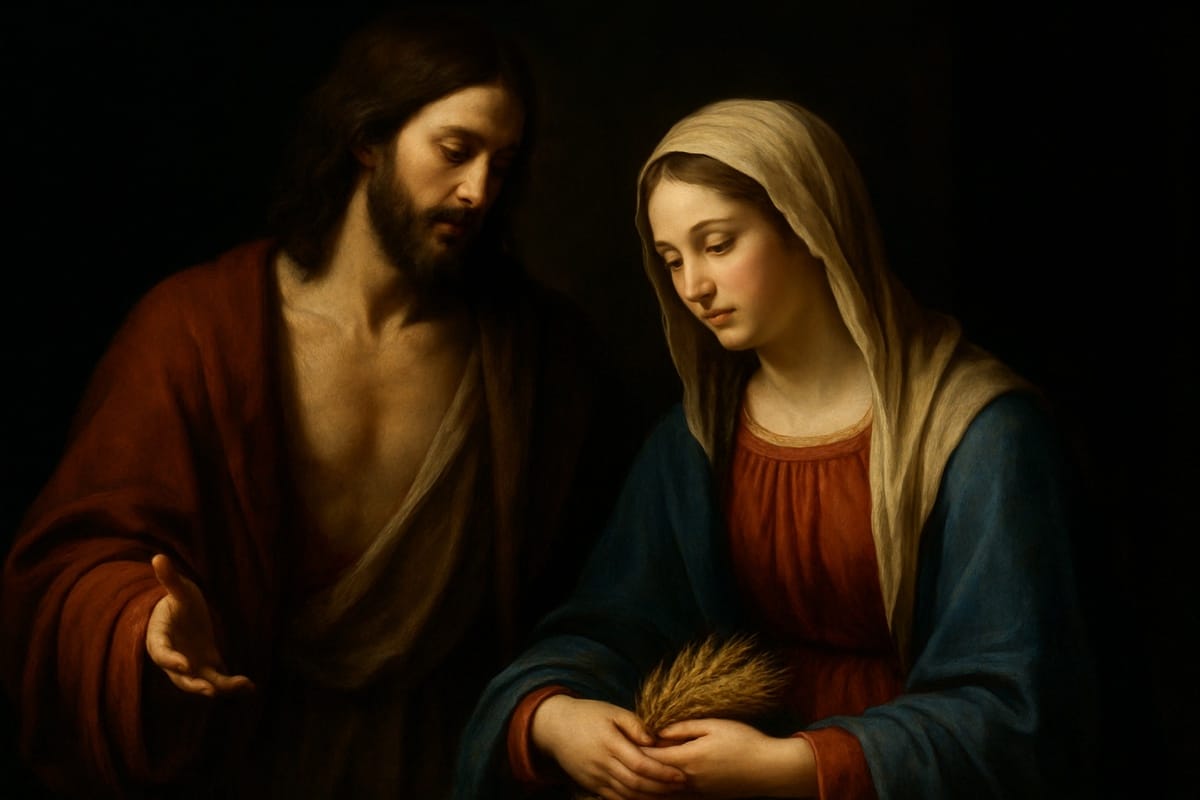
And it is here that the first reading closes the circle in a way that devotion does not always perceive. The Body that Paul says is communion, the bread that makes of many a single body, is a body that was taken from a concrete woman. The Son of God was born of a woman (Gal 4:4), and the Church confesses Mary as true Mother of God and of the Redeemer (LG 53). The flesh received at the altar entered the world through her consent. For this reason devotion to her name is never a deviation from the Eucharist, if it is rightly understood, because it leads the Eucharist back to the point where the Word became flesh.
Saturday of the Twenty-Third Week therefore leaves two verifications to be made, and neither of them is answered with words. At which table do we sit when no one is watching, and what does our mouth say when we are not keeping watch over it.
Postgraduate Program in Mariology
Would you like to deepen your formation in Mariology? Discover the Postgraduate Program in Mariology of Locus Mariologicus – an academic formation that unites theological rigor, spiritual life, and the living tradition of the Church.
Responses