The birth that prepared salvation: Mic 5, Rom 8 and Mt 1, the Nativity of Our Lady
Quos praedestinavit, hos et vocavit. Quos vocavit, hos et iustificavit. Quos iustificavit, illos et glorificavit.
“Those whom He predestined, He also called. Those whom He called, He justified. Those whom He justified, He glorified”. (Rom 8:30)
I. From Bethlehem Shall Come the Ruler of Israel
The first reading of the Feast of the Nativity of Our Lady belongs to the Book of Micah and presents the prophecy of the Bethlehemite origin of the Messiah. “And you, Bethlehem-Ephrathah, little among the clans of Judah, from you shall come forth for Me the one who is to rule Israel. His origins go back to ancient times, to the days of eternity”. This prophecy, quoted by the chief priests and scribes in answer to Herod’s question about the birthplace of the Messiah, points to a paradoxical reality: the eternal ruler comes from the least of the clans. The greatness of God is always manifested through human smallness.
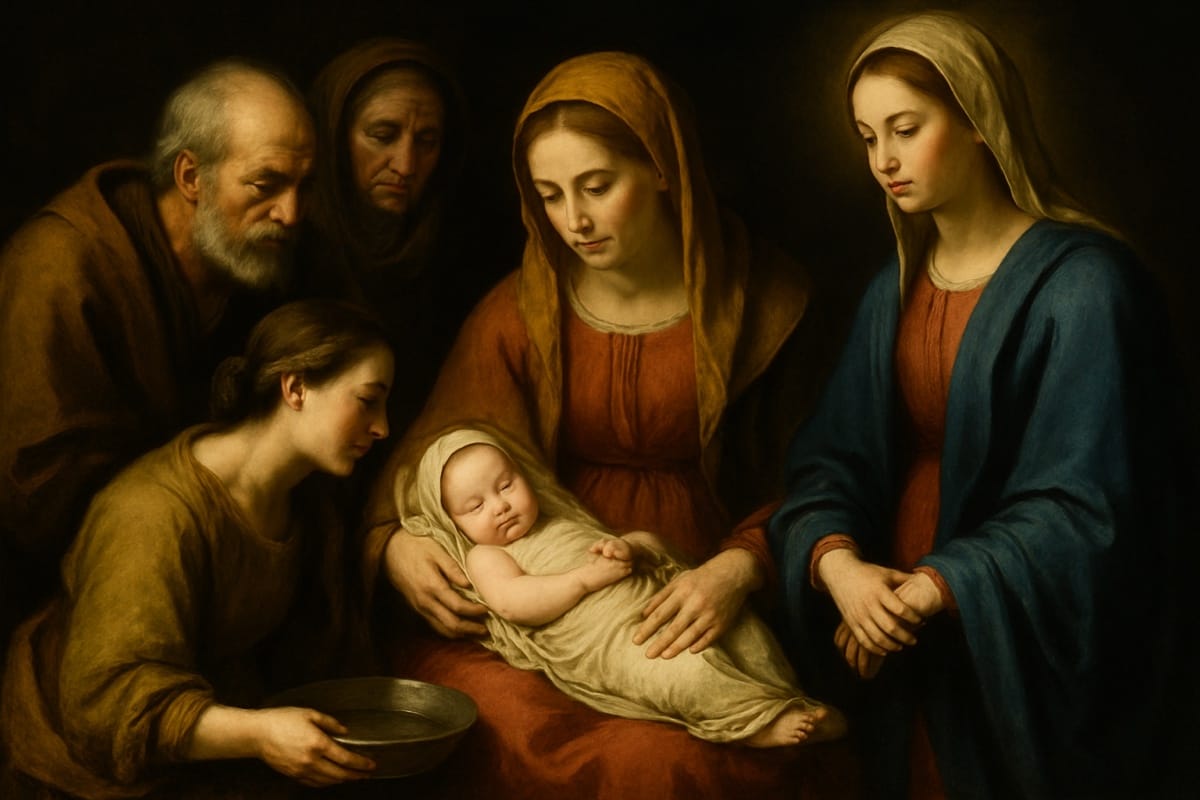
The liturgy places this prophecy in the context of Mary’s birth because she is the most direct human preparation for the fulfillment of Micah’s prophecy. Mary is of the tribe of Judah, of the line of David, rooted in the same tradition from which the Messiah was to come. Her birth, celebrated in this feast, is the penultimate link in a chain that God had been preparing since ancient times: the patriarchs, the kings, the prophets, down to the young girl who was born of Joachim and Anne and who would be the Mother of the ruler announced by Micah.
The prophecy ends with an image of maternal care: “He shall stand firm and shepherd His flock by the strength of the Lord, by the majesty of the name of the Lord His God. They shall dwell secure, for then He shall be great to the ends of the earth”. The shepherd whom Micah announces is the son Mary will bear. And Mary, in shepherding her son during the first years of His life, shares in the pastoral mission of the Son. The birth of Mary is the birth of the shepherdess who will form the Shepherd.
II. Predestined Before the Foundation of the World
The second reading, from the Letter to the Romans, presents the great chain of divine predestination that Mariology has applied in a singular way to the case of Mary. “We know that all things work together for good for those who love God, for those who are called according to His purpose. For those whom He foreknew He also predestined to be conformed to the image of His Son”. Pauline predestination is not fatalism. It is the recognition that the love of God precedes all history and every human decision: God loved His children before they existed.
Classical Mariology, from Duns Scotus to Saint Louis Marie Grignion de Montfort, developed the theology of Mary’s predestination as a constitutive part of God’s eternal plan. If the Son was predestined from eternity, the Mother of the Son was also predestined from eternity. This co-predestination of Christ and Mary does not mean that Mary is equal to the Son, but that her role in the plan of redemption is as eternal as the plan itself. God did not improvise the Incarnation. He prepared it from all eternity, and that preparation includes the predestination of Mary.
The chain of Rom 8:30 applies to Mary in an exemplary way: she was predestined, called at the Annunciation, justified by the grace of the Immaculate Conception, and glorified in the Assumption. Each link of this chain was realized in Mary in a singular, anticipated, and complete way. The birth we celebrate in this feast is the temporal beginning of an existence that God had planned in eternity. To celebrate the birth of Mary is to celebrate the fidelity of God to His eternal plan of salvation.
III. The Genealogy of Matthew and Mary’s Place in History
The Gospel of the Nativity of Our Lady is the genealogy of Matthew, which runs from Abraham to Jesus through forty-two generations. This liturgical choice has a theological depth that is worth contemplating. The genealogy is not a devotional text in the usual sense. It is a document of the history of salvation: it shows that Jesus did not fall from heaven as a being foreign to human history but that He entered it through a long series of concrete men and women, with their sins and their acts of fidelity, with their failures and their hopes.
The genealogy of Matthew is notable for the inclusion of four women before Mary: Tamar, Rahab, Ruth, and “the wife of Uriah” (Bathsheba). All of them have irregular or surprising stories. Tamar disguised herself as a prostitute. Rahab was a prostitute of Jericho. Ruth was a foreign Moabite. Bathsheba was the woman of an adulterous marriage. This inclusion is not accidental. Matthew shows that the messianic genealogy did not follow the logic of human ethnic or moral purity but the logic of the grace of God that acts through unexpected situations.
At the end of the genealogy, Matthew presents the birth of Jesus in a way that radically distinguishes the generation of Jesus from that of all the others: “Joseph the husband of Mary, of whom was born Jesus, who is called Christ”. The formulation is careful: not “Joseph begot Jesus”, as in the previous cases, but “Mary, of whom was born Jesus”. The virginity of Mary, explained in the episode that follows, places the birth of Jesus outside the biological logic of human generation. The birth of Mary that we celebrate today is the beginning of a history that will culminate in this virginal birth of the Son of God.
IV. The Birth of Mary in Theology, the Dawn That Precedes the Sun
The Feast of the Nativity of Our Lady is, after Christmas and the Nativity of Saint John the Baptist, one of the three feasts in the Roman calendar that celebrate a person’s birth. This liturgical fact is eloquent: the birth of Mary is celebrated as an event of salvation, not merely as the commemoration of a birthday. The Church recognizes that with the birth of Mary “the dawn of our salvation began”, as the office of this feast says. The dawn is not yet the sun, but without the dawn the sun would have no way of rising.
The apocryphal tradition, particularly the Protoevangelium of James, gave names to the parents of Mary: Joachim and Anne. Although these details are not part of the biblical canon, the liturgical veneration of Saint Joachim and Saint Anne (celebrated on July 26) reflects the Church’s awareness that the Mother of God had a family, a childhood, a concrete human history. Mary did not appear out of nowhere. She was born like any human being, of a father and a mother, in a family and in a community, marked by the religious tradition of her people.
The predestination of which Paul speaks is concretely realized in the birth of Mary: God called into existence, at a precise moment of history and in a concrete place in Galilee, the one who was to be the Mother of His Son. There is no accident in this birth. There is providence. And the Church that celebrates this birth recognizes that the history of salvation passes through the flesh, the blood, the tears, and the joy of real mothers who gave birth to real children. The Nativity of Mary is the beginning of the end of the long wait: the dawn is breaking and the Sun is not far off.
Postgraduate Program in Mariology
Would you like to deepen your formation in Mariology? Discover the Postgraduate Program in Mariology of Locus Mariologicus – an academic formation that unites theological rigor, spiritual life, and the living tradition of the Church.



Responses