Non veni ministrari sed ministrare: The Service of the Son and Mary Handmaid of the Lord
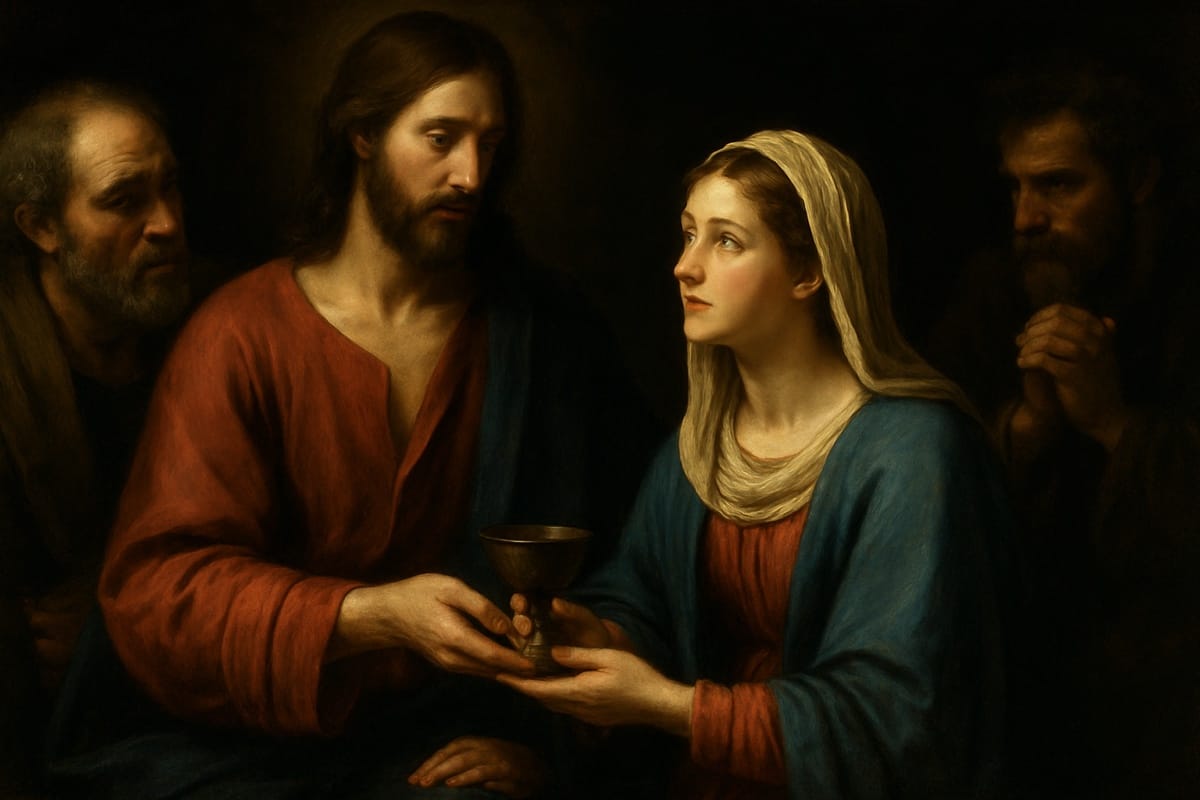
Sicut Filius hominis non venit ministrari, sed ministrare et dare animam suam redemptionem pro multis.
Mt 20:28
Mt 20:17-28 articulates three intimately linked moments: the third prediction of the Passion (vv. 17-19), the request of the mother of the sons of Zebedee for the first places in the Kingdom (vv. 20-23), and Jesus’ teaching on service as the law of the Kingdom (vv. 24-28). The juxtaposition is theologically deliberate: immediately after announcing His death and resurrection, Jesus confronts the temptation of glory without the Cross. The final answer, “the Son of Man did not come to be served but to serve and to give His life as a ransom for many” (Mt 20:28), is at once the synthesis of His mission and the program of all discipleship.
The third prediction of the Passion (Mt 20:17-19) is the most detailed of the three: Jesus announces that He will be “delivered to the chief priests and the scribes, condemned to death and delivered to the Gentiles to be mocked, scourged, and crucified”, and that He will rise on the third day. The growing specificity of the predictions marks the nearness of Jerusalem and Jesus’ ever clearer awareness of what awaits Him.
I. “Tradetur et tertia die resurget”: The Awareness of the Cross
Jesus’ awareness of His own death, expressed in the three predictions of the Passion, is one of the most important elements of Matthew’s Christology. Jesus does not go to Jerusalem in ignorance of what awaits Him: He goes knowing, deciding, choosing the way of obedience to the Father. The “handing over” (παραδίδωμι) that appears in the prediction is at the same time passive (He will be handed over by men) and active (He hands Himself over, cf. Jn 10:18: “I lay down My life on My own initiative”). The Passion is not only something that happens to Jesus, it is something that Jesus does.
The disciples’ reaction immediately after the prediction, the request for the first places, reveals that their incomprehension is total. This juxtaposition is brutal: Jesus announces the Cross. The disciples think of the throne. The X-ray of the fallen human condition: even in the face of the clearest revelation of the logic of service, the human heart automatically seeks greatness.
The request of the mother of James and John, “say that these two sons of mine may sit, one at Your right hand and the other at Your left, in Your Kingdom” (Mt 20:21), has its unsettling answer: “Are you able to drink the cup that I am to drink?” (Mt 20:22). Jesus does not refuse the request as illegitimate, the request for communion with Him is in itself right. But He reveals the real content of the “cup”: not the glory of the throne but the suffering of the Cross. The “right and left” of Jesus on Calvary will be two thieves, not the sons of Zebedee.
II. “Calicem meum bibetis”: The Cup and the Cross
“My cup you shall drink” (Mt 20:23), Jesus’ statement is at the same time prophecy and invitation. James was the first apostle to die a martyr (Acts 12:2). John lived to old age but suffered exile on Patmos. Both “drank the cup”, in different ways, but both within the logic of the service that goes as far as total self-giving. Jesus’ promise is not easy glory but communion in redemptive suffering.
The indignation of the other ten apostles (Mt 20:24) reveals that they too wanted the places of honor, they simply had not had the courage to ask for them. Jesus’ answer is not a rebuke but a structural teaching: the distinction between the logic of the “rulers of the nations” (who dominate and impose) and the logic of the Kingdom (where the greatest is the servant of all). This distinction is not a detail of protocol but an ontological revolution: authority in the Kingdom is not power over others but service to others.
III. Mary: From the Handmaid of the “Fiat” to the Handmaid of Calvary
Mary is, from the Annunciation to Calvary, the most perfect realization of the “non veni ministrari sed ministrare” that Jesus proclaims in Mt 20:28. She who said “behold the handmaid of the Lord” (Lk 1:38) did not use a title of rhetorical humility but a definition of mission: the “handmaid” (δούλη) is the one who places her existence entirely at the service of another. Mary’s “fiat” is the model of the service that Jesus describes: availability without reserve, self-giving without conditions.
The comparison between the “mother of the sons of Zebedee” and Mary is theologically revealing. The first mother asks glory for her sons without understanding what she asks. The second Mother offers her Son to death without asking anything in return, “stabat” (she stood at the foot of the Cross, Jn 19:25), present, silent, faithful. The mother of Zebedee’s sons wanted her sons to be served by others. Mary accepted that her Son should serve even to the giving of His life. The difference between the two mothers is the difference between the motherhood that holds back and the motherhood that offers.
The “giving of His life as a ransom for many” (Mt 20:28) has in Mary its most intimate cooperation: she who brought forth the “ransom” (λύτρον) cooperated in its offering. The theology of Mary’s cooperation in the Redemption finds here its most solid biblical foundation: Mary at the foot of the Cross was not only a witness but a participant, the “handmaid” who served the Lord at the moment of the greatest service.
IV. “Sicut filius hominis”: The Model of Service for the Church
“Even as the Son of Man did not come to be served but to serve” (Mt 20:28), the “even as” (ὥσπερ) is the imitative dimension: the disciples are called to serve “as” Jesus served. This imitation is not only moral (the behavior of service) but ontological: to share in the redemptive mission of Jesus, to offer one’s own life as a partial “ransom” in the service of others. The deacon, the priest, the layman who serves the poor, the mother who sacrifices her comfort for her children, all share in the one redemptive service of the Son.
Mary is the ecclesial model of this imitation: she who lived the most radical service (the divine maternity as absolute service) is the one who most perfectly reproduces the “non ministrari sed ministrare” of the Son. The Church that contemplates Mary at the foot of the Cross learns the law of service: not to ask for the first places but to be where the Son is, “where I am, there shall My servant be also” (Jn 12:26).
Saint Pontian and Saint Hippolytus, whose names the liturgy recalls on this August 13, two bishops who died in the mines of Sardinia, a pope and his theological adversary reconciled in martyrdom, are the historical examples of how the “serving” of the Son is accomplished in the reconciliation of those who serve: the greatness of the Kingdom belongs to the one who humbles himself, not to the one who is right.
Postgraduate Program in Mariology
Would you like to deepen your formation in Mariology? Discover the Postgraduate Program in Mariology of Locus Mariologicus – an academic formation that unites theological rigor, spiritual life, and the living tradition of the Church.
Would you like to study Mariology seriously?
This article grows out of the works in the Locus Mariologicus library. The Postgraduate Program in Mariology takes you to the same source, with academic guidance: Scripture, the Fathers of the Church, and the Magisterium, from the first dogma to contemporary questions.





Responses