Five loaves: Mary and the bread that anticipates the Eucharist
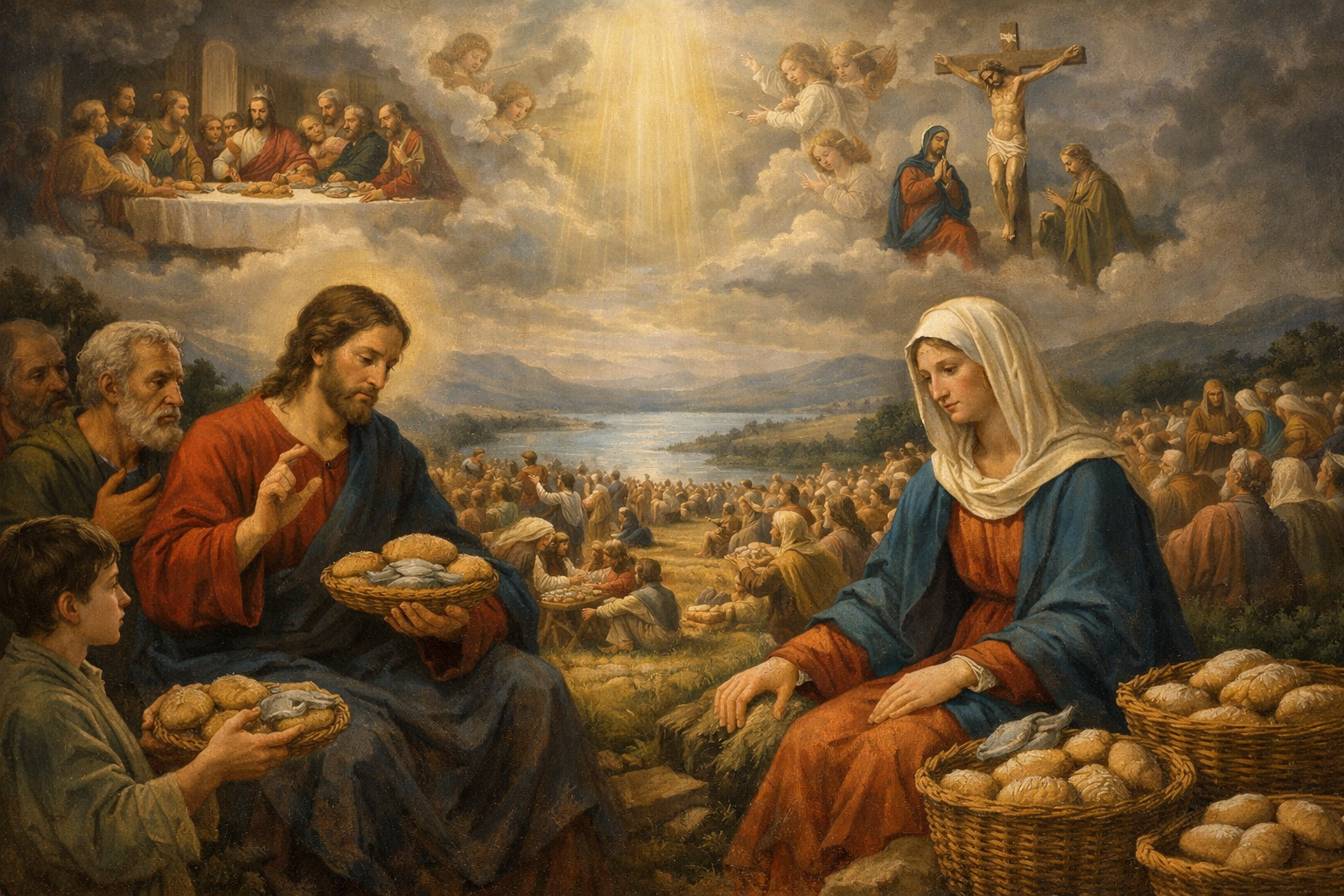
Est puer unus hic qui habet quinque panes hordeaceos et duos pisces.
Jn 6:9
The multiplication of the loaves, recounted in the sixth chapter of the Gospel of John with a theological richness unparalleled in the Synoptics, opens the great discourse on the Bread of Life. This sign, sēmeion, is not merely a work of social compassion: it is a window opened onto the Eucharistic mystery that Jesus will reveal in the words that follow, and an anticipation of the total gift that the Son will make of Himself on the Cross and at the Last Supper. In that opening, the figure of Mary casts a particular light on the identity of the Bread that comes down from heaven: she who gave the Word the flesh by which He becomes food is implicitly present in every Eucharistic meditation of the sixth chapter of John.
I. The sign of the loaves and its theological logic
Five barley loaves and two fish, a scandalous poverty before five thousand men. Andrew formulates the logical objection that everyone shares: “but what is this for so many people?” (Jn 6:9). The human logic of scarcity collides head-on with the divine logic of abundance. Jesus takes what there is, gives thanks (eucharistēsas) and distributes, and what was insufficient becomes superabundant. After the meal, twelve baskets full of fragments are left over. The sign says that with God scarcity becomes fullness, and that the little offered to God returns multiplied beyond all expectation.
The word eucharistēsas, which the Vulgate renders as gratias egisset, is deliberately Eucharistic: it is the same verb that describes Jesus’ action at the Last Supper (Lk 22:19; 1 Cor 11:24). In the sign of the loaves, John anticipates the reality of the Eucharistic Bread: the gesture of taking, giving thanks, breaking and distributing is the same in both moments. This correspondence is not accidental. It is part of the theological architecture of the Fourth Gospel, which presents the signs as anticipations of the deeper reality that the ministry of Jesus progressively reveals. The sign of the loaves points to the Eucharist as the Eucharist points to Calvary.
John emphasizes that “the Passover, the feast of the Jews, was near” (Jn 6:4). This chronological detail is not decorative: it places the sign of the loaves within the paschal horizon that dominates the whole Fourth Gospel. The Jewish Passover was the memorial of the exodus and of the manna in the desert. The new Passover that Jesus inaugurates is the gift of His own Body as the “true bread that comes down from Heaven” (Jn 6:32). The sign of the five loaves on the eve of the Passover is the last “prefiguration” before the reality: just as the manna prepared Israel for the promised land, the sign of the loaves prepares the disciples for the Bread that will lead them to eternal life.
The theology of abundance in Jn 6 has precise Mariological resonances. Mary, who said “they have no wine” at Cana (Jn 2:3), is the figure of the woman who perceives human need and presents it to her Son. Her sensitivity to the needs of others, characteristic of Marian devotion in every age, is an extension of her motherhood: she who fed her Son in the first months of His life understands better than any other human being the meaning of a Son who becomes food for the world.
II. Mary as the “baker” of the bread of life
The image is bold but has solid patristic roots: Ambrose of Milan and Peter Chrysologus called Mary furnus Verbi, “the oven of the Word”, because in her the Bread of Life was “baked”. The metaphor expresses a precise and inescapable theological truth: the body of Christ, which becomes Eucharistic food, has its origin in the flesh of Mary. There is no Eucharist without the Incarnation. There is no Incarnation without the virginal motherhood of Mary. The Eucharist is, in a certain way, the Son of Mary who becomes food for all her other children, the members of His ecclesial Body.
This relationship between Mary and the Eucharist was developed masterfully by John Paul II in Ecclesia de Eucharistia (nn. 53-58): “The Church has learned from Mary to contemplate the face of Christ. Mary is a Eucharistic woman in her whole life”. The mulier eucharistica is she who gave the Word the flesh with which He gives Himself in the Eucharist, and who therefore lived, more intimately than any other human being, the logic of “take and eat, this is my body”. When Jesus speaks these words at the Last Supper, He is offering what Mary gave Him: the flesh born of her, by the action of the Holy Spirit.
Medieval Eucharistic spirituality developed a particularly rich devotion in the articulation between the mystery of Mary and the Eucharistic mystery. The antiphons of Corpus Christi, a feast instituted by Thomas Aquinas at the request of Urban IV in 1264, include implicit references to Mary’s motherhood: the “bread of angels” (panis angelicus) became the “bread of pilgrims” through the mediation of Mary’s womb. This transition from the eternal to the temporal, from the incorporeal to the carnal, from the divine to the human, which is the core of the mystery of the Incarnation, is also the core of the Eucharistic mystery. The two transitions pass through the same point: Mary.
Christian iconography grasped this truth intuitively: in many medieval and Renaissance depictions of the Last Supper, the presence of Mary is evoked symbolically, now by a female figure in the background, now by the blue color that dominates the mantle of one of the disciples, now by the arrangement of the loaves that echoes the arrangement of the Child in the manger. These iconographic suggestions are not arbitrary: they express the theological conviction that the Eucharist is inseparable from Mary’s motherhood, and that to celebrate the Eucharist is always, implicitly, to thank Mary for the gift she made possible.
III. “Gather up the fragments”: the care that loses nothing
After the multiplication, Jesus commands that the leftover pieces be gathered up: “That nothing may be lost” (Jn 6:12). Twelve full baskets, an abundance that overflows and that must be received with care. The instruction to gather the fragments reveals a trait of God’s love that sacramental theology emphasizes: God’s grace is not wasted. Everything is gathered, kept, destined. There is not a single person whom grace does not reach. There is not a single fragment of God’s work that is lost through carelessness.
Mary is, in this perspective, the figure of that careful and loving “gathering”. The Gospel of Luke describes her as the one who “kept and pondered in her heart” (Lk 2:19, 51). The Greek verb synterein, “to keep with care”, evokes exactly the gesture of gathering the pieces with loving attention. Mary “kept” the fragments of the mystery that overflows human understanding: the words of the angel, the song of Elizabeth, the words of Simeon, the answer of her adolescent Son, the gestures of the public ministry. Nothing is lost in Mary’s heart. Everything is kept for the moment when its meaning will become clear.
Ignatian spirituality, with its method of “apostolic contemplation”, found in Mary the model of spiritual “gathering”: just as she gathered the fragments of the mystery of Christ, the contemplative is invited to “gather” the fruits of prayer and to keep them so that they are not lost in the bustle of the active life. This disposition of “careful keeping” of the gifts received is one of the deepest characteristics of Marian spirituality, applicable to the life of every disciple who desires not to squander the grace offered to him.
The “twelve baskets” left over from the multiplication have a numerical symbolism that did not escape patristic exegesis: twelve is the number of the tribes of Israel and of the apostles, the number of the fullness of the people of God. The fragments gathered are enough to feed the whole people of God, present and future. The Eucharist celebrated at every Mass is a “fragment” of that original multiplication, and Mary, who intercedes for the Church at every Eucharistic celebration, is the guarantor that “nothing may be lost” of the gifts the Son left to His Body.
IV. The Passover and the bread: Mary between the two Testaments
John emphasizes that the sign of the loaves took place “when the Passover was near” (Jn 6:4). This paschal contextualization places the episode within the long history of sacred bread in the Bible: the manna in the desert (Ex 16), the bread of the Presence in the Tabernacle (Ex 25:30), the bread that the angel brought to Elijah (1 Kgs 19:6), the loaves that the young David asked of the priest Abiathar (1 Sam 21:4-7). In each of these episodes, bread is a sign of God’s providence toward His people, a language of nourishment through which God expresses His maternal care. Mary, who shared in the Jewish tradition and who fed her Son with her own milk, takes her place naturally in this long chain of divine mediations of nourishment.
The manna in the desert, to which Jn 6:32 explicitly refers (“your fathers ate the manna in the desert and died”), is the most direct prefiguration of the Eucharistic Bread of Life. But whereas the manna nourished only the body and for a limited time, the Bread that Jesus offers nourishes the soul, and for eternal life. Mary, who gave the Son His human flesh, is, in this sense, the link between the perishable manna and the eternal Bread: she who was a “daughter of Israel” and heir to the promise of the manna became the mother of the Bread that surpasses every earlier promise and definitively fulfills what the manna only prefigured.
The relationship between the Jewish Passover and the Christian Passover, explicitly taken up in Jn 6, has in Mary a particular point of articulation. She who was raised in the faith of Israel, who celebrated the Passover throughout her whole life, who accompanied Jesus on the paschal pilgrimages to Jerusalem, is the human figure who most organically unites the two Passovers: that of the liberation from Egypt and that of the liberation from sin and death. Mary is, in that sense, the “suture point” between the two Testaments, the faithful Israelite who received the fulfillment of the Promise in her own womb.
In the paschal context in which we find ourselves, this meditation invites a deeper Eucharistic gratitude. In every Eucharist, we receive the Bread that came down from Heaven and that took flesh from Mary. The formula of the Roman Canon that commemorates “the glorious ever-Virgin Mary, Mother of our God and Lord Jesus Christ” at the moment of the Eucharistic consecration is not a devotional concession: it is a theological affirmation that the Bread we break has a maternal genealogy, and that this genealogy begins in Mary of Nazareth.
The Bread that nourishes the world unto eternal life had its origin in the flesh of Mary. Contemplating the Eucharistic mystery, we are invited to acknowledge, with gratitude, the maternal mediation through which the Word became food.
Postgraduate Program in Mariology
Would you like to deepen your formation in Mariology? Discover the Postgraduate Program in Mariology from Locus Mariologicus – an academic formation that unites theological rigor, spiritual life and the living tradition of the Church.
Would you like to study Mariology seriously?
This article is born from the works in the library of Locus Mariologicus. The Postgraduate Program in Mariology takes you to the same source, with academic guidance: Scripture, the Fathers of the Church and the Magisterium, from the first dogma to contemporary questions.





Responses