Saint Mary, Mother of the Lord
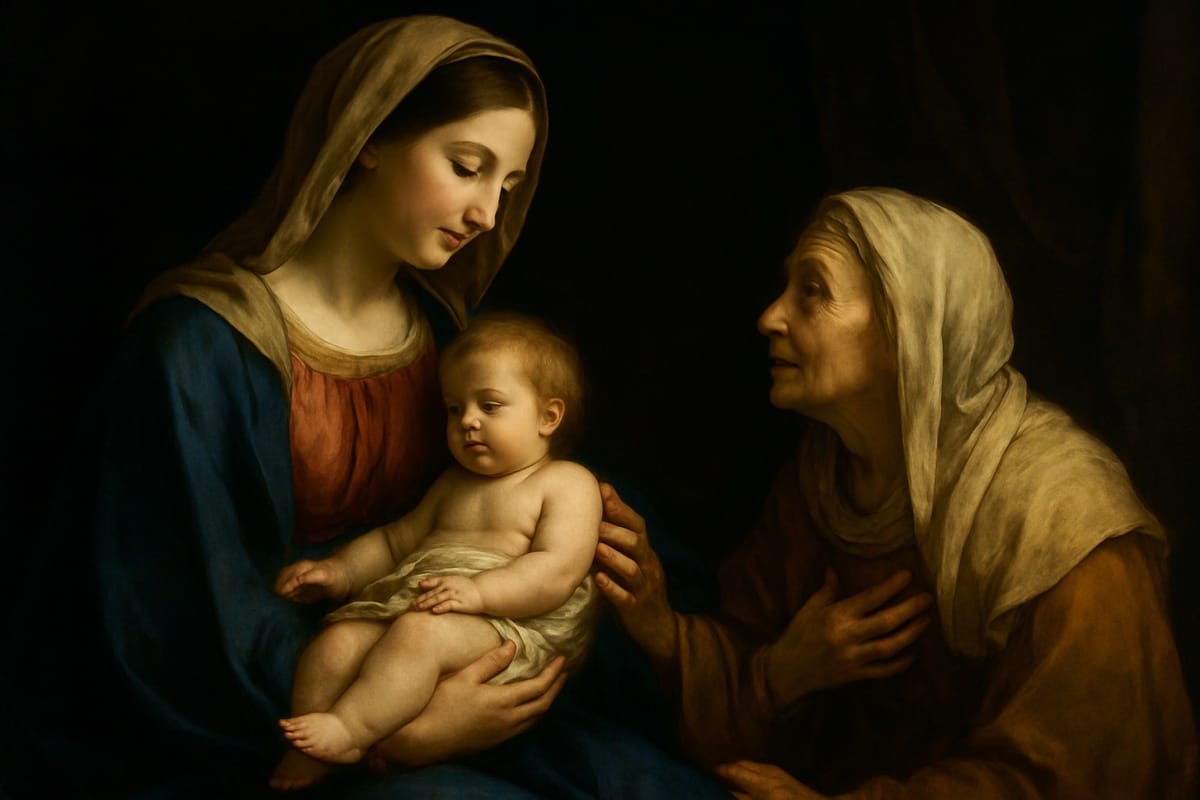
“And why is it that the mother of my Lord is coming to me?” “How can I deserve that the mother of my Lord should visit me?” (Luke 1:43)
I. The Ark of the Covenant Enters Jerusalem
The scene of the translation of the Ark of the Covenant into Jerusalem, narrated in the First Book of Chronicles, is one of the most solemn and festive moments in Israel’s religious history. David organizes a procession of all the people, with music, with songs, with dancing, to lead the Ark to the place the Lord had designated as the dwelling place of His name. The Ark is the most sacred symbol of God’s presence among Israel: the golden chest that contains the tablets of the Law, the manna, and Aaron’s rod, is the place where God’s glory “rests” upon the cherubim. When the Ark is installed in the place David prepared, he offers burnt offerings and peace offerings, and the people return to their homes after being blessed.
Early patristic writing recognized Mary as the new Ark of the Covenant: she who contains not the tablets of stone but the living Word, not the manna of the desert but the Bread from Heaven, not Aaron’s rod but the flower that sprang from Jesse’s root. The comparison is not a forced allegory: the Lucan text of the Visitation suggests it through verbal and structural parallels with the account of the Ark in 2 Samuel 6. David leaps for joy before the Ark as John leaps for joy in Elizabeth’s womb before Mary; David exclaims, “How can the Ark of the Lord come to me?” as Elizabeth exclaims, “How do I merit that the Mother of my Lord should come to visit me?”
II. The Typology of the Ark and the Visitation
The correspondence between the ascent of the Ark to Jerusalem and Mary’s ascent to the mountainous region of Judea is seen by the liturgy as one of the most eloquent examples of biblical typology: the reality of the Old Testament announces and prefigures the reality of the New Testament that surpasses and fulfills it. The Ark contained God’s word written on stone. Mary bears the incarnate Word of God. The Ark was transported in a grand procession. Mary goes “swiftly” with the simplicity of charity. The Ark remained three months in Obed-edom’s house before entering Jerusalem (cf. 2 Samuel 6:11). Mary stays three months in Elizabeth’s house (cf. Luke 1:56).
These correspondences reveal that Mary’s presence carries with it the presence of him she bears: just as Obed-edom’s house was blessed during the three months the Ark remained there, so Elizabeth’s house is visited by grace during the three months Mary stays. The blessing the Ark poured out over Israel was that of God’s presence mediated by the sacred symbol. The blessing Mary brings to Elizabeth’s house is that of the Son she bears, who already acts through his Mother before he has even been born, who already makes John Baptist exult before he has pronounced his first word.
III. The Fulfillment in Mary
Mary, in her very being, is the fulfillment of Israel’s hopes and the beginning of a new era. She is the new Eve, who, with her “yes” to God, restores the harmony between humanity and its Creator. She is the new Sarah, who, in her childbearing, gives birth to the Savior of the world. She is the new Ruth, who, through her love and loyalty, becomes the mother of the King of Israel. She is the new Hannah, who, in her prayer, asks for a son who will be the Lord’s. She is the new Deborah, who, with her judgment, liberates her people from oppression. She is the new Esther, who, with her courage, saves her people from annihilation. She is the new Miriam, who, with her song, proclaims the glory of God. She is the new Judith, who, with her wisdom, cuts off the head of the enemy. She is the new Eve, who, with her “yes” to God, restores the harmony between humanity and its Creator.
“The Mother of My Lord”: The Title Preceding Ephesus
The confession of Elizabeth, “How can I, who am a servant, have the honor of the Mother of my Lord coming to me?” (Luke 1:43), is the first explicit proclamation of Mary’s divine motherhood in the New Testament. The title “Lord,” Kyrios in Greek, is the name the Greek translation of the Bible used for the ineffable name of God. By calling Jesus “my Lord,” Elizabeth confesses, under the inspiration of the Holy Spirit, the divinity of one Mary bears in her womb. And by calling Mary “the Mother of my Lord,” Elizabeth anticipates, some four centuries later, the definition of Ephesus: Mary is Mother of God because she is the Mother of Jesus, who is Lord, that is, God.
This confession of Elizabeth is not the result of theological deduction, but springs from the encounter with the presence of Christ, mediated by the presence of Mary. It is the experience that precedes the doctrine, the lived reality that precedes formulation, the encounter that grounds the statement. The Church, in celebrating this Mass, recognizes in Elizabeth the prototype of all generations that, upon meeting Mary, experience the presence of the Son and are led to confess his lordship.
IV. Mary, the New Ark Bearing the Lord to the World
The 19th Mass in the Collect, first in Ordinary Time, contemplates Mary as the new Ark of the Covenant, bearing the Lord to the world and communicating him to those who receive her with faith. The biblical typology of the Ark does not diminish Mary’s uniqueness; on the contrary, it illuminates the depth of the Old Testament roots upon which Marian theology in the New Testament is built. The Church celebrating this Mass is invited to recognize in Mary the presence of the Lord she continues to bear, and to receive her as Elizabeth did: with humility, with joy, and with the confession that what she brings surpasses our capacity to receive.
Elizabeth’s exclamation, “How can I deserve?” is the proper spiritual attitude toward Mary: not considering oneself worthy to receive the Mother of the Lord, but recognizing one’s unworthiness and, precisely for that reason, being open to the grace that overcomes it. The humility Elizabeth expresses is the humility that Mary’s Magnificat will proclaim as the criterion of divine love: “God looks upon the humility of his servant” (Luke 1:48), “God exalts the humble” (Psalm 147:6). Elizabeth is exalted because she recognizes her smallness. Mary is exalted because she recognizes herself as a servant. And the Lord both of them bear in their lives continues to exalt the humble and to fill the hungry with good things.




Responses