The hidden treasure and the wisdom of Solomon: 1 Kings 3, Romans 8, and Matthew 13
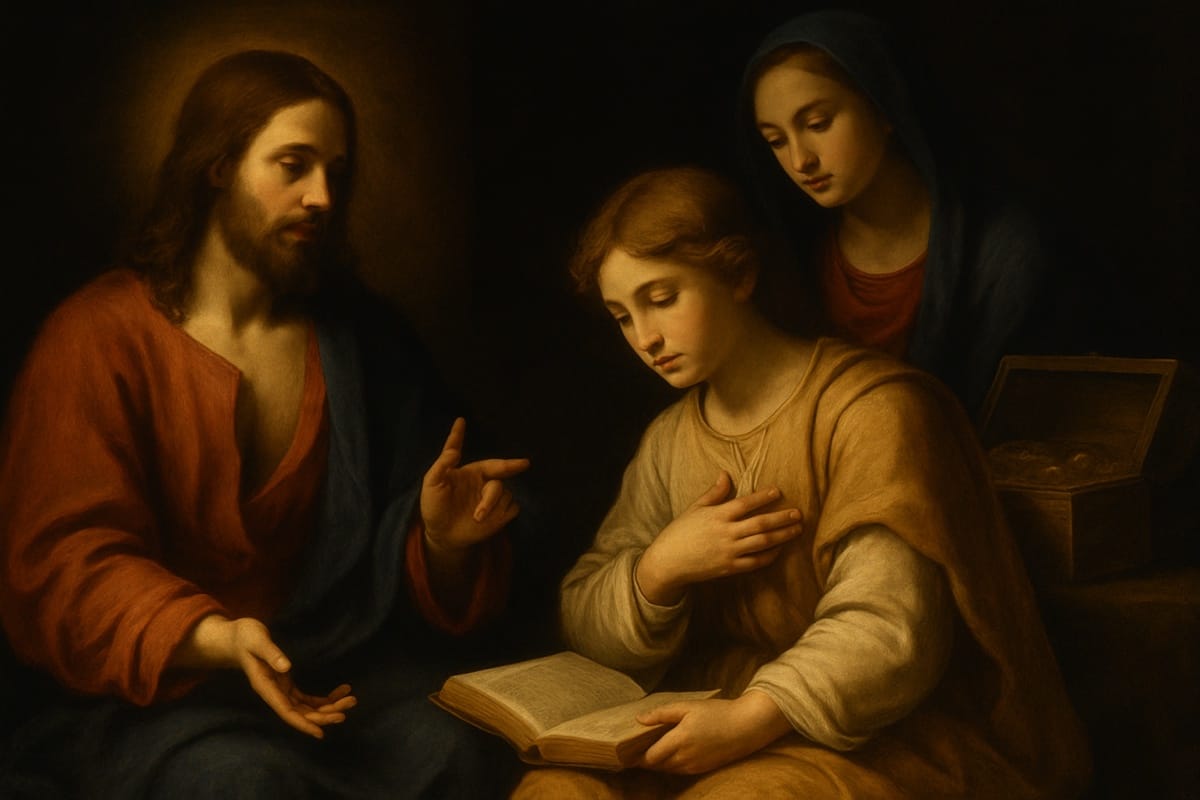
> **Quote:** “All things work together for good for those who love God.” (Romans 8:28)The seventeenth Sunday of Ordinary Time in Year A brings together three texts around the treasure that surpasses all else and the wisdom that recognizes it. 1 Kings 3:5-7-12 recounts Solomon’s dream: God offers him anything, and he asks not for wealth nor victory, but for a discerning heart to rule. Romans 8:28-30 assures us that “all things work together for good for those who love God,” who have been predestined, called, justified, and glorified. Matthew 13:44-52 tells the parables of the hidden treasure and the precious pearl: whoever discovers them sells all to obtain them. The three texts converge on the same insight: there is a good that surpasses all goods, and wisdom consists in recognizing it and choosing it wholeheartedly, leaving behind what once seemed valuable.## I. The First Reading: 1 Kings 3:5-7-12The Lord appears to Solomon in a dream at Gibeon and says, “**Ask for whatever you wish**” (1 Kings 3:5). Solomon acknowledges his limitations: “**I am still young and untrained**” (v. 7). And he asks not what the logic of power would suggest—riches or victory—but for a humble heart to govern his people and discern between good and evil, for who could rightly rule such a large population? God commends his choice: Solomon did not ask for longevity, wealth, or the death of his enemies, but for discernment. And because he asked this, he will receive even more than he asked: “**I will give you a wise and understanding heart**” (v. 12). Solomon’s wisdom is the parable of the pearl: whoever recognizes the supreme value of discernment finds everything they needed.## II. The Second Reading: Romans 8:28-30Paul states one of his most profound theological principles: “**We know that all things work together for good for those who love God, who have been called according to his purpose**” (Romans 8:28). “**All things**” includes suffering, weakness, uncertainty, and the wheat mixed with the tares: nothing is outside of God’s purpose for those who love Him. The foundation of this certainty lies in the chain of predestination: “**Those whom he foreknew, he also predestined to be conformed to the image of his Son, so that he might be the firstborn among many brothers. And those he predestined, he also called; and those he called, he also justified; and those he justified, he also glorified**” (vv. 29-30). Glorification is stated in the past, “**he glorified them**,” because Paul speaks of what God has already decided: history may not be over, but God’s decision is prior to history and irreversible.## III. The Gospel: Matthew 13:44-52Jesus tells three brief parables. The first: “The Kingdom of Heaven is like a treasure hidden in a field. When a man finds it, he hides it again and, filled with joy, goes and sells all that he has to buy the field” (Mt 13:44). The second: “The Kingdom of Heaven is also like a merchant searching for fine pearls. When he finds one of great value, he sells everything he has to buy it” (vv. 45-46). Both parables have the same structure: discovery, joy, selling everything, buying. What changes is the type of discovery: in the first, the man stumbles upon the treasure. In the second, the merchant actively seeks it. In both cases, the reaction is identical: “sells everything.” The Kingdom is not an addition to existing life: it is the replacement of everything else with the only thing that matters. The third parable describes a net that collects fish of every kind: by the shore, the good are separated from the bad. It’s the same logic as wheat and tares: separation comes, but not yet. To the scribe who became a disciple of the Kingdom, Jesus compares him to the homeowner who “brings out new treasures and old from his store” (v. 52): the novelty of the Gospel does not annul the richness of Scripture, but fulfills it.IV. Mary and the precious pearlRom 8:29 speaks of predestination to be conformed to the image of the Son. Mariological tradition recognized in Mary the most predestined creature: chosen from all eternity to be the Mother of the Son, preserved from original sin precisely so that the image of the Son might shine in her without obstacle. Solomon asked for wisdom and received everything. Mary received everything because she was chosen for the supreme mission, and in this election she received full grace. The parables in Mt 13 shed light on Mary’s response to the Annunciation: when the angel announced, Mary found the hidden treasure. Her response, “Be it done unto me according to thy word,” is the “sell everything” of the parable: Mary did not bargain, did not ask for guarantees, did not impose conditions. She sold her entire autonomy to buy the field where the Son of God would dwell. The liturgical tradition called her “Sedes Sapientiae” (Seat of Wisdom): not only because she generated incarnate wisdom, but because in her person was fulfilled the choice that Solomon made in a dream, now in full wakefulness and full freedom.
Graduate Studies in Mariology
Wishing to deepen your formation in Mariology? Discover the Graduate Studies in Mariology from Locus Mariologicus – an academic formation that combines theological rigor, spiritual life, and the living tradition of the Church.



Responses