Totus tuus: Mary and Saint John Paul II
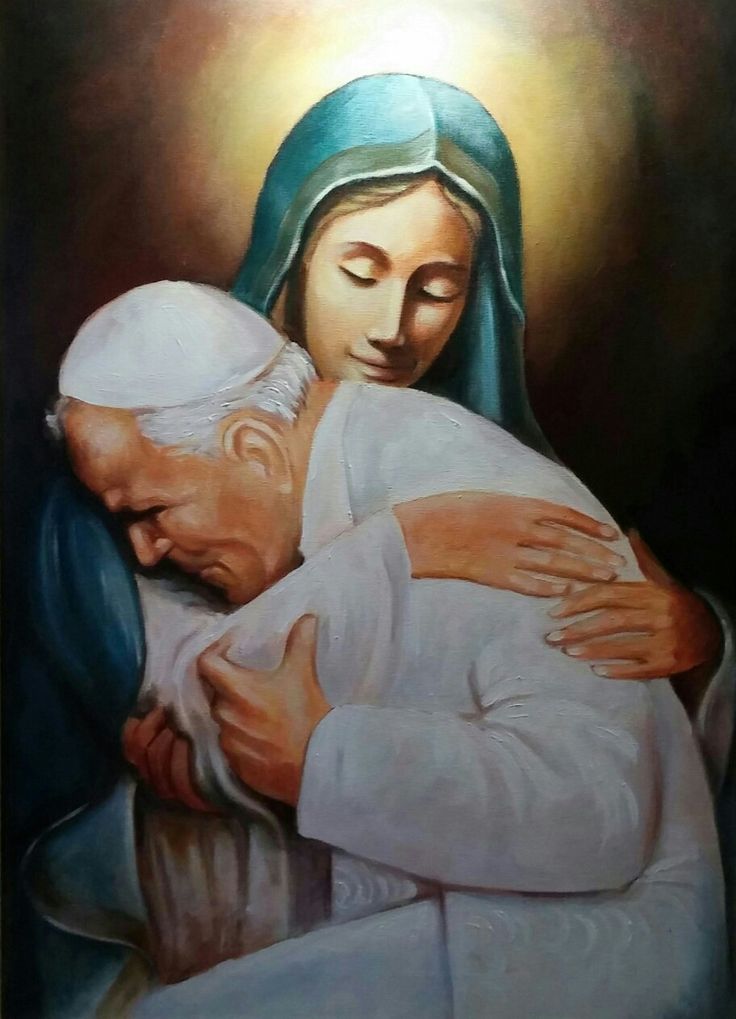
Totus Tuus is a Latin expression that means “All yours” (or “Totally yours”), addressed to Mary. It was the motto of Saint John Paul II, who took it from the Treatise on True Devotion to the Blessed Virgin, by Saint Louis Marie de Montfort. It expresses total consecration to Jesus through Mary. The full phrase is “Totus tuus ego sum, et omnia mea tua sunt” – “I am all yours, and all that is mine is yours”.
The life of John Paul II was entirely marked by his devotion to Mary, and he never concealed his deep and concrete piety toward the Virgin, whom he called his “special patroness.” The motto Totus Tuus, drawn from the Treatise on True Devotion of Saint Louis de Montfort, reflects this total consecration and found its systematic theological foundation in the encyclical Redemptoris Mater (1987) and in the apostolic letter Rosarium Virginis Mariae (2002). This devotion was a gift that became the principle of an even more complete consecration to Christ, exercising a decisive influence on his thought and his ministry as Bishop of Rome.
Totus tuus ego sum et omnia mea tua sunt, “I am all yours and all that is mine is yours.” This phrase of Saint Louis Marie Grignion de Montfort became the episcopal motto of Karol Wojtyla, later Pope John Paul II, and it sums up the core of Marian consecration: the total and unconditional self-giving to Mary, as the path to Christ. The article explores the meaning of the expression, its roots in Montfort, and the way in which John Paul II lived it throughout his pontificate.
The biblical foundation of the totus tuus: Jn 19:26-27, Saint Louis de Montfort, and the Marian spirituality of John Paul II
On Golgotha, Jesus “said to his mother: ‘Woman, behold your son!’ Then he said to the disciple: ‘Behold your Mother!’ And from that hour the disciple took her into his home” (Jn 19:26-27). This famous Gospel passage, widely meditated upon and studied by generations of Christians, may be taken as the basis of the “Marian thread,” as John Paul II himself defined it in his book Gift and Mystery, which always united the disciple of Jesus, Karol Wojtyla, to Mary, the Mother of the Redeemer. From the meditation of this great mystery of salvation he became convinced, and with his intense Marian Magisterium he taught us, that Mary leads us to Christ, but also that Christ leads us to His Mother. The Mariological doctrine of John Paul II is an immense patrimony. His Magisterium harmoniously combines personal devotion, ecclesial and ecumenical responsibility, poetic intuition, and theological and anthropological depth, together with a pastoral flexibility, composing a vast and deeply harmonized picture, always marked by the dynamism of the present, the past, and the future.
In his teaching, all the great themes of faith and of existence meet. For this reason, as he taught, one cannot ignore contemporaneity, which gives theological reflection the capacity to bring both believers and non-believers into the trinitarian mystery, emphasizing how the heart of God in Christ beats eternally for the humanity of every age, continent, and culture. Mary, in this sense, was the singular beneficiary of this mystery and continues to be, as in the past, its unique witness in the present of the Church and of the world. Much has already been said and written about John Paul II and his filial and pronounced Marian devotion. All agree that his teaching was always deeply connected with and inspired by the Magisterium of the Second Vatican Council, in which he was a passionate and convinced protagonist. His most authoritative and challenging Marian teaching is a clear expression of his conciliar, pastoral, and human experience. He had the merit of constantly presenting the Mother of the Redeemer in the light of the trinitarian, christological, and ecclesial mystery, as an exemplary, charismatic, and “transversal” figure.
The addresses, in-depth treatments, and mentions of the Virgin or of the themes related to Mariology in the Magisterium of Wojtyla are innumerable. No pope before him dealt so extensively with the mystery, the meaning, and the Marian practice of the Church. According to the then Cardinal Joseph Ratzinger, the Marian teaching of John Paul II expresses the conviction that in the Virgin of Nazareth all the fundamental themes of faith are concentrated, and that men and women, peoples and nations seek in her faith the support of their own faith. In the final analysis, Mary is, for the Polish pope, what René Laurentin concisely defines as: the key to the Christian mystery. Mary realizes the principal Christian values in a singular, exemplary, inspiring, dynamic, and imitable way, because she stands at the beginning of the Christ event, at the center of history, and because God placed in that beginning a complete perfection, at the center of the Church. In the eyes of the people of God she thus becomes the “paradigm,” that is, the “perfect model” of preserved, full, and radiant holiness. Of woman and of femininity. Of grace as gratuitousness and fullness. Of conscious and total faith. Of virginity and of human and divine motherhood, and, consequently, of the virtues and charisms of which the divine motherhood is the prototype. Of the kingship of God as the summit of freedom and of the peculiar omnipotence of love. Of the Gospel hundredfold. Of the eschatological goal. Mary recalls and shows to the Church and to humanity, above all, the “essential” and “existential” dimension of faith, which is a personal, familiar, and intense relationship with Christ, correcting an anthropology orphaned of God and contributing to restoring that culture of life, of welcome, of gift, and of love, proper to Christianity.
The Marian magisterial interventions of John Paul II: from Redemptoris Mater (1987) to Rosarium Virginis Mariae (2002)
Let us now look briefly at the most important magisterial interventions in the nearly twenty-seven years of his pontificate, following a chronological order:
- The encyclical Redemptoris Mater (1987). It is a powerful reflection on the conciliar doctrine with a biblical, theological, and spiritual emphasis, presenting Mary in the historical-salvific event of Christ, at the center of the people of God on their trinitarian journey and, finally, in the explanation of her “maternal mediation,” with original developments. The encyclical highlights, more markedly than Vatican II, the “historical” dimension of Mary in her life and faith, as well as her active and exemplary “presence” in the mystery of the Church and in the dynamics of salvation.
- The apostolic letter Mulieris Dignitatem (1988). The first ecclesial document that deals specifically with the “question of woman” and contributes in an original way with a proposal of biblical anthropology, with reference to Mary, who reveals to women their dignity and vocation. Mary is presented as the New Eve, a sign of the original anthropology, and as Virgin-Mother, giving meaning to motherhood and virginity.
- The Marian catecheses at the Wednesday general audiences (1995-1997). They consist of 70 catecheses delivered between September 7, 1995, and November 13, 1997. These catecheses are a true Mariological summa, outlining the life, virtues, holiness, and presence of Mary in the Scriptures and in tradition, always in the light of Vatican II.
- The apostolic letter Tertio Millennio Adveniente (1994). A document dedicated to the preparation of the great Jubilee of the year 2000, in which John Paul II affirms that Mary is present in a “transversal” way to the event of the redemption, expressing her relationship with the Trinity and with redeemed humanity.
- The apostolic letter Novo Millennio Ineunte (2001). Published at the end of the Jubilee of 2000, it is considered a synthesis of all the documents of his pontificate. In a missionary and contemplative tone, it reaffirms the new evangelization and the contemplation of the mystery of Christ, highlighting the role of Mary as the first and greatest contemplative.
- The apostolic letter Rosarium Virginis Mariae (2002). Written at the beginning of the twenty-fifth year of his pontificate, it calls Christians to the prayer of the Rosary, motivating its practice and highlighting figures such as Blessed Bartolo Longo. The letter encourages the contemplation of the face of Christ in the company and the school of Mary, who helps in the contemplation of this mystery.
Besides these, various other documents of the Magisterium of John Paul II contain a significant reference to the Virgin Mary, such as:
- In Catechesi tradendae (1979), Mary is “Mother and model of the disciple.”
- In Familiaris consortio (1981), Mary is invoked as “Mother of the domestic Church.”
- In Redemptionis donum (1984), she is “the one most fully consecrated to God.”
- In Sollicitudo rei socialis (1987), the difficult situation of the world is entrusted to Mary.
- In Redemptoris missio (1990), she is “a model of maternal love.”
- In Veritatis splendor (1993), Mary is “a luminous sign and example of the moral life.”
- In Evangelium vitae (1995), the defense of life is entrusted to her as “Mother of the living.”
- In Ecclesia de Eucharistia (2003), Mary is the “Eucharistic Woman,” teaching the Church to rediscover her intimate relationship with the Eucharist.
The Marian pilgrim: shrines, pastoral visits, and the daily devotion of John Paul II
During his pontificate, John Paul II made 146 visits within Italy and 104 journeys abroad, becoming a pilgrim at numerous Marian shrines. In all of them he always entrusted to Mary the peoples and the nations he visited and often addressed the Mother with a prayer composed for the occasion. To conclude this brief excursus, we would like to share the prayer addressed to the Virgin of Lourdes on the evening of August 14, 2004, during his last apostolic pilgrimage to that shrine, commemorating the 150th anniversary of the proclamation of the dogma of the Immaculate Conception:
“Hail Mary, poor and humble woman, blessed by the Most High! Virgin of hope, prophecy of the new times, we join in your song of praise to celebrate the mercies of the Lord, to announce the coming of the Kingdom and the full liberation of man.
Hail Mary, humble handmaid of the Lord, glorious Mother of Christ! Faithful Virgin, holy dwelling of the Word, teach us to persevere in listening to the Word, to be docile to the voice of the Spirit, attentive to His appeals in the intimacy of consciences and to His manifestations in the events of history.
Hail Mary, woman of sorrow, mother of the living! Virgin bride beside the cross, new Eve, be our guide along the roads of the world, teach us to live and to spread the love of Christ, to remain with you beside the innumerable crosses on which your Son continues to be crucified.
Hail Mary, woman of faith, Virgin Mother of the Church, help us always to give an account of the hope that is within us, trusting in the goodness of man and in the love of the Father. Teach us to build the world from within: in the depth of silence and of prayer, in the joy of fraternal love, in the irreplaceable fruitfulness of the cross.
Deepen your studies: explore Mariology, Marian Theology, Marian apparitions, and the Postgraduate Program in Mariology.
To deepen Marian devotion in the spirit of the Totus tuus, consult the Apostolic Exhortation Marialis Cultus of Pope Paul VI.
Postgraduate Program in Mariology
Would you like to deepen your formation in Mariology? Discover the Postgraduate Program in Mariology of Locus Mariologicus – an academic formation that unites theological rigor, spiritual life, and the living tradition of the Church.
📖 Would you like to study this seriously? Discover the Postgraduate Program in Mariology at Locus, a rigorous academic formation for theologians, priests, religious, and laypeople.
Frequently asked questions about Totus Tuus
What does “Totus Tuus” mean?
“All yours” (or “Totally yours”), in Latin – the total self-giving to Mary. It was the motto of Saint John Paul II.
Where does the motto Totus Tuus come from?
From the Treatise on True Devotion to the Blessed Virgin, by Saint Louis Marie de Montfort. John Paul II adopted it as his episcopal motto and, later, as his papal motto.
What is the full phrase of Totus Tuus?
“Totus tuus ego sum, et omnia mea tua sunt” – “I am all yours, and all that is mine is yours”.
Is Totus Tuus a devotion to Mary or to Jesus?
To Jesus through Mary: by giving himself totally to Mary, John Paul II gave himself entirely to Christ.
{“@context”:”https://schema.org”,”@type”:”FAQPage”,”mainEntity”:[{“@type”:”Question”,”name”:”What does “Totus Tuus” mean?”,”acceptedAnswer”:{“@type”:”Answer”,”text”:”“All yours” (or “Totally yours”), in Latin – the total self-giving to Mary. It was the motto of Saint John Paul II.”}},{“@type”:”Question”,”name”:”Where does the motto Totus Tuus come from?”,”acceptedAnswer”:{“@type”:”Answer”,”text”:”From the Treatise on True Devotion to the Blessed Virgin, by Saint Louis Marie de Montfort. John Paul II adopted it as his episcopal motto and, later, as his papal motto.”}},{“@type”:”Question”,”name”:”What is the full phrase of Totus Tuus?”,”acceptedAnswer”:{“@type”:”Answer”,”text”:”“Totus tuus ego sum, et omnia mea tua sunt” – “I am all yours, and all that is mine is yours”.”}},{“@type”:”Question”,”name”:”Is Totus Tuus a devotion to Mary or to Jesus?”,”acceptedAnswer”:{“@type”:”Answer”,”text”:”To Jesus through Mary: by giving himself totally to Mary, John Paul II gave himself entirely to Christ.”}}]}





Responses