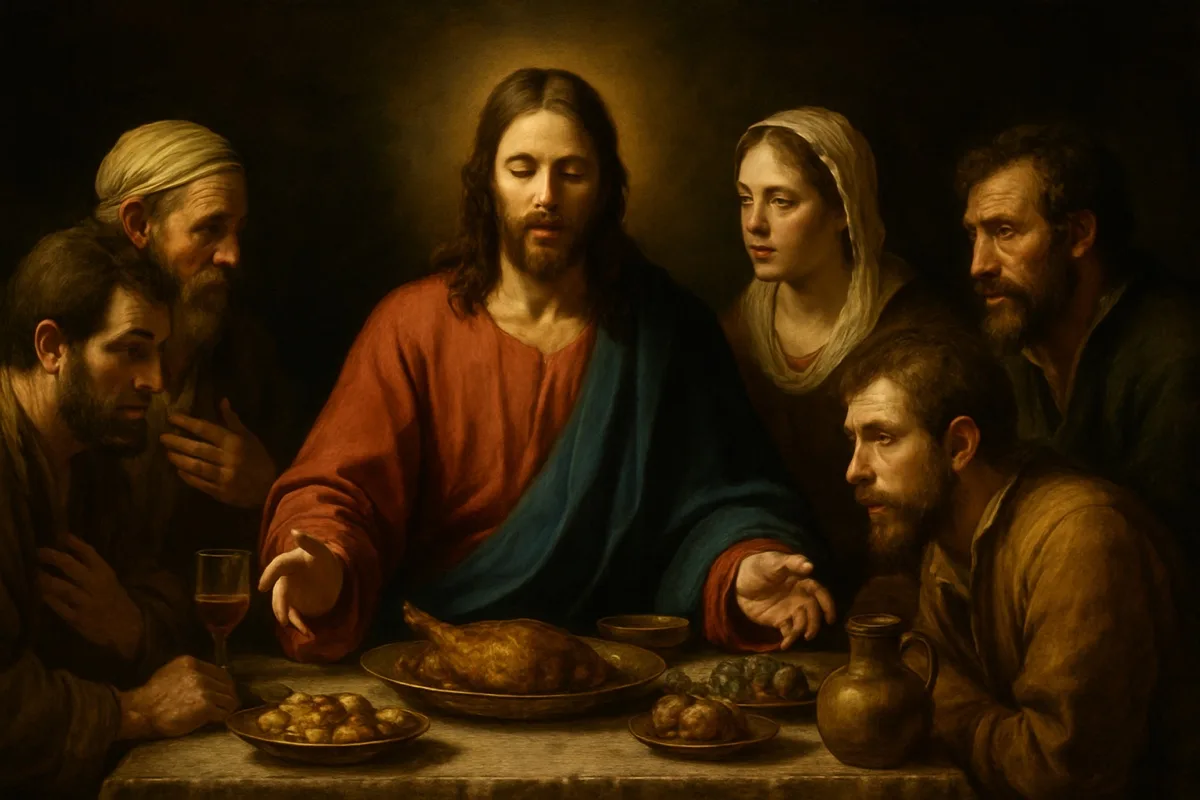
The banquet of the peoples: Is 25:6 and the parable of the royal banquet in Mt 22
By Prof. Dr. Daniel C. Afonso · Updated
Multi enim sunt vocati, pauci vero electi.
Mt 22:14
The Twenty-Eighth Sunday in Ordinary Time of Year A brings together three texts centered on God’s banquet, which is prepared but which not everyone accepts. Is 25:6-10a prophesies the eschatological banquet for all peoples, the destruction of the veil that covers the nations and the definitive elimination of death. Phil 4:12-14, 19-20 describes Paul, who has learned the secret of being well in every circumstance, because his God will supply every need. Mt 22:1-14 tells the parable of the king’s banquet that the guests refuse: the king then sends for everyone at the crossroads to be invited, but one without a wedding garment is cast out. The three texts converge: the banquet is prepared and abundant, the invitation is universal, but receiving it requires readiness and the proper garment.
I. The first reading: Is 25:6-10a
The prophet describes God’s final banquet: “The Lord of hosts will prepare for all peoples, on this mountain, a banquet of rich dishes, a banquet of aged wines, rich dishes full of marrow, aged wines well refined” (Is 25:6). The banquet is not for one people: it is for all. And what follows the banquet is even greater: “He will destroy on this mountain the veil that covered all peoples and the shroud that enveloped all nations. He will destroy death forever. The Lord will wipe away the tears from all faces” (vv. 7-8). Death destroyed, tears wiped away: it is the description of the Apocalypse (Rev 21:4), anticipated by Isaiah. And the response of the guests: “Noque díem dixerint: Ecce Deus noster. In eo sperávimus et ipse salvávit nos. Exultémus et gáudiamus quia nos salva” (v. 9). The banquet is not a prize: it is the consummation of the love of God, who waited for everyone.

II. The second reading: Phil 4:12-14, 19-20
Paul shares the secret of his peace: “I have learned to be content in whatever circumstance I find myself. I know what it is to be in need and I know what it is to have abundance. In everything and in every state I have been initiated: to be well fed and to go hungry, to have abundance and to suffer want” (Phil 4:11-12). The word “initiated” (memyēmai) is technical: Paul uses the language of the Hellenistic mysteries to describe a profound process of spiritual learning. And the principle that sustains everything: “I can do all things in him who strengthens me” (v. 13). It is not self-sufficiency: it is radical dependence on Christ. And the promise for the community: “My God will supply all your needs according to his riches in glory in Christ Jesus” (v. 19). The banquet of Is 25 is real: the God who prepared the banquet also provides what is necessary to reach it.
III. The Gospel: Mt 22:1-14
Jesus tells the parable of the king who celebrates his son’s wedding. He invites those who had been called: they pay no attention and go off, some to their fields, others to their business. And some seize the messengers and kill them. The enraged king destroys the murderers and burns their city. Then he sends the servants to the crossroads: “Invite to the banquet all whom you find” (Mt 22:9). The hall was filled with guests. But on coming in to see the guests, the king notices one without a wedding garment. “Friend, how did you get in here without a wedding garment?” The man is left speechless. The king orders the servants to bind him and cast him out, into the darkness. And the conclusion: “Many are called, but few are chosen” (v. 14). The parable has two moments: the universal openness of the invitation (everyone at the crossroads) and the requirement of the wedding garment. The call is gratuitous. Acceptance has a form. Entering the banquet is not enough: one must be properly dressed, which means having accepted the transformation that the invitation implies.
IV. Mary and the wedding garment
The banquet of Is 25 destroys the shroud that enveloped all nations. The Mariological tradition saw in the Assumption of Mary the first fulfillment of this promise: Mary was not enveloped by the shroud of corruption. Death did not hold her. In the terms of Is 25, she was the first to sit at the banquet where death was destroyed and tears were wiped away. Phil 4:13 says “I can do all things in him who strengthens me”: Mary lived this total dependence from the Annunciation onward. Everything she did, carrying the Son in her womb, accompanying the Passion, persevering in the Upper Room, was possible not by her own strength but by what God gave her. The wedding garment of Mt 22 is the grace that transforms whoever accepts the invitation. Mary entered the banquet with the garment that no one else received in full: the fullness of grace that the angel recognized in his greeting (“full of grace,” Lk 1:28). Not by accumulated merit: by the generosity of the king who provides everything necessary to enter.
Postgraduate Program in Mariology
Would you like to deepen your formation in Mariology? Discover the Postgraduate Program in Mariology of Locus Mariologicus – an academic formation that unites theological rigor, spiritual life and the living tradition of the Church.
Responses