Jasna Góra, the devotion of Saint John Paul II to the Virgin Mary.

Jasna Góra (Częstochowa, 1382): the shrine of the Black Madonna, the resistance to the Swedish invasion (1655), and the Marian devotion of John Paul II
From distant Poland, in the region of Jasna Góra, Bright Mount, of Częstochowa, we find the largest Marian shrine in the country that saw the birth and educated the Marian piety of Saint John Paul II. This shrine is still today the center of the spiritual vitality of the Polish nation, even reaching an average of four million pilgrims a year!
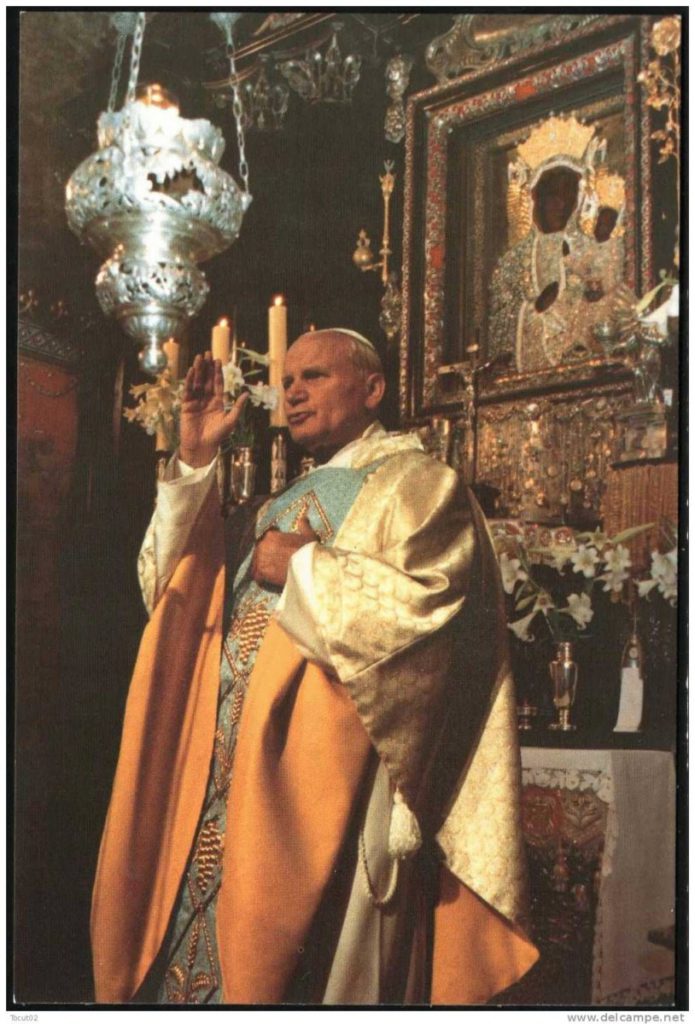
The great festivities take place on May 3, Our Lady Queen of Poland, August 15, Assumption of the Blessed Virgin Mary, today, August 26, the celebration of Our Lady of Jasna Góra, and finally on September 8 the feast of the Nativity of Our Lady, which have an average attendance of two and a half million people.
The life of the Shrine is marked by a calendar that from year to year remains unchanged: the exposition of the miraculous image from 6:00 a.m. until the Supplication of Jasna Gora at 9:00 p.m. Among the various pastoral initiatives we highlight the Family of the Rosary of Jasna Góra.
The historical origins of the Shrine go back to the Order of Saint Paul, the Hermit of Egypt, which arose in Hungary in the thirteenth century and which founded in 1382, under the patronage of King Ludovico d’Angiò, king of Poland and of Hungary, a monastery on the hill of Jasna Góra. It is from this date that we have a record of the presence of the image of Our Lady, which became a goal of pilgrimage within and outside Poland. The influx of pilgrims did not cease to grow, to such a point that structures began to be built on top of structures, with diverse architectural styles, to increase the space for welcoming the pilgrims.
A particular episode of this shrine was the resistance in 1655 to the invasion that Sweden carried out in Poland, and in the Shrine, fortified over the centuries to protect the various offerings of the pilgrims from possible thefts. Thanks to this resistance, together with the devotion of King John Casimir, on April 1, 1656 Mary was proclaimed Queen of Poland. The crowning of the image took place on September 8, 1717, and in the Polish Constitution of 1746 it was written that ‘the nation is devoted to this its Most Holy Queen, the Virgin Mary of the painting of Częstochowa, famous for her miracles, who grants protection in times of need’. During the occupation of the Second World War the leaders of the various forces opposed to the invaders met in the shrine, and so Jasna Góra is a symbol of hope, victory, and freedom, becoming the spiritual capital of Poland.
The miraculous image is the symbol of the Poles in the world, for the six centuries of political, cultural, and spiritual history are condensed around the Blessed Virgin Mary. To understand Poland means to be aware of the construction of the identity of Jasna Góra.
The miracles connected with this image go back, in the archives of the Shrine, to 1517, although it is plausible to find other miracles even earlier. Polish religious culture, in its encounter with the icon of Our Lady, usually does not speak, it only looks. This shows the alliance with the Polish faithful and the union of Marian religiosity with the Polish national spirit. Protectress of the integrity of the faith, of human, Christian, and national values, the effectiveness of her intercession is found in the ex voto present by the thousands, from all social strata and from all times.
In 1946 Cardinal A. Hlond, following the inspiration of Pope Pius XII, consecrated the nation to the Immaculate Heart of Mary. In 1956, on August 26, the Polish Episcopate together with pilgrims from all over the world made vows, on the occasion of the 300th anniversary of the proclamation of Mary as Queen of Poland, with the text written by the Cardinal Primate Stefan Wyszyński while still in prison in Kománcza. This act sets off a series of events called the ‘great novena’, which culminated in the fall of the Berlin Wall.
We can conclude, then, that Our Lady of Częstochowa is honored as Mother of the Church. What is strengthened is the drawing near, the awareness of problems, and the awakening of consciences to responsibility for the Church and the consolidation of fidelity to Mary.
In her shrine the local Church is united to the universal Church. Since the act of entrustment to Mary carried out by Saint John Paul II on June 4, 1979, the miraculous image is considered Our Lady of Pope John Paul II, Our Lady of the unity of the Churches of the East with the Church of the West.
____________________________________________________________
Meaning of the image:
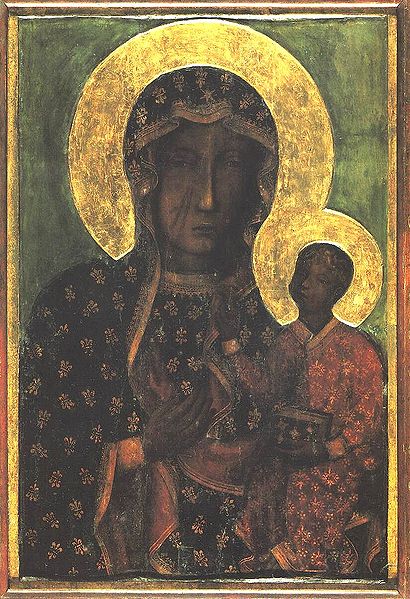
The painting represents the Most Holy Virgin Mary holding the Child Jesus in her left hand. Her eyes look at the one who observes. On the left side of the face wavy hair descends, hidden by the mantle. The color is above all between dark brown and light brown. On the left cheek we find two lines that run parallel across half of the cheek and extend toward the neck. A third transverse line crosses the cheek at the height of the nose. Above the brow of Our Lady we find a star with 6 points. The mantle and the robe are blue, and the color of the robe of Jesus is carmine. The background of the painting is pale blue with faint nuances of green. The Child Jesus has His arm raised and in His left hand He holds the Gospel.
The edifying narrative speaks of a painting attributed to Saint Luke, on the table where prayer took place and the Holy Family took its meals. The painting is said to have been taken from Jerusalem to Constantinople and placed in a temple. The Russian Prince Leo fell in love with the beauty of the image, and the emperor is said to have donated this image of inestimable value. Later, for reasons of war, when it already had considerable fame for the miracles obtained, the image is said to have been taken to the city of Jasna Góra and placed in the Church, being entrusted to the care of the Pauline monks.
In the historical-archaeological reconstruction we know today that the image arrived together with the Paulines at Jasna Gora in 1382. However, in 1430, during a sacrilegious attack, the image was pierced by a sword that broke it into three pieces. Its reconstruction took place in 1434 and was an approximation to the ancient painting, with traces of the painting of the Middle Ages and of the original design of the image, which was probably executed in the first Christian millennium.
The lines on the image of the Virgin symbolize the scars and refer to the cuts made on the original canvas. In fact, the restorers wished to preserve not only the image but also the life of Mary as an art of memory. In this sense, the image acquired a great artistic value in its iconographic originality. On the meaning of this image for Saint John Paul II, we present here his words from 1979:
“So many times we have come here, to this holy place, in vigilant pastoral listening, to hear the heart of the Church and that of the homeland beat in the heart of the Mother. Jasna Góra is, in fact, not only a goal of pilgrimages for the Poles of the Mother Country and of the whole world, but it is the shrine of the nation. It is necessary to listen attentively to this holy place in order to feel how the heart of the nation beats in the heart of the Mother. This heart, in truth, throbs, as we know, with all the events of the nation. Yet if we wish to know how to interpret this history of the heart of the Poles, it is necessary to come here, to listen attentively to this shrine, in order to understand the echo of the life of the entire nation in the heart of its Mother and Queen”
Our Lady of Częstochowa, pray for us!
To deepen the devotion of John Paul II to Mary, consult his encyclical: Redemptoris Mater on Mary in the life of the pilgrim Church.
Deepen your studies: explore Mariology, Marian Theology, Marian apparitions, and the Postgraduate Program in Mariology.
Postgraduate Program in Mariology
Would you like to deepen your formation in Mariology? Discover the Postgraduate Program in Mariology of Locus Mariologicus – an academic formation that unites theological rigor, spiritual life, and the living tradition of the Church.
Would you like to study Mariology seriously?
This article is born of the works in the library of Locus Mariologicus. The Postgraduate Program in Mariology brings you to the same source, with academic guidance: Scripture, the Fathers of the Church, and the Magisterium, from the first dogma to contemporary questions.




Responses